
Word Against Image
ElementsThis flow traces the changing balance between verbal mathematical language and the visual language of coloured diagrams.
increasing Bearing strength in each event
 decreasing
Bearing strength in each eventdecreasingVerbal Inheritance

Verbal Inheritance
Words as Signs
The introduction acknowledges that ordinary language represents objects through spoken and written signs.
Words remain useful for common communication.
Limitation
They become slow when many similar geometric parts must be distinguished at once.
The Faithful Eye

The Faithful Eye
Sensory Argument
The author invokes Horace's contrast between what reaches the ear and what reaches the eye.
Visual impressions are said to remain longer and engrave knowledge more firmly.
Rhetorical Force
The quotation turns a pedagogical preference into a claim about human perception.
Diagrammatic Language

Diagrammatic Language
Signs Become Visible
Colours and forms identify the parts that words would otherwise name through letters.
The diagram functions as a compressed statement of relations.
No Rejection of Speech
The method supplements verbal explanation rather than abolishing it.
Synchronized Channels
Synchronized Channels
Eye and Ear
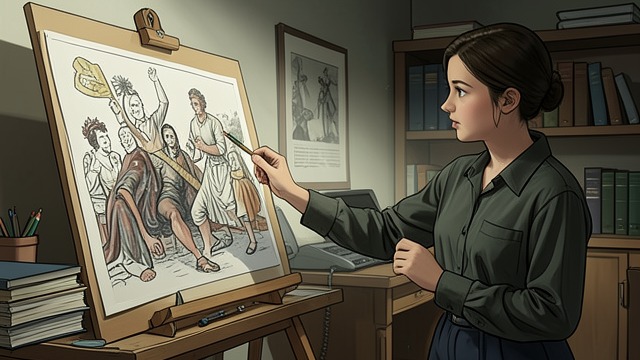
The teacher can speak the proof while the learner sees its objects.
Each sense contributes a different kind of information.
Resolution
The conflict between word and image becomes cooperation between explanation and recognition.
Image Governed by Reason
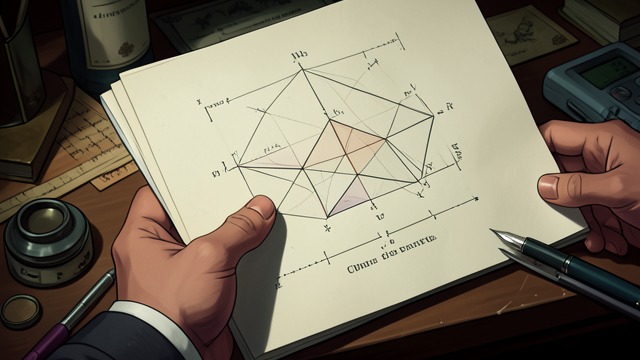
Image Governed by Reason
Controlled Visualization
Colour has no effect on length angle or magnitude; it merely names them.
The visual aid remains subordinate to mathematical proof.
Balance
The book's final position is not image against language but image disciplined by reasoning.
at the opening explanation of language
during the quotation from Horace
during the explanation of coloured symbols
during the discussion of oral demonstrations
at the close of the introduction
