
The Architecture of Book I
ElementsThis flow traces the movement of Book I from elementary construction through parallel lines triangles parallelograms and the Pythagorean theorem.
increasing Bearing strength in each event
 decreasing
Bearing strength in each eventdecreasingEquilateral Construction

Equilateral Construction
The Task
A finite line becomes the basis for an equilateral triangle through intersecting circles.
The construction shows how a desired figure can emerge from only the permitted instruments.
Significance
Equality is not assumed visually; it is secured through the definition of a circle and a reasoned conclusion.
Triangle Congruence

Triangle Congruence
Isosceles Equality
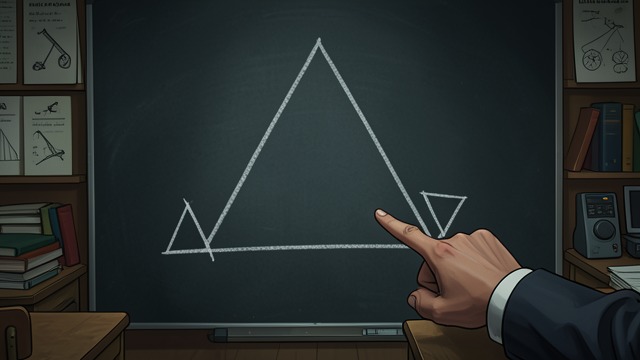
Isosceles Equality
External Construction
The equal sides of an isosceles triangle are extended and auxiliary equal segments are introduced.
Two pairs of congruent triangles then transfer equality from the construction to the base angles.
Resolution
The theorem converts side symmetry into angular symmetry through a carefully staged proof.
Parallel Structure
Parallel Structure
Angle Criteria
Equal alternate angles and supplementary interior angles become tests for parallelism.
The book then derives the familiar consequences of a transversal crossing parallel lines.
Logical Dependence
The Parallel postulate supplies the global condition that allows local angle relations to control an entire figure.
The Right Triangle Climax
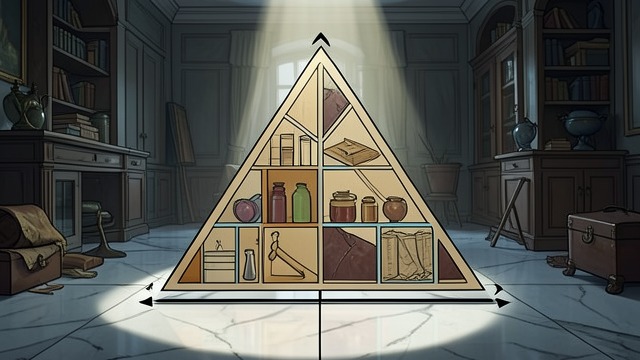
The Right Triangle Climax
Squares on Sides
Squares constructed on the sides of a right triangle are rearranged through parallelograms and triangles.
The resulting equality proves the Pythagorean theorem geometrically rather than numerically.
Reverse Direction
The following proposition establishes the converse, showing that the same relation identifies a right angle.
at the first proposition of Book I
at the fourth proposition of Book I
at the fifth proposition of Book I
from the twenty-seventh through thirtieth propositions
at the forty-seventh proposition of Book I
