
The Book's Public Mission
ElementsThis flow follows the work as a proposed educational instrument intended for classrooms public instruction and wider intellectual access.
increasing Bearing strength in each event
 decreasing
Bearing strength in each eventdecreasingPublic Instruction
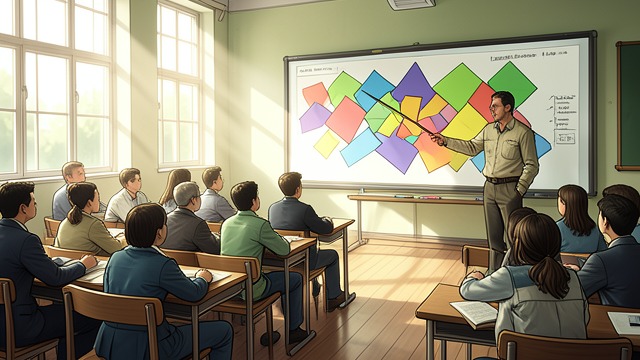
Public Instruction
Wider Access
The author imagines geometry taught efficiently to classes rather than reserved for a few advanced students.
Coloured diagrams allow an instructor to address many eyes at the same instant.
Social Promise
The classroom becomes the place where mathematical reasoning can be distributed on a broad scale.
Chalk and Pencil

Chalk and Pencil
Practical Materials
Dyed chalk is recommended for schools and coloured pencils for private study.
The method is therefore designed as a working practice rather than a purely theoretical innovation.
Reproducibility
Its success depends on ordinary teachers being able to recreate the visual system.
Female Education

Female Education
Expanding Curriculum
The author notes that mathematics is becoming part of sound female education.
He presents visual geometry as especially attractive for learners who might be discouraged by formal exposition.
Cultural Argument
The passage connects method with the widening social reach of mathematical study.
Mass Mathematical Literacy

Mass Mathematical Literacy
A Large Audience
The author argues that a thousand learners can receive the same visual and auditory instruction as one.
This makes geometry a candidate for broad popular education.
Intellectual Citizenship
The desired result is not memorized information but a population trained in orderly thought.
Classroom Concentration
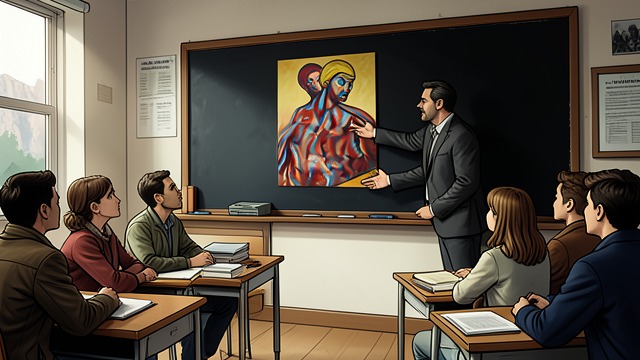
Classroom Concentration
Shared Attention
Colours let an instructor identify a common object immediately for everyone in a class.
Students need not decode separate letter sequences before understanding the reference.
Reduced Confusion
The classroom becomes more concentrated because sight and speech point toward the same mathematical part.
in the opening paragraphs of the introduction
near the conclusion of the introduction
in the final educational appeal of the introduction
at the final paragraph of the introduction
during the explanation of oral demonstrations
