
Book II and Geometric Algebra
ElementsThis flow traces how Book II turns rectangles squares and gnomons into a visual treatment of algebraic identities.
increasing Bearing strength in each event
 decreasing
Bearing strength in each eventdecreasingRectangle Language

Rectangle Language
Geometric Products
A rectangle is defined through two adjacent sides rather than an abstract numerical product.
The definition makes multiplication visible as an area.
Conceptual Shift
Algebraic relations can therefore be read through the decomposition of a parallelogram.
The Gnomon
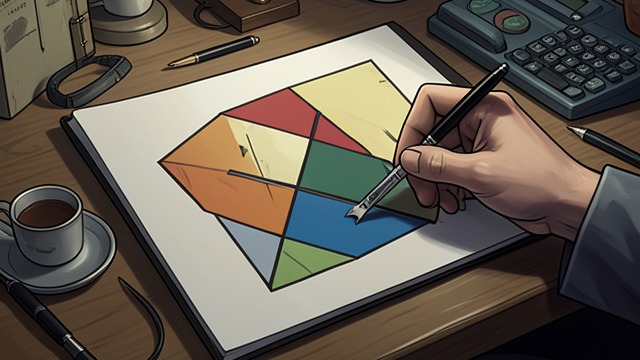
The Gnomon
Composite Figure
A gnomon combines one parallelogram about a diagonal with two complements.
Its unusual shape becomes a device for organizing equal areas.
Proof Utility
The figure translates addition subtraction and completion into visible partitions.
Square Expansion
Square Expansion
Partitioned Whole
A line divided into two parts produces a square equal to the two smaller squares plus twice their rectangle.
The proof displays the identity as a completed arrangement.
Algebra in Space
The result gives geometric form to a relation later recognizable as a binomial square.
Golden Division

Golden Division
Required Partition
A line is divided so that the rectangle of the whole and one part equals the square of the other.
The construction turns an algebraic condition into a geometric cut.
Later Importance
This result prepares the construction of the golden ratio in Book VI.
Area Extraction
Area Extraction
Constructing a Square
A rectilinear figure is converted into a line whose square equals the given area.
The proof assembles and transforms rectangles until a single length represents the whole figure.
Measurement Without Numbers
Area becomes a constructible magnitude rather than a numerical calculation.
at the opening definition of Book II
in the second definition of Book II
at the fourth proposition of Book II
at the eleventh proposition of Book II
at the fourteenth proposition of Book II
