Maple Grove
EmmaMaple Grove, the seat of Mr. Suckling near Bristol, is never directly visited in the novel but functions as a constant point of reference for Mrs. Elton, who uses it to assert her own consequence and to disparage or patronize the homes and habits of her new neighbours in Highbury. It represents the world of mercantile prosperity and aspiring gentility from which she has come, and which she believes entitles her to lead and instruct the local society.
Location and Character
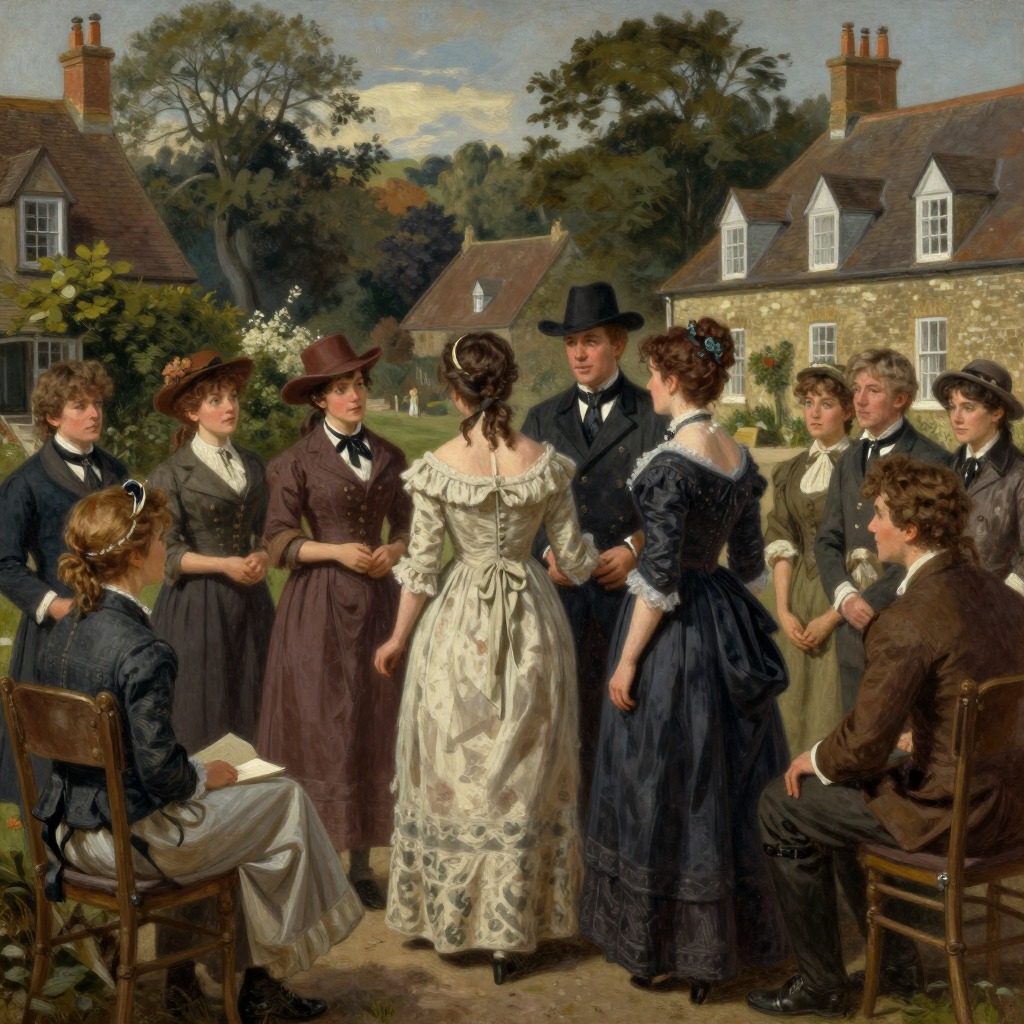
Maple Grove is described as a place of extensive grounds, with laurels planted across the lawn and a fine large tree with a bench round it, details Mrs. Elton eagerly points out as resembling Hartfield. The house itself is large enough to have a morning-room, a favourite apartment of Mrs. Suckling's, and the estate is sufficiently retired to be shut out from the road by an immense plantation. Mrs. Elton speaks of having spent many happy months there, and of the family's style of living, which includes a barouche-landau and two carriages, as a model of elegance. The Sucklings have been resident at Maple Grove for eleven years, and old Mr. Suckling completed the purchase before his death, giving the family a settled, established air that Mrs. Elton is anxious to claim.
Mrs. Elton's Use of Maple Grove as a Social Yardstick
From her very first visit to Hartfield, Mrs. Elton compares everything to Maple Grove. She declares the room she is sitting in to be the very shape and size of the morning-room at Maple Grove, and the staircase placed exactly in the same part of the house. She assures Emma that her brother and sister will be enchanted with Hartfield because "people who have extensive grounds themselves are always pleased with anything in the same style." When Mr. Elton expresses fears that the retirement of Highbury might be disagreeable to her, she replies that she has conditioned for nothing but a musical society, having been used to every luxury at Maple Grove, but that two carriages are not necessary to her happiness. This constant invocation of Maple Grove is a transparent attempt to elevate her own status by association, and Emma immediately recognizes it as a mark of vulgar pretension.
Maple Grove as a Contrast to Highbury Society
The Maple Grove circle provides the standard against which Mrs. Elton judges the society of Highbury, usually to the latter's disadvantage. She speaks of the musical society at Maple Grove and in Bath as something she cannot do without. She compares the retired situation of Maple Grove to that of Enscombe, and when Mr. Weston mentions Mrs. Churchill's desire for change, she immediately draws a parallel: "Aye—like Maple Grove, I dare say. Nothing can stand more retired from the road than Maple Grove." She also uses the neighbourhood of Maple Grove as a source of desirable situations for Jane Fairfax, mentioning Mrs. Bragge, a cousin of Mr. Suckling, whose family moves in the first circle and has wax-candles in the schoolroom, and later Mrs. Smallridge, who lives only four miles from Maple Grove and whose establishment is, after the Sucklings and Bragges, the most liberal and elegant in Mrs. Elton's acquaintance.
The Sucklings' Delayed Visit and Its Significance
The anticipated visit of Mr. and Mrs. Suckling to Highbury is a major topic of conversation for Mrs. Elton, who promises to introduce Jane Fairfax to them and to include her in exploring parties in the barouche-landau. The visit is repeatedly postponed, first from spring to autumn, and finally it never occurs within the timeframe of the novel. This failure of the Maple Grove connection to materialize in Highbury underscores the emptiness of Mrs. Elton's pretensions and the gap between her self-importance and her actual influence. The Sucklings remain an absent, idealized presence, a symbol of the world Mrs. Elton has left and to which she constantly, and rather pathetically, appeals.
Narrative Significance
Maple Grove is not a real place in the story but a rhetorical device. It embodies the kind of wealth and social ambition that Jane Austen subjects to ironic scrutiny. Mrs. Elton's incessant references to it reveal her as a woman whose "notions were drawn from one set of people, and one style of living," and who is incapable of appreciating the genuine, unpretentious gentility of Hartfield or Donwell Abbey. The estate functions as a foil to the older, more established families of Highbury, highlighting the difference between inherited consequence and newly acquired wealth that seeks to assert itself through conspicuous display and constant comparison.