Code of Honour
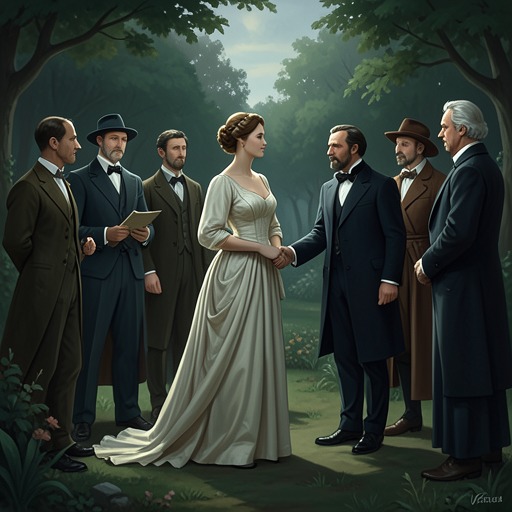
Eugene OneginThe Code of Honour is the social authority of reputation and public opinion in the poem: an informal rule system that can make a person’s standing among others feel more compelling than private judgment. Its power is clearest in the tension between what a character recognizes as sensible and what he fears the world will say, and in the duel scene, where the abstract demand for honour takes procedural form.
Public Opinion as Social Authority
The poem presents public judgment as an idol around which the social world turns. A character may identify disdain as the proper response to idle jeers and slander, yet the passage immediately invokes the world’s opinion as a force that cannot simply be dismissed. The contrast is consequential: the speaker can see that gossip is foolish and malicious while still acknowledging its power to shape action. Honour is therefore not only a private belief in one’s integrity; it is also a reputation held in the minds of others, vulnerable to their sneers and stories.
The opening social portrait supplies a smaller-scale version of this authority. A young man dances the mazurka gracefully and bows without constraint; the world’s verdict is that he is charming and wise. The episode shows how public character is made legible through manners and performance. A polished gesture becomes social evidence, and the community turns it into a judgment of the person. The Code of Honour consequently operates not only at moments of explicit conflict but through ordinary acts of display and evaluation.
Conduct, Judgment, and Self-Restraint
The poem distinguishes honourable conduct from mere compliance with convention. In assessing the quarrel, it asks whether a young poet’s foolishness ought to be disregarded rather than answered with a jest that wounds his timid, shrinking love. It further suggests that the response should come from a man of sense and probity, not from a hot, pugnacious boy. The contrast makes restraint, not aggression, the measure of sound judgment: age and wounded pride do not excuse the failure to consider what another person’s vulnerability requires.
Yet the poem also exposes how difficult it is to act on that judgment when reputation is at stake. Disdain might be the right answer to an idle insult, but fear of calumny and ridicule pulls in another direction. The pressure does not need to take the form of an explicit command. It works through anticipation: a person imagines the audience’s verdict and adjusts his conduct before that verdict is even delivered. The Code of Honour thus lies in the gap between knowing what would be reasonable and submitting to what convention appears to demand.
From Reputation to Duel Procedure
At the mill, public honour becomes a sequence of material preparations. Eugene calls hurriedly for Monsieur Guillot, who supplies a dressing gown, slippers, and linen. As he dresses as quickly as he can, Eugene directs his trusted servant to accompany him and escort a box of terrible import. The rapid sledge is harnessed, and Eugene sets out for the mill. The scene’s urgency makes the social code tangible: clothing, attendant, journey, and box are not an abstract debate about reputation but the practical apparatus surrounding a confrontation.
When Zaretski notices that Eugene has left his second behind, his question exposes a breach of expected form. The poem describes Zaretski as a duellist of classical mind, devoted to method and unwilling that a man should be killed without due procedure. His attention to the missing second shows that the duel is governed by more than the participants’ private feelings. Its conventions specify how the encounter is to be conducted, and even a figure associated with the duel’s danger attends to procedural order. Honour is therefore both a motive for entering the conflict and a code that regulates its performance.
Hierarchy and the Limits of Formal Rules
The poem places this informal social authority beside other systems of order. A landowner replaces the older barshchina with the more indulgent obrok, while servants wait on guests according to rank as settled by the State. The detail distinguishes different kinds of constraint: obligations on the estate and prescribed social rank have an institutional or customary structure, whereas public honour works through evaluation, reputation, and the threat of ridicule. Together, these examples show a society in which conduct is ordered through overlapping rules rather than through private choice alone.
The Code of Honour is most revealing where those rules conflict. The poem can name the folly of gossip, praise sense and probity over pugnacity, and still show how the world’s opinion draws people toward conduct they might otherwise reject. In the duel, that pressure acquires a procedural shape; in ordinary social life, it appears as the force of a verdict about who is charming, wise, foolish, or dishonourable. The code’s power lies in making public judgment feel at once superficial and binding.