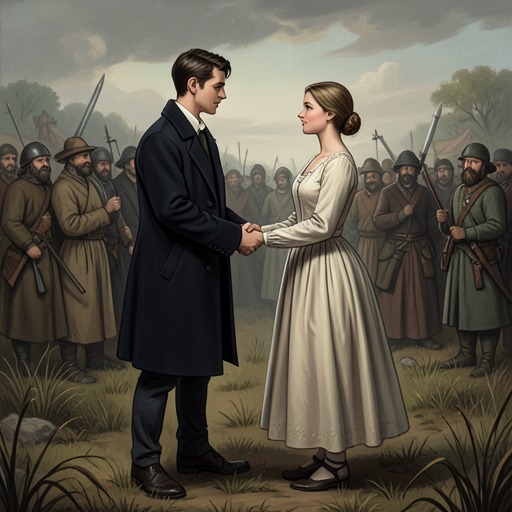
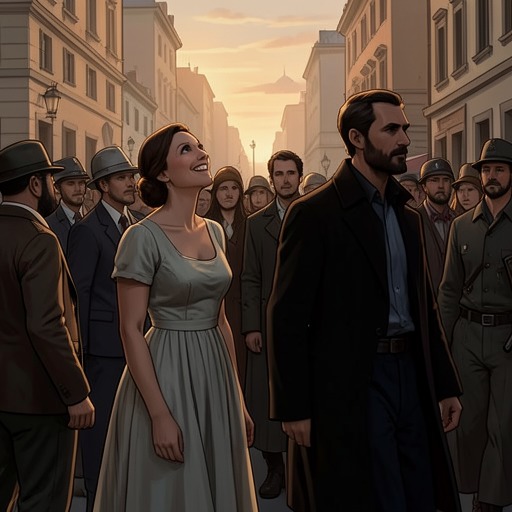
Onegin flirts with Olga at Tatyana’s name-day ball
Eugene OneginOnegin flirts with Olga at Tatyana’s name-day ball is the public provocation that turns Vladimir Lenski’s jealousy into an open break with Eugene Oneguine. Against the dizzy repetition of the waltz, Oneguine chooses Olga for conspicuous attention; Lenski sees the intimacy, seeks Olga afterward, and leaves when her prior promise to dance with Oneguine excludes him. What looks like a moment of amusement to the company becomes, for Lenski, an intolerable humiliation—and sets the ball on a course toward the duel.
A Public Gesture in the Waltz
The episode unfolds amid a waltz described as a whirlwind: pairs race on in a movement at once steady and giddy. Oneguine seizes what the narration calls the moment for revenge, approaches Olga with a smile, and carries her into the dance before the assembled company. The dance’s repetitive momentum makes his choice conspicuous. After a turn, he seats Olga on a chair and talks with her; scarcely two minutes later the waltz begins again, and he takes her back into it. The short pause does not soften the gesture: it gives the surrounding guests time to register it.
The narrator emphasizes the public effect as well as the private interaction. The company is amazed, while Lenski can scarcely believe what he sees. Oneguine’s attention is therefore not merely a flirtation hidden from his friend; its visibility is part of the injury. The ball’s lively, communal rhythm becomes the setting in which a friendship is tested before spectators.
Olga as the Focus of the Provocation
When the company’s movements bring Olga and Tatyana to Bouyanoff and the poem’s hero, Oneguine carries Olga away. He glides with her in an apparently negligent manner, bends to whisper a madrigal, and presses her hand. Olga’s cheek grows redder under the flattery. The account records these small, legible gestures rather than establishing the content of the whispered compliment: what matters to the scene is the attention Oneguine displays and Lenski witnesses.
The contrast between Oneguine’s ease and Lenski’s response sharpens the action. Oneguine smiles, dances, speaks, and touches with apparent lightness; Lenski sees the same conduct as a betrayal and burns with jealous indignation. Olga is not shown initiating a contest between the men, but her reply to Lenski makes the immediate conflict concrete: when asked to dance, she says she cannot because she has promised Eugene. The promise, and not an inferred declaration of love, is what the text explicitly supplies. Yet in the charged circumstances of the ball, it confirms to Lenski that Oneguine’s claim on Olga has taken precedence over his own.
From Jealousy to Departure
Lenski endures the sight through the close of the mazurka, then confronts Olga. Her explanation that she promised Eugene only intensifies his distress. The narration presents his reaction as a sudden inability to bear the blow: he curses womankind, departs, orders his horse brought out, and gallops home. His exit turns jealousy from an inward response into decisive action, removing him from the party and preparing the next stage of the conflict.
The departure is followed by the poem’s stark announcement that two pistols and a pair of bullets will decide his fate. Thus the ball’s sequence runs from public dancing to private rejection, from rejection to flight, and from flight toward armed confrontation. The flirtation does not itself contain the duel, but it supplies the immediate chain of circumstances that brings the friends to it.
Narrative Significance
The scene’s force lies in the gap between the lightness of its surface and the gravity of its consequence. A waltz repeats; Oneguine’s attention lasts only moments at a time; a whispered compliment and a pressed hand seem small beside the pistols invoked at the canto’s end. But because Lenski watches, and because Olga says she has promised Eugene, these gestures acquire a public meaning that neither the dance’s gaiety nor Oneguine’s apparent nonchalance can undo.
The narration marks the act as revenge, but the episode’s concrete details also reveal its cost. Oneguine’s smile and social fluency place him at ease within the company; Lenski’s disbelief gives way to jealousy, then to departure and a journey home on horseback. The festive dance therefore becomes the hinge between the gathering and the fatal conflict: an apparently playful choice is read as an affront, and the response carries the friends toward the duel and Lenski’s death.