Onegin rejects Tatyana
Eugene OneginOnegin rejects Tatyana in a garden conversation that turns her written confession into a painful face-to-face answer. He recognizes the sincerity of her letter and admits that it has stirred feelings that had long been absent, but refuses to turn that response into a promise: even if he could find happiness in marriage, he says, she alone would be his choice; because he believes himself incapable of domestic happiness, he warns that their union would bring grief. The rejection is therefore not a denial of Tatyana’s worth, but an avowal of his own presumed inability to sustain love.
The conversation in the garden
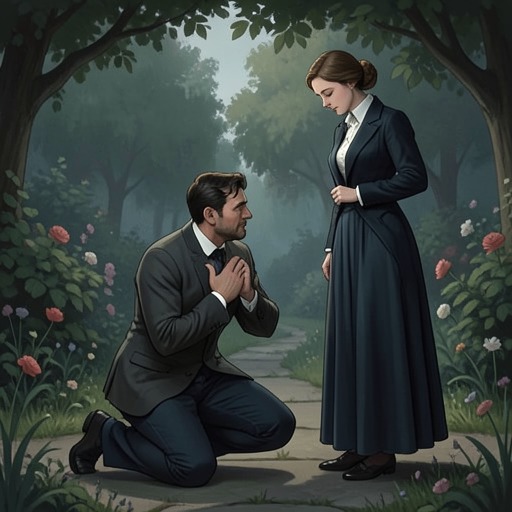
The encounter opens with two minutes of silence before Onegin approaches Tatyana. He tells her that he has received her letter and asks her not to excuse herself. Her confidences, he says, were offered with innocence, and he finds her sincerity charming. More consequentially, the letter has awakened feelings in his breast that he thought had ceased to exist. That acknowledgment gives Tatyana’s confession genuine force: it has moved him, even though he will not answer it with courtship.
Onegin frames his reply as compensation for her frankness. Instead of flattering her or concealing his position, he asks her to listen to an equally plain confession. The exchange makes candor its governing principle, but candor does not make the encounter gentle. His words are delivered as counsel and explanation, while Tatyana, as the scene later shows, receives them in silence and tears.
The conditional promise and its refusal
Onegin briefly names the life that might have made Tatyana his bride. If the domestic hearth could provide him with happiness, if a wife and children and the scenes of home could give him even an instant of delight, he says that he would desire no bride but her. The declaration is intimate but conditional. It singles out Tatyana while placing the obstacle within himself: he does not claim that she is unsuitable, but that the life she might share with him cannot make him happy.
He then states his judgment more directly. Happiness is foreign to his cast of thought; Tatyana’s perfections, he believes, would not bless him, and he considers himself unworthy of them. Their union, in his prediction, would produce grief. Even if his love were now intense, he expects habit to bring indifference. The reasoning turns the possibility of mutual attachment into a forecast of its decay: the feelings awakened by the letter cannot, in his view, overcome the disposition he attributes to himself.
A warning shaped by his self-image
Onegin describes the domestic future he rejects through an image of a dreary house, burdened by frigid jealousy and mute, solemn gloom. He presents this not as a danger peculiar to Tatyana, but as a picture of himself and of the marriage he believes he would make. He asks whether this was what she expected when she wrote her innocent and charming note. In doing so, he casts his answer as a warning intended to correct her expectation, rather than as an invitation to wait for him.
His speech also looks beyond their immediate encounter. He tells Tatyana that she may fall in love again, and urges her to learn self-control because not everyone will behave as he does; thoughtlessness, he warns, could lead to sorrow. The advice is protective in its stated purpose, but its effect is inseparable from the refusal that prompts it. He acknowledges her tears, yet says they do not soften his heart and instead exasperate him. The scene thus sets her visible distress against his insistence on keeping emotional distance.
Tatyana’s response and the scene’s turn
After Onegin has spoken, Tatyana listens attentively, her eyes dim with tears, breathless and without reply. He offers his arm. She accepts it mechanically, hangs her head, and walks home through the garden in silence. The outward courtesy of his gesture does not undo the rejection; her bowed head and wordless acceptance register the emotional cost more sharply than an argument would.
The encounter changes the meaning of Tatyana’s letter. What she offered as a confession of love becomes, in Onegin’s hands, the occasion for a lesson in self-restraint and a prediction that love will not last. His answer leaves open the idea that he could have chosen her under different conditions, but closes the prospect of marriage in the present by declaring those conditions impossible for him. The scene’s decisive contrast is between the feeling his response admits and the domestic life he refuses: Tatyana’s sincerity reaches him, but it does not persuade him to act on the attachment it awakens.