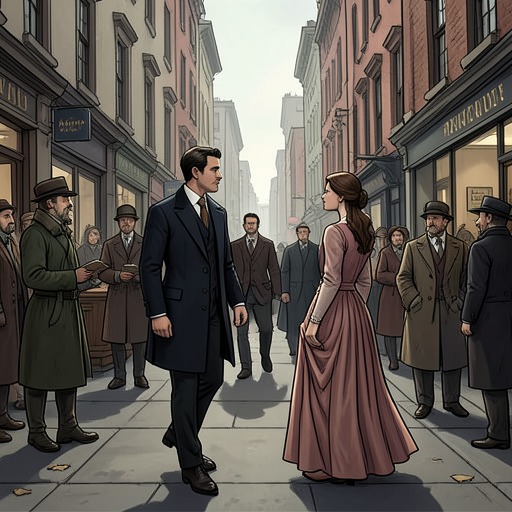
Onegin’s rejection of Tatyana
Eugene OneginOnegin’s rejection of Tatyana is a private encounter in which frankness both answers and wounds her confession. He acknowledges that her letter has stirred feelings that had long seemed extinguished, yet insists that he cannot return her love as a husband: the domestic life she might hope for would not make him happy, and he offers instead a brother’s love. Tatyana listens with tears in her eyes, making the speech a decisive refusal rather than the beginning of a courtship.
The Encounter and Its Terms
The scene opens in silence. After two minutes, Onegin approaches Tatyana and tells her that he has received her letter. He asks her not to excuse herself: he has read the confessions of a trusting heart. The pause gives way not to a simple reprimand but to an admission that her words have awakened feelings in him that had long ceased to be active. His response recognizes the intimacy of what she has risked, even as it prepares to deny her the relationship she seeks.
Onegin presents his answer as an exchange of candor. He says he has not come to flatter her and will repay her frankness with an equally plain avowal. He asks her to hear his confession and says that he bends his will to her decree. This language grants Tatyana’s letter the seriousness of an address to which an answer is owed. But the balance is rhetorical rather than romantic: his willingness to speak honestly does not become a willingness to bind himself to her.
Marriage and the Domestic Future
Onegin measures the possibility of marriage against the prospect of happiness at the domestic hearth. He imagines a life whose sum would be a wife and children, then explains that this form of happiness is not available to him. The refusal is therefore more than a declaration that he does not presently choose Tatyana. He rejects the domestic future itself as something he cannot inhabit happily, separating the idea of a suitable household from any promise that love might transform his character.
He makes that limit explicit by describing happiness as foreign to his cast of thought. Tatyana’s perfections, he says, would not bless him. The reasoning turns her qualities away from being a solution: the failure lies not in a defect he names in her, but in his own estrangement from the happiness she represents. His speech presents that estrangement as settled rather than as an obstacle he intends to overcome.
The Refusal and Its Emotional Consequence
Onegin warns against the misery of a household in which an unhappy wife deplores an unworthy husband. The imagined marriage would not preserve Tatyana’s present hope; it could make her suffer under a spouse who failed to deserve her. This argument gives the refusal a protective rationale, but it also makes the consequence of accepting him vivid: marriage would risk converting her confession into long-term domestic unhappiness.
He then closes the possibility of change. Ideas and time do not move backward, he says, and he cannot renovate his soul. His final definition of his feeling is love “with a brother’s love,” a phrase that acknowledges attachment while denying the erotic and marital bond Tatyana desires. The distinction leaves her neither entirely unrecognized nor romantically answered: she has reached him, but cannot make him into a husband.
Tatyana’s Reception and the Scene’s Role
The narrator identifies Onegin as delivering a sermon, a word that frames the speech as instruction as well as refusal. Tatyana listens attentively, her eyes dim with tears. Her silence does not undo the rebuff; instead, it shows the cost of receiving a clear answer from the person to whom she has entrusted her feelings. The scene’s movement is from her written confession, recalled by Onegin, to his spoken judgment, and finally to her tearful attention.
The account places this intimate encounter against a broader world of social distinctions, noting that the countryside possesses liberties and privileges allowed even to proud Moscow. That contrast enlarges the setting beyond the private exchange without changing its central outcome. Within the scene, Onegin’s formal fairness and emotional incapacity coexist: he honors the candor of Tatyana’s letter by answering plainly, yet his answer leaves her love unreturned. The rejection thus establishes a lasting divide between the depth of her confession and the limits he declares in himself.