Romanticism
Eugene OneginRomanticism is presented in the poem not simply as a literary label but as a style whose conventions meet the awkward facts of feeling, composition, and lived custom. Vladimir Lenski writes in what the narrator calls the romantic style, yet the narrator pointedly doubts that romance can be found within it; elsewhere, passion is imagined as a power that directs conduct and brings song. The translator’s preface adds a wider literary frame, identifying Byron’s influence on Pushkin’s early work while describing the formal and cultural challenges of rendering the poem into English.
Style and Irony
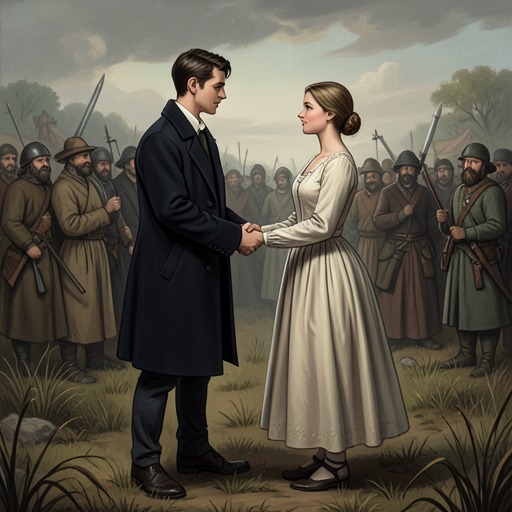
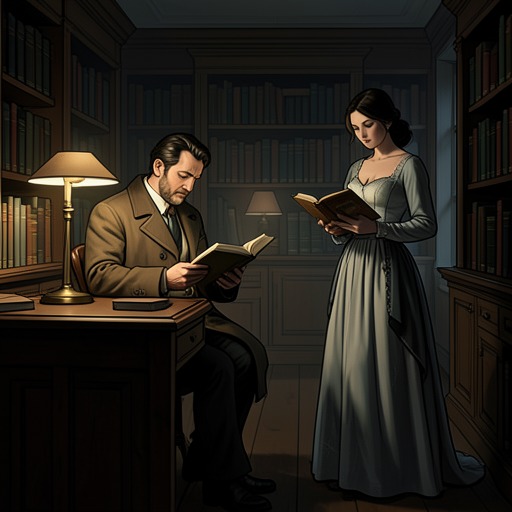
When Vladimir Lenski sees Olga Larina, he closes his book and takes up a pen. His verses are described as neat, though filled with the conventional material of lovers’ poetry. The narrator calls the ensuing manner obscure and stale, then identifies it as romantic style while disclaiming romance within it. The distinction is central: Romanticism is recognizable as a set of literary gestures, but the label does not guarantee either freshness or genuine romantic substance.
The joke continues in the account of Lenski’s labor. He writes until dawn, and his head sinks onto his breast as he grows drowsy while trying to shape the word “Ideal.” The lofty abstraction is brought down to the physical comedy of a tired young poet struggling over a single word. Rather than simply dismissing his feeling, the passage lets the mismatch between elevated diction and exhausted composition expose the conventions through which feeling is made into verse.
Passion and Poetic Impulse
A later passage describes the speaker’s former surrender to passion’s sway: its promptings were made into law, and the speaker followed the pursuits of the crowd. The passage associates that impulsive life with noisy feasts and fights, with becoming a terror to the guardians of the night, and with wild festivities. Passion is therefore not confined to private love or poetic language; it is presented as an organizing force that shapes behavior and social experience.
Within that recollection, passion also brings the gift of song. The movement from unruly activity to song makes Romantic feeling both an appetite for intensity and a source of poetic expression. The poem does not reduce this force to a purely literary pose: it shows how an ideal of passionate life can connect conduct, feeling, and art, even as Lenski’s scene demonstrates how poetic convention may make such ideals look stale or artificial.
Translation and Literary Context
The translator’s preface situates Pushkin’s work within a European literary context. It says that Russian poets had drawn on English literature and identifies Byron’s influence on Pushkin as especially strong early in his career, while distinguishing Pushkin from a plagiarist. Romanticism thus appears in the prefatory account as both a recognizable literary inheritance and an influence that Pushkin’s own work engages openly.
The preface also emphasizes the difficulty of translating beyond conventional poetic subjects. Abrupt scraps of conversation and descriptions of local customs, the translator says, make the task more arduous; the difficult stanza form and the inelasticity of some subject matter help explain roughness in the versification. The translator claims close adherence to the original, but acknowledges that formal constraints complicate that aim. This account underscores a tension relevant to Romantic writing in the poem: literary style travels through inherited forms, yet it is also bound to particular voices, customs, and rhythms.
Form, Voice, and Cultural Particularity
The poem’s two letters offer further evidence of Romanticism’s connection to expressive writing. The narrator announces that national honor requires translating the letter written by Tattiana Larina, then presents it under the heading “Tattiana’s Letter to Oneguine.” Later, a separate passage introduces “Oneguine’s Letter to Tattiana.” The letters make writing itself part of the work’s emotional and formal design: intimate feeling reaches the reader through composed language, not as unmediated speech.
The translator’s note on pronunciation likewise makes the mediation visible. Russian proper names are to be pronounced as in French, except for the nasal sounds of m and n, and the accent is indicated in the rhythmical composition. Alongside the translator’s stated effort to remain close to the source, this practical direction shows how the English presentation must negotiate sound, meter, and cultural difference. Romanticism in this evidence is consequently not one uniform doctrine: it is a literary inheritance, a set of conventions open to irony, and a mode of passionate expression shaped by the forms through which it is translated.