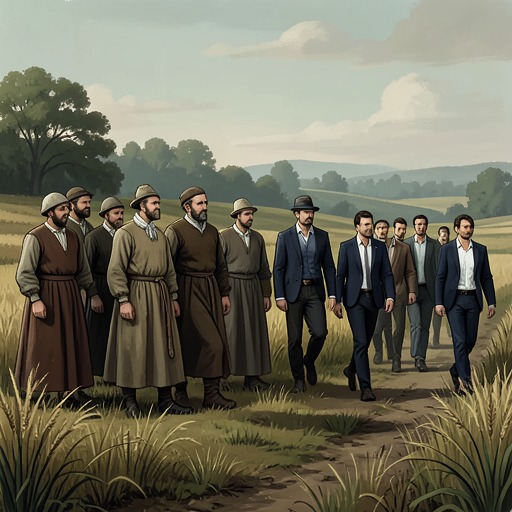
Tatyana's marriage
Eugene OneginTatyana’s marriage is a decisive change in her life, but the poem withholds the wedding and presents the union through its consequences. When Onegin encounters her again in fashionable society, he learns that she has been married for two years and is now the wife of a prince. Later, when he presses his suit, Tatyana acknowledges that she loves him but asks him to leave her for good: she is another man’s bride, and will remain faithful. Marriage thus becomes both her altered social position and the limit she chooses not to violate.
Background and Narrative Disclosure
Tatyana’s marriage is not narrated as a ceremony or courtship. Its circumstances emerge in the later reunion with Onegin, when he asks whether she is married and how long she has been so. The answer is that the marriage has lasted two years; when he asks to whom, the prince identifies his wife as Tatyana Larina. He then takes Onegin to meet her, presenting her as his relative and friend. This brief exchange supplies the essential facts while leaving the match’s negotiations, wedding, and private beginnings outside the narrated scene.
That delayed disclosure gives the marriage a particular dramatic shape. Onegin does not first encounter Tatyana as the country girl who once loved him, but as a prince’s wife in fashionable life. The title and social setting announce how radically her public circumstances have changed, while the prince’s easy introduction establishes that she is now embedded in his world. The earlier story of her love is not erased; instead, it returns as the history that makes their new encounter charged.
From Larina to a Prince’s Wife
The poem had introduced her by the name Tatyana, a name its narrator presents as unusual in a love narrative. The later identification as Larina makes the connection between the young woman of the country and the woman Onegin meets unmistakable. The marriage changes her status, but her identity remains continuous across the contrast: the prince’s wife is the same Tatyana whose earlier feelings form a central strand of the story.
The social change is stated directly when Tatyana challenges Onegin’s pursuit. She asks whether he is drawn to her because she now moves in fashionable life and is rich and a prince’s wife. She also points to her husband’s standing: he has been maimed in battle and is favored by the Emperor. Her questions expose the external distinctions that now surround her—wealth, rank, public visibility, and a husband honored by imperial favor. The text does not establish that these advantages caused the marriage, nor does it describe Tatyana’s motives for marrying; it shows instead how clearly she recognizes the social value Onegin may now attach to her.
Marriage and the Reunion with Onegin
At the reunion, the marriage first appears as a fact that Onegin had not known. His surprise and immediate questions make the revelation a turning point in their renewed contact. The prince’s invitation carries Onegin from the conversation about Tatyana into her presence, where her new role is not an abstraction: she stands before him as the prince’s wife, introduced by her husband as both relative and friend.
The scene reverses the earlier imbalance between them. In the country, Tatyana had written to Onegin and received his refusal; now Onegin seeks her, and her marriage has become the circumstance he cannot undo. Yet the reversal does not make her simply an object of his longing. When he later pursues her, she speaks directly about the terms of his attention, naming her wealth and rank as possible attractions and refusing to let his desire define what her changed life means.
Fidelity and the Ending
In her final appeal, Tatyana asks Onegin to leave her forever. She acknowledges that she loves him and says that she will not deceive him about that feeling. The admission makes her refusal more than an absence of affection: she is not claiming that the old attachment has vanished. But she sets that love against the fact of her marriage, declaring that she is another man’s bride and will remain faithful.
The marriage therefore governs the ending without resolving Tatyana’s feelings into a conventional romantic union with Onegin. Her plea turns the encounter toward separation, and her fidelity is the decision that gives the separation its final force. The poem offers no account of her life after this declaration; its endpoint is the boundary she states, not a subsequent explanation of the marriage or its future.
Narrative Significance
Because the wedding itself remains offstage, marriage is defined less by ritual than by disclosure, social consequence, and choice. Its two-year duration marks a stretch of life that the poem does not narrate; its public signs appear in Tatyana’s rank, wealth, and place in fashionable society; and its ethical significance comes into focus only when she refuses Onegin. This structure makes the marriage both a reversal in their relationship and a constraint that Tatyana actively upholds.
The closing conflict also distinguishes status from feeling. Onegin encounters a woman whose circumstances have become more desirable to him, and Tatyana herself asks whether her fashionable life, wealth, and princely marriage explain his pursuit. But the decisive fact is not that she has risen socially; it is that she names her continuing love and still chooses fidelity. The marriage thus closes the possibility of their union not by proving that she feels nothing, but by making her commitment stronger than the desire she confesses.