Tatyana’s marriage and fidelity
Eugene OneginTatyana’s marriage and fidelity bring the novel’s late love story to its decisive impasse: Tatyana still loves Eugene Oneguine, but she will not leave her husband. The contrast between her startled yet controlled recognition of Oneguine and her final declaration that she is another’s bride makes fidelity not an absence of feeling, but a choice maintained in the presence of feeling.
Marriage and Social Identity
At their reunion, Oneguine learns that Tatyana has been married for two years. The exchange identifies her husband by the family name Larina, and Oneguine asks whether she means Tatyana; the prince answers that he and his wife live near Oneguine. Marriage has thus changed Tatyana’s place in the social world and made her the prince’s wife, even as her identity remains immediately legible to Oneguine through the name he remembers.
The disclosure also marks how much of Tatyana’s story has unfolded beyond Oneguine’s view. He did not know that she had married, and the brief conversation gives him the fact before he is brought face to face with her. What had once been an unreturned declaration of love now confronts him in the form of a married woman whose life has continued without him.
The Reunion and Composure
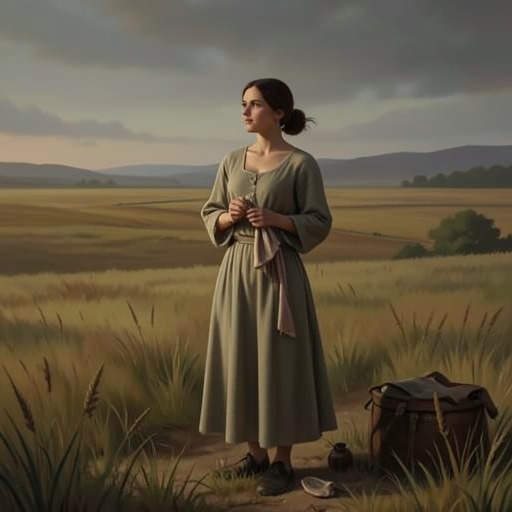
The prince leads Oneguine to his wife and introduces him as a relative and friend. Tatyana’s soul may be confused, and she gazes at Oneguine with intense astonishment; nevertheless, no outward sign betrays her disturbance. She preserves an unchanged bearing and offers him an easy, unreserved bow.
That public self-command is significant beside the private force of the recognition. Tatyana does not greet Oneguine with visible reproach or surrender to the shock of his appearance. Her measured bow keeps the reunion within the forms of social encounter, while the narrator makes clear that her calm exterior does not prove an untroubled inner life. The scene therefore establishes the distinction that governs the ending: feeling persists, but it does not dictate her conduct.
Love and the Final Refusal
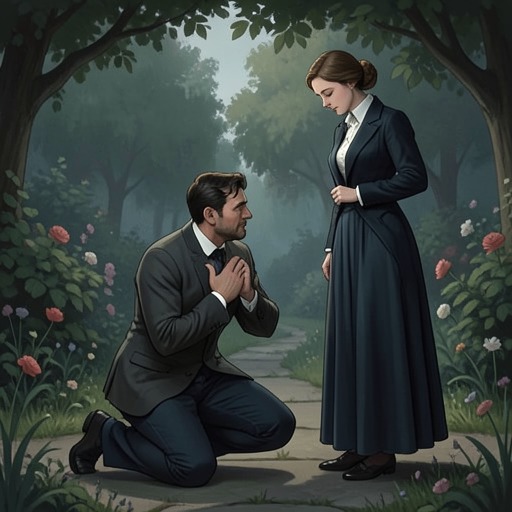
In her final appeal, Tatyana asks Oneguine to leave her forever. She recognizes in him a heart governed by inflexible honour and pride, then tells him plainly that she loves him and has no reason to deceive him. The confession does not open a path toward renewed union. It comes together with her decisive statement that she is now another’s bride and will remain faithful forever.
The sequence gives her refusal its full weight. Tatyana does not claim that her love has vanished, nor does she pretend that the choice costs nothing: she acknowledges the love precisely while ending the possibility that Oneguine can act on it. Her fidelity is therefore a commitment she names and sustains, rather than a consequence of indifference. The request that he leave her forever closes the encounter as firmly as her earlier unreserved bow had contained it.
Narrative Significance
The marriage and the final refusal reverse the earlier imbalance between the lovers. Once, Tatyana offered her love and Oneguine rejected her; now Oneguine’s belated love meets a boundary she chooses to keep. The reversal does not erase the earlier rejection or convert the story into a reunion. Instead, the past returns with altered positions: Tatyana can answer honestly that she loves him, yet she will not abandon her marriage.
Her fidelity gives the ending its moral and emotional tension. The novel allows inward desire and outward obligation to remain in conflict without pretending that one cancels the other. Tatyana’s last word is neither a denial of love nor a promise of future fulfillment, but a commitment to her husband. In that choice, the relationship reaches its final separation: Oneguine is told to leave, and Tatyana remains faithful.