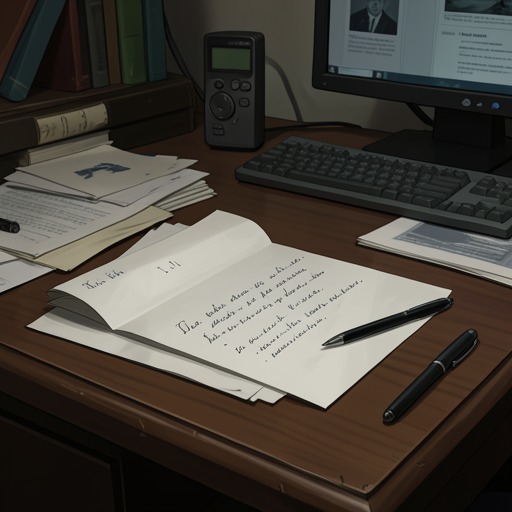
Hino family home
Even If This Love Disappears From the World TonightThe Hino family home is more than a domestic backdrop: its rooms hold the records through which Maori Hino reconstructs a life her memory cannot retain, while its thresholds and private spaces bring concealed knowledge into contact with the people trying to protect her. A summer visit brings Tooru Kamiya into her bedroom, where a direct question about his feelings and a hidden reminder of her amnesia make the house a charged meeting place for intimacy, secrecy, and care.
Setting and Domestic Thresholds
During summer vacation, the Hino family home is close enough to serve as a practical meeting place when Maori Hino, Izumi Wataya, and Tooru Kamiya plan to wait together for an announcement. The nearest family restaurant is too far away, and the group is concerned that Izumi, traveling by bicycle, might arrive too late. Izumi proposes that she sleep over at Maori’s home and that they sneak Tooru into Maori’s room. Maori takes up the idea cheerfully, while Tooru, who knows about her amnesia although she thinks he does not, is immediately uneasy about entering a girl’s home at night and being discovered by her parents.
The visit turns the house into a small stage for an elaborate deception. Maori explains that her father is overprotective, so the three devise a plan: Maori will tell her mother that Izumi is coming over; Izumi will keep Maori’s parents occupied in the living room; and Maori will lead Tooru upstairs, first leaving him in the hallway while she tidies her room. The plan depends on the difference between public and private space: the parents welcome Izumi, even saying they do not mind if she stays overnight, while Tooru must enter unseen. As they ride to the house, he asks how he will get out; Izumi confidently promises to distract the parents again.
Tooru sees the home for the first time and notes that it is a proper single-family house, not a standardized, cookie-cutter one. He locks his bicycle by the roadside, waits until Maori and Izumi have entered, and then slips in when Maori opens the front door and beckons him. She whispers that he should carry his shoes rather than leave them at the entrance. In the hallway he hears Izumi’s cheerful voice from the living room, where Maori’s parents are, before Maori hisses at him to stop lingering and leads him upstairs. These details make the house’s ordinary layout—entryway, living room, stairway, and bedroom hallway—part of the concealment itself.
The Bedroom and Its Hidden Records
Maori’s bedroom gives Tooru a brief view into a space she has prepared for herself and is still trying to put in order. It is considerably larger than his own room and very tidy. She lays out a magazine she plans to throw away and tells him to put his shoes on top of it, making even his place in the room subject to a practical arrangement. While she cleans, he waits anxiously outside; once admitted, he is alone in her private space until Maori and Izumi return.
Tooru looks around, aware that inspecting a girl’s room would be improper, and notices the sketchbook that he and Maori bought together on her desk. A pencil, sharpener, and small utility knife lie beside it. The materials recall the art room at his junior high school, and the sketchbook contains several line drawings of people, including a sudden portrait of Tooru himself. His hand stops when he sees his own face. The image gives the room an intimacy that is not based on what Maori can remember from one day to the next: the drawing is a lasting trace of attention, made in a place where her relationship with Tooru has become part of her private life.
The sketchbook is not the only record in the room. Tooru notices paper protruding from a wide desk drawer and suspects it may be connected with the tidying Maori did before letting him in. He hesitates, then sees several loose papers, a binder, and notebooks. On one sheet, in Maori’s handwriting, is the instruction that she has lost her memory in an accident and should read the notebook on the desk. The note confirms the condition he already knows about, but its presence in her bedroom reveals how deliberately she has prepared for a morning when she may not recognize the life around her. Tooru closes the drawer quickly and carefully arranges the protruding paper so it will not crease; his heart pounds and his hands shake. The house’s private storage holds knowledge Maori must leave herself, while the person who finds it must decide what not to disturb.
A Question That Changes the Room
The bedroom’s seclusion also makes possible a question Maori asks Tooru directly: whether he likes her. For a moment, he forgets the complicated feelings he has been trying to manage; even the ticking clock seems thunderous. The question lands against a relationship shaped by the very facts Maori’s hidden note records. Their romance is pretend, and Tooru has concealed that he knows she has amnesia. He fears that, in a different world, he would keep hiding his feelings while Maori kept her condition secret and their false relationship continued until they eventually separated.
Tooru’s thoughts about that imagined ending are bitter, but not regretful: he accepts that his feelings might come to nothing. The bedroom concentrates the difference between the relationship’s outward arrangement and its inward reality. The two have come to wait for an announcement under a scheme that hides Tooru from Maori’s parents; in the room, Maori asks what their bond means to him. The conversation does not erase the constraints around their relationship, but it makes the emotional truth of those constraints impossible for Tooru to treat as merely abstract.
A House Built Around Daily Care
Elsewhere in Maori’s life, the home is the setting for the routine that helps her live with a memory that resets. After her mother explains that an accident caused her memory loss, Maori drinks a cinnamon latte brought to her room, but the familiar favorite does not calm her shaking. Her mother watches with a pained expression and explains that Maori repeats the same routine every day. Maori has a binder and journal to consult, and she usually wakes early to read them. Because she needs that time, she has to be in bed by ten at the latest; her mother has adjusted her own schedule to match.
The different roles of these records give the domestic routine its structure. The binder gathers important information in a tabbed, expandable format, and Maori uses it to preserve essential details beyond phone notes. The journal, by contrast, is a freer diary: it begins the day after the accident, continues to the present, and includes weekly summaries to make it quicker to review. Maori tries to keep to her pre-accident routine so that other people will not notice how much has changed. Reading these records in her room, she learns that she has a boyfriend and finds diary entries about the life she has no recollection of living. The house is therefore both a place of family care and a daily point of encounter with an unfamiliar self.
That private routine does not mean the illness stays within the home. Izumi later recalls a serious breakdown in mid-May: Maori stayed home from school without warning and did not answer texts or calls. Izumi went to the Hino family home after school, where Maori’s mother’s face stiffened at her arrival. Although Maori’s memories reset, Izumi explains, her emotions do not necessarily reset with them; feelings from the previous day can persist. On the morning in question, after her mother told her again that she had amnesia, Maori said she could not bear it and insisted there was no point in living that way. The home’s doors thus mark not a barrier against crisis but the point where friends and family discover how severe it has become.
Records, Loss, and the Work of Remembering
After Tooru dies, the home again becomes the setting for a difficult disclosure. Izumi visits Maori the next afternoon. Since the accident, Maori has avoided spending time with friends other than Izumi: answering many people’s messages would be hard, and seeing others move steadily toward their futures could make each new version of Maori feel left behind. Tooru, however, is already present in her journal. Izumi recognizes that Maori will eventually notice his absence and that, because she knew them both, she must tell Maori what happened. Maori responds by asking whether Tooru Kamiya is her boyfriend. In this setting, the relationship first disclosed through written records becomes the point from which she has to face his death.
The home’s role in preserving and altering those records grows more deliberate after the funeral. Tooru’s sister offers to type Maori’s binder and journal into a computer, removing him from the text and repairing the passages around each deletion. She can work from the originals or copies. Izumi does not decide immediately whether this is right. She considers the risk that Maori will face each morning with both her amnesia and the knowledge that her boyfriend has died, but recognizes that her fear of Maori’s depression cannot by itself justify changing the records. The decision concerns not only what the family home shelters but what the people around Maori believe she can bear.
On the morning of the third day after Tooru’s funeral, Izumi comes to the house early by prior arrangement with Maori’s parents. Maori is still weak and has been sleeping in her parents’ room at her mother’s suggestion. In the quiet, Izumi opens the desk drawer in Maori’s room, gathers the binder and many volumes of the journal, and places them carefully in her bag. She then transfers the edited digital journal and notes to Maori’s laptop. Tooru’s sister has added entries for the days since his death and used a program to falsify the time stamps on the files. From then on, Maori is to read the digital versions and add new entries there. The physical desk and the room’s carefully kept papers are not simply a private archive: they become the site of a choice about which parts of that archive will remain accessible.
A second, hidden message complicates the attempt to erase Tooru. On the back of one of Maori’s notes, Izumi finds a reminder written for the possibility that Maori recovers: always remember Tooru Kamiya; important things will always be in an important place. Izumi guesses Maori placed it there so she would see it when she took down the notes after recovering, though she cannot know whether Maori had sensed what Izumi and Tooru’s sister were doing. The bedroom’s drawer, which earlier held a note explaining the amnesia, now preserves a counter-instruction that anticipates recovery. The home’s intimate storage becomes a quiet contest between the wish to protect Maori from pain and the wish to leave her a path back to the person she loved.
Narrative Significance
The Hino family home gathers the novel’s different forms of remembering into reachable spaces. The bedroom holds a sketchbook in which Maori has drawn Tooru, a binder and journal that teach her who she has been, and notes written to guide a future version of herself. The living room, meanwhile, shelters her parents and Izumi’s conversation while Tooru slips upstairs unseen. Ordinary domestic arrangements—bedtime, a drink brought to a room, shoes set on a discarded magazine, records stored in a drawer—sit beside extraordinary acts of concealment and care.
The home’s significance changes with the people who enter its rooms. For Maori, it is where her mother repeats the truth of the accident and where daily reading supplies a continuity her memory cannot provide. For Tooru, the bedroom is where the private evidence of Maori’s drawings and the note about her condition sharpen his awareness of what she faces. For Izumi, the house becomes a place to tell Maori of Tooru’s death and later to remove his traces from her records, even as a hidden note resists that erasure. The family home cannot cure memory loss or settle the ethics of deciding what another person should know. It can, however, hold the documents, people, and choices through which memory is cared for, concealed, and eventually made available again.