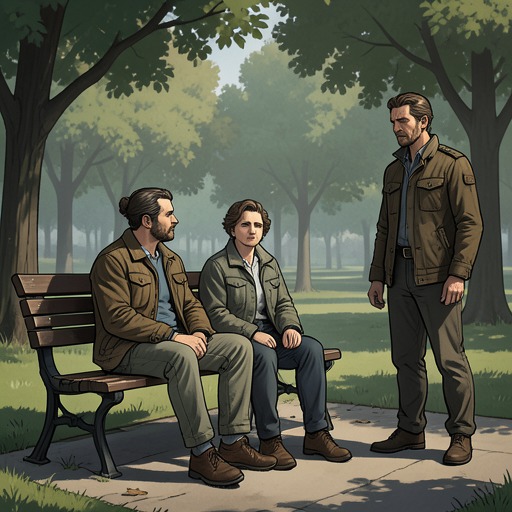
Izumi Wataya and Tooru Kamiya
Even If This Love Disappears From the World TonightIzumi Wataya and Tooru Kamiya are joined most consequentially by a final request that turns their friendship into an act of custodianship over Maori Hino’s past. Tooru asks Izumi to remove him from Maori’s records if he dies, believing that the truth of his death could harm someone who wakes each day unable to retain new memories. After Tooru’s sudden death, Izumi must decide whether to honor his wish. The relationship’s defining action is therefore not simply a promise kept: it is a difficult, practical intervention in what Maori can know about her own life.
The Request and Its Reasoning
Tooru explains that Maori keeps a journal and a separate binder of important information, so removing him would require more than deleting one entry. Izumi would have to transfer their contents to a laptop and edit out every reference to him. He acknowledges that the work would be burdensome, apologizes for asking it of her, and asks her first to listen. Izumi refuses at first, telling him he should do it himself. Tooru answers that he should, but presses her to understand why he is asking.
His stated reason is tied to the couple’s unusual history: he says he had little interaction with Maori before her memory loss, so if he were absent from her journal after his death, it might be possible to make their relationship seem as though it had never happened. He considers a breakup inadequate because Maori might search for him; learning that her boyfriend had died, he fears, could be especially damaging to her. He tells Izumi that he could accept being erased altogether. The request asks her to treat the written record not as a neutral account, but as something capable of shaping the future emotional life of a person who depends on it to understand each new day.
The conversation also shows the limits of Tooru’s certainty. He speaks about life as miraculous and frightening: people are not machines assembled from a blueprint, and an abnormality may go unnoticed until something stops working. Looking down at the left side of his chest, he reflects on the vulnerability of being alive. Izumi later recognizes that she might have challenged his assumption that erasing him would make Maori happy, but in that moment she sees some truth in his fear that Maori could fall into depression. His request is both an expression of care and a decision made under uncertainty.
Izumi’s Decision After Tooru’s Death
After Tooru dies, Izumi remains unsure whether to obey him. She is the only person who can carry out the request, but she does not regard that responsibility as permission to decide lightly. After accompanying Maori and arranging for her to get home by taxi, Izumi returns alone to the Kamiya family home to ask Tooru’s sister for advice. She explains the records that would need to be changed, the possibility that Maori might become depressed, and Tooru’s request to remove himself from the journal and binder.
Tooru’s sister offers to type the materials into a computer and repair the edited passages. But she does not settle the moral question for Izumi. She argues that the outcome is uncertain: Maori might suffer if Tooru remains in the journal, while Izumi might suffer guilt if she removes him. She says the decision belongs to Izumi because Tooru entrusted it to her, and offers to help fulfill his last wish if that is what Izumi chooses. Izumi leaves without deciding. Her hesitation matters: carrying out Tooru’s plan will not simply be an act of loyalty to him, because it will also determine what Maori can read, remember, and ask about.
The choice sharpens when Izumi imagines what the unaltered record would mean for Maori. Each morning, Maori would learn again that she has amnesia and that her boyfriend has died, with the journal preserving the happy days that preceded the loss. At first, Izumi lets Maori write about Tooru’s death and read about it the next morning. Maori appears profoundly depressed. Izumi later explains that she wanted to see how Maori would react without her interference, a decision she herself recognizes as wrong. The visible distress turns the feared consequence from an abstract possibility into an immediate caregiving crisis.
Editing the Record
Tooru’s sister stays awake through the night typing the journal and binder into a laptop. Rather than merely remove Tooru’s name, she substitutes Izumi into the account and adjusts the surrounding details to make the revised history read naturally. For example, she changes the record to say that Izumi and Maori were in the same class in their third year of high school, as they had been the year before. She asks Izumi to review the altered text, then retreats to Tooru’s room, where Izumi hears her muffled sobs. Their work on the record takes place alongside their grief, not outside it.
Izumi and Tooru’s sister extend the erasure beyond the journal. Maori’s old phone contains Tooru in photographs, videos, messages, and even text exchanges with Izumi. The family buys a new phone, tells Maori that the old one broke, and plans to explain the missing messaging history as a failed data transfer. On the morning of the third day after the funeral, Izumi gathers the paper binder and journal volumes from Maori’s desk, transfers the revised digital records to her laptop, and uses a program to falsify the timestamps on the files. From that day onward, Maori reads and adds to the digital journal on her computer, believing that this has always been her routine.
Izumi also removes drawings of Tooru from Maori’s sketchbooks, carefully tearing out the pages and trimming the remaining edges. She keeps the old phone and the drawings rather than destroying them, preserving materials that Maori can no longer access in her ordinary daily life. Before leaving, Izumi replaces every wall note that tells Maori to read the journal and notes on her desk, changing the instruction to say they are on her laptop. A hidden sticky note on the reverse of one reminder tells Izumi that Maori may have anticipated a future recovery; moved, she keeps that note attached and carries it with the other saved traces. The changed papers look lifeless to Izumi, but the concealed note remains a fragment of Maori’s attachment to Tooru that the broader edit cannot explain away.
Care, Cost, and Continuing Consequences
The altered record protects Maori from repeatedly discovering the death of someone she cannot remember, but it also changes the terms on which she lives with her own past. Soon after the switch, Maori complains that the messaging-app transfer failed because the old conversations had reminded her of enjoyable times with Izumi. Izumi hugs her and promises that they will make more happy memories in real life. Her response redirects their friendship toward the future, even as the past that helped shape it has been edited out.
That kind of everyday support has a history. During Maori’s amnesia, her mother adjusts her schedule to match Maori’s early-morning reading routine and gives her space to consult the binder and journal. Izumi tells Maori that she does what she can and wants to do, rather than treating her friend’s memory loss as a burden. Tooru, meanwhile, makes plans for shared activities because he wants future versions of Maori to find reasons to face ordinary life with more courage. Izumi’s later promise that she will make Maori’s tomorrows enjoyable echoes this care, but it also places her in a position Tooru once occupied: helping make a future that Maori cannot carry forward by memory alone.
The erasure does not end the question of what Maori should know. After Maori recovers from amnesia, she finds a drawing of Tooru that Izumi thought she had collected. Although Izumi believes Maori could endure the truth and that the risk of depression has passed, she tells her that the depicted boy was someone she had seen a couple of times at the library during summer break in high school. She remains uncertain about what is best for Maori and withholds the relationship’s true significance. Later, when Maori considers whether photographs and videos might help her remember, she fears that those images could overwrite her own emerging image of Tooru. Izumi proposes listening to his voice instead; the audio brings back the day Maori insisted they ride a bicycle together. The story thus gives memory more than one route back: not only altered text and deleted files, but also sound, drawing, and the feelings that persist when their origins are unknown.
Eventually, Maori tells Tooru’s sister that memories matter and that, if other people are gradually forgetting him, she wants to gradually remember. Izumi’s role in the relationship with Tooru therefore remains ethically unsettled even after his request has been fulfilled. She has preserved Maori from an immediate and recurring confrontation with death, but she has also managed the records that make a life legible to its owner. Keeping the old phone, the removed drawings, and the hidden reminder leaves open the possibility of restoration; Maori’s later decision to seek her memories makes clear that protection through forgetting cannot be the whole of her future.