Izumi tells Maori that Tooru was her boyfriend
Even If This Love Disappears From the World TonightIzumi tells Maori that Tooru was her boyfriend at the moment when the evidence she has been trying to interpret can no longer be explained away. Maori has found hidden portraits, noticed their absence from her diary, and asked whether Izumi is concealing something. Izumi answers that Tooru was Maori’s boyfriend—and that he is dead. The disclosure restores the relationship’s name while confirming its irreversible loss; it is also the point at which Izumi’s loyalty to Tooru’s final request gives way to her refusal to lie to Maori.
The Clues Before the Disclosure
Maori’s question grows out of a collision between what she can see and what her records say. She has discovered numerous drawings of a man she does not remember, hidden behind her bookcase, and cannot find an account of him in her diary. Her first practical explanation is that she had only recently begun drawing portraits and that the man had offered to pose. Yet the hidden sketchbook troubles that account: as a child, she had used the space behind the bookcase to conceal things from her overprotective father, who used to read the group journal she kept with friends. The old hiding place gives the drawings a personal history that their absence from the diary cannot settle.
The mystery is sharpened by an earlier, deliberate record. After her accident, Maori relies on a binder and journal to learn about her circumstances each morning; her mother says she reads them early and keeps important information in the binder so it will not be lost with her phone data. The section labeled “My Boyfriend” directs her to diary entries beginning on May 27. In the corresponding phone folder, she finds photographs and videos of Tooru Kamiya. One short video, made while they ride together at twilight, shows him glancing back as he pedals and captures the two of them having fun. For Maori, these records offer a boyfriend without an accessible memory of becoming one. For Izumi, the later decision to erase Tooru from the journal, binder, and digital traces has made that absence more complete, but not complete enough to explain the drawings.
The Question and Izumi’s Answer
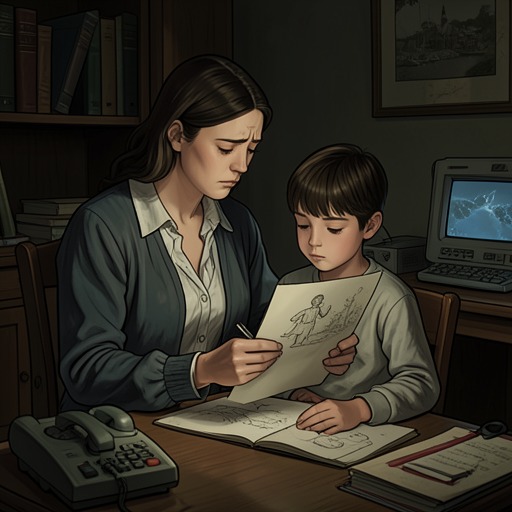
Maori’s questions become direct: why are there so many drawings of him, why were they hidden, and, finally, is Izumi hiding something? That last question shifts the scene from interpreting an object to testing a friendship. Izumi knows she could laugh the suspicion off or invent an explanation, but her vision blurs with tears. She begins to tell Maori who the man was, falters, and then says plainly that he was her boyfriend. The statement gives the hidden drawings their emotional context and overturns the cover story that Tooru was simply a convenient portrait subject.
The second half of Izumi’s answer is more devastating. She tells Maori that Tooru is no longer alive and that he died. The pause between identifying him as her boyfriend and explaining his absence makes the disclosure arrive in two stages: first the lost relationship, then the fact that it cannot be resumed. Izumi’s tears are part of the revelation’s meaning. She is not calmly correcting an incomplete record; she is speaking through the grief of someone who knew Tooru and had agreed to carry out his request to remove him from Maori’s written life.
What the Records Could—and Could Not—Preserve
The wider circumstances make the truth difficult to deliver. During Maori’s amnesia, she could not retain informational memories from one day to the next, so her family and Izumi helped sustain her daily life through written records and care. Her parents and Izumi’s devotion enabled her to graduate from high school and attend art classes several times a week. Tooru, meanwhile, had asked Izumi to erase him from Maori’s journal and binder if he died. After his funeral, Izumi worked with his sister to transfer edited records to Maori’s laptop, replace her phone, and remove old messages that referred to him. They attempted to protect Maori from suffering by taking the relationship out of the ordinary documents through which she reconstructed her life.
That choice could not erase every material trace. A sticky note on the back of one reminder says, “Even if I recover, always remember Tooru Kamiya. The important things will always be in an important place.” Izumi suspects Maori had placed it where she would see it after recovering. The hidden drawings also survive the revision: when Maori later finds them behind the bookcase, their presence conflicts with the cleaned-up diary and prompts the very questions Izumi had hoped she could postpone. The scene thus distinguishes memory held in official-looking records from memory lodged in objects, habits, and private acts of concealment. The records can be altered; their omissions become clues.
Care, Loyalty, and the Cost of Choosing
Izumi’s decision to speak follows an earlier conflict over whether fulfilling Tooru’s request would truly help Maori. Tooru’s sister had offered to retype the binder and journal, patching the places where he was removed. She warned Izumi that neither choice had a certain outcome: Maori might suffer if Tooru remained in the records, while Izumi might suffer from guilt if she erased him. She left the decision with Izumi because Tooru had entrusted it to her, and said she would help fulfill his last wish. The later disclosure does not make that earlier decision disappear; it exposes its limit. Erasure could change what Maori read, but it could not guarantee that she would feel no unexplained absence or find no surviving trace.
Izumi’s care has throughout included respect for Maori’s capacity to face what is happening. When Maori apologizes for involving her in the memory loss, Izumi says she does only what she can and wants to do. She also helps create the happy activities that Tooru hoped would make tomorrow easier for Maori, whose days otherwise began without recollection of the preceding one. In this scene, care no longer means managing the information available to her. Maori asks a direct question, and Izumi answers it, despite the cost to both of them. Her tears and her earlier embrace—when she promised to make Maori’s tomorrows fun—show how practical support and grief coexist rather than cancel each other out.
The Revelation’s Consequences
The confession changes the sketchbook from an unexplained collection into evidence of a relationship Maori once lived. Yet the disclosure does not instantly restore that life to her: she hears that Tooru was her boyfriend and that he died, but the words do not supply the memories her amnesia has withheld. The gap between factual knowledge and remembered experience remains central. Izumi can name the relationship; the drawings can attest to Tooru’s existence and to Maori’s sustained attention to him; neither can by itself return the shared past.
The scene also prepares the story’s later movement from externally preserved evidence toward Maori’s own recollection. In the cherry-blossom park, Izumi sees drawings of Tooru that she has never encountered before, rendered as Maori remembers him, and watches Maori look toward the cherry trees as if trying to recall something. Against the earlier confession, those drawings suggest that removing Tooru from the diary did not extinguish every route back to him. The revelation is therefore both a painful disclosure and a threshold: Izumi stops protecting Maori through silence, while the surviving images and Maori’s searching attention leave open the possibility of a memory that belongs to Maori herself.