Keiko Nishikawa
Even If This Love Disappears From the World TonightKeiko Nishikawa, born Sanae Kamiya, is Tooru Kamiya’s older sister and an aspiring writer who spends much of her youth caring for her bereaved family. Her departure is not an act of disgust or estrangement from her father: it comes after years in which domestic duty and an undisclosed personal circumstance have kept her from pursuing the work she wants to do. Tooru’s insistence that she reclaim that ambition helps turn leaving home from an apparent abandonment into a step toward a life of her own.
Identity and Family Background
Keiko is the daughter of Tooru's father and the older sister of Tooru Kamiya. Her family’s household changes sharply after their mother, who had long been frail, dies of heart disease. Keiko is then only in her first year of junior high; Tooru has just started first grade, and their father is depressed by the loss. Keiko takes on the work of keeping the household going while still a child herself.
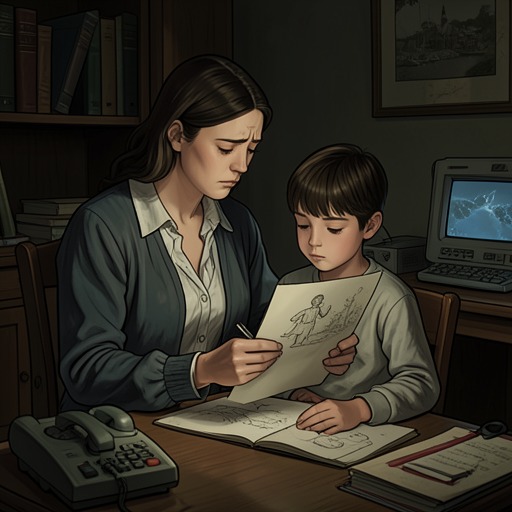
The chores are comprehensive and unrelenting: she cleans, does laundry, cooks, takes out the garbage, and cares for Tooru. She rarely rests at home. Her private pleasure is reading novels once the work is done, in a house full of old books because her father had wanted to become a writer. Keiko describes books as places she visits rather than merely things she reads, a response that helps explain why writing becomes more than an idle pastime for her.
She begins writing novels secretly, on nights when her father and Tooru have gone to sleep. In her third year of junior high, one of her stories receives honorable mention in a local writing contest. She does not tell her father. Tooru guesses that she fears discouraging him while he is only beginning to recover from their mother’s death; the precise reason is not confirmed, but the silence makes clear that her early achievement remains concealed within the family.
Departure and the Decision to Write
At one point Keiko leaves the family home, but Tooru later clarifies that she did not go because she was disgusted with their father. The siblings normally share everything, yet something happens that Keiko cannot tell him. That distinction matters: her leaving is bound up with a private matter, not a simple rejection of the family or an openly stated break with her father.
Years later, Tooru encounters her at a book signing, where she is presented as the author Keiko Nishikawa. She sits at a long table, signing books for readers and thanking them with a smile Tooru has never seen before. Tooru pushes through the crowd carrying a bulky picnic basket to reach her. The scene sets her public identity as an author against the earlier image of a girl writing in secret after everyone else has gone to bed.
In their conversation, Keiko frames her choices as a sacrifice: she says she sacrificed her family and Tooru for writing. The weight of that judgment comes from the history behind it. She had shouldered the housework and looked after her younger brother from early adolescence, while her father’s grief and Tooru’s dependence left little space for her own plans. Tooru, however, refuses to accept that her ambition must be understood only as a cost imposed on him.
He tells her not to give up so easily and reminds her that becoming a novelist is her dream. He also says she does not need to remain in the house because he can take care of their father. This is a change in their family arrangement as much as an expression of encouragement: Tooru claims responsibility for the household so Keiko can stop treating her own future as incompatible with his welfare.
Recognition and Sibling Relationship
Keiko apologizes for taking Tooru’s time and opportunities. He answers that what she did from her first year of junior high outweighs any hardship her departure might cause him, wishes her well, and says he will always root for her. His response recasts their relationship from one organized around her care for him to one in which he can acknowledge that care and support her independent choice.
Keiko leaves the familiar apartment complex to enter the wider world. About six months later, a novel by Keiko Nishikawa wins the Literary World New Author Prize. A year and a half after her departure, another book is nominated for the Akutagawa Prize. The rapid succession of recognition gives concrete form to the future Tooru urged her to pursue, even as he resists the idea that her success proves she wronged her family by leaving.
Their bond continues to matter after Tooru’s death. When Izumi Wataya faces the decision whether to erase Tooru from Maori Hino’s journal, she asks Keiko’s sister for perspective. Keiko does not claim that the choice has a certain correct answer: either course could lead to suffering, and Izumi must decide whether she wants to carry out Tooru’s request. Keiko says she will follow that decision and offers her own desire to fulfill Tooru’s last wish as support, not as a substitute for Izumi’s judgment. Her intervention echoes the family conversation in which she once let Tooru’s encouragement help her act without making his choice for her.
Narrative Significance
Keiko’s arc links the novel’s private histories of care to its larger concern with what written records can and cannot settle. Her achievement begins in concealed pages written after household duties are done; later, her name appears on books she signs for readers. Writing is both a vocation she has to protect and a means by which a life can move beyond the role a family’s crisis has assigned it.
Her story also complicates the language of sacrifice. Keiko interprets her departure as a cost paid by her family, while Tooru insists that the years she spent caring for him must count too, and that pursuing a long-deferred dream need not mean abandoning him. The novel does not make the family’s losses disappear; instead, it shows how the siblings revise what those losses mean through speech, recognition, and changed responsibilities. Later, Keiko’s measured advice to Izumi carries the same respect for uncertainty: people may act without knowing in advance which choice will prove right, but they can still decide what they are willing to stand behind.