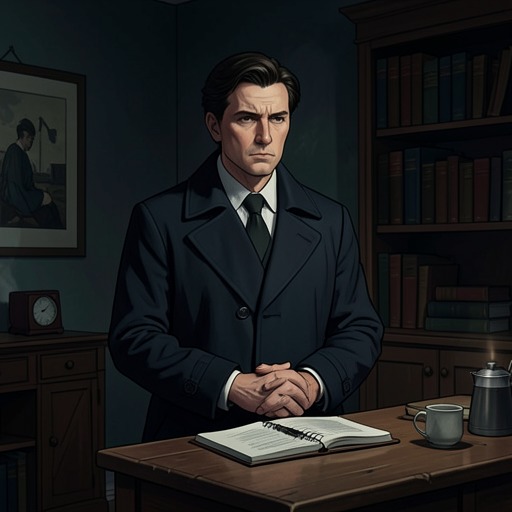
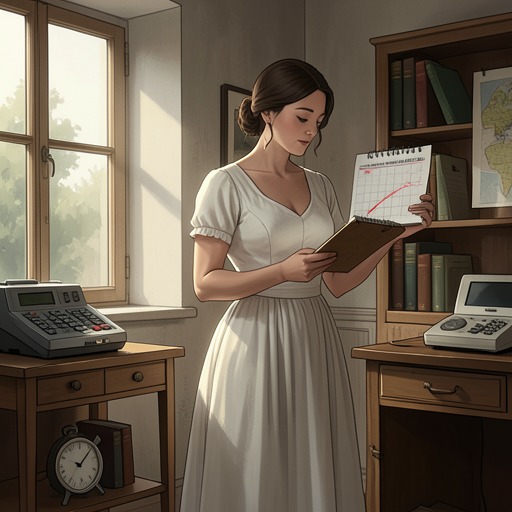
Maori Hino
Even If This Love Disappears From the World TonightMaori Hino is a high-achieving student whose anterograde amnesia resets her memory each time she sleeps, turning ordinary continuity into something she must build anew. Her story follows both the practical work of living with that condition and the harder choice that comes after recovery: whether to restore a painful love that others have deliberately erased from her records. The answer she reaches is neither to remain captive to loss nor to deny it, but to remember Tooru Kamiya while continuing toward a life beyond him.
Identity and the Daily Conditions of Her Life
Maori is in the advanced class and has worked hard to get there. After her accident, she tries to maintain the routine she had before so that her classmates will not notice how much has changed. Her condition is anterograde amnesia: when she goes to sleep, the events of that day disappear from her memory. She explains the illness to Tooru during their first date, when the wind blows through her long hair and the disclosure takes time to reach him. The diagnosis is not a figurative forgetfulness but a strict limit on how she can carry experience from one day into the next.
That limit shapes her schooling and her privacy. Maori and her parents consult the school, where they learn that she can graduate if she attends for the required number of days. The administrators also raise the risks of disclosing her condition: if other students learn that she cannot remember what happens to her, they might come to watch her, and information could spread beyond the school. Her binder records this reasoning alongside the fact that only her parents, Izumi Wataya, and her teachers know what happened. The decision to keep the condition from classmates is thus presented not as shame, but as a protective measure against exposure and the anxiety that exposure might bring.
Her written instructions preserve both information and the reasons behind it. The binder summarizes essential facts, while her journal begins after the accident and continues through the present, with weekly summaries to make it easier to catch up. The journal is looser and more personal than the binder; its brief entries—after-school meetings, dates, Tooru, Izumi, black tea—describe a life that the waking Maori cannot remember having lived. Reading them can be painful: she sees that she worked to enter the advanced class only for that achievement to lose its ordinary meaning, and that her memory has not improved. Yet the records also tell her that she has a boyfriend, giving the otherwise frightening account of her condition a point of connection to another person.
Choosing a Relationship and Finding Ways to Continue
Maori’s relationship with Tooru begins when he is pushed into confessing to her after school. Rather than simply accept or reject him, she agrees to date under three conditions. Her decision is a deliberate experiment: she wants to try something new despite her memory loss, after feeling that the days pass without allowing her to build anything over time. She also asks that their relationship remain private. The conditions make the romance a structure she can enter on her own terms, rather than a situation in which her illness leaves her only to be acted upon.
Tooru becomes part of the way she reclaims activity, not only a subject in her records. During summer vacation she starts drawing again, after having stopped when she entered high school to concentrate on studying. Her sketchpad contains a portrait of the teenage boy she barely recognizes as her boyfriend, as well as figure drawings and pages of practice. A callus remains on her hand, and the new sketchbook shows no dramatic leap across its few dozen pages; what it records instead is gradual improvement. Maori and the earlier versions of herself reason that drawing may continue through procedural memory even when autobiographical memories do not. She tests that possibility by practicing croquis, and the physical skill does in fact develop.
The end of summer gives that daily effort a vivid emblem. On August 31, the last day of vacation and the day planned for fireworks, Maori wakes to find a yukata laid out on her desk. A note from yesterday’s self, illustrated with a drawing, tells her to have enough fun for both of them. At the riverbank, she and Tooru watch the fireworks among the crowd and hold hands. The beauty of the evening does not reassure her that its feelings will survive the night. She wonders whether emotion, like memory, will fail to accumulate, and hopes that something of what she feels will reach the Maori who wakes tomorrow.
Her support network gives that uncertainty practical shape without making recovery a condition for living. Izumi knows about the amnesia and shares her life; Tooru sees Maori almost every day over summer and encourages her to draw. When Izumi later considers how to handle the records after Tooru’s death, Tooru’s sister offers to type the binder and journal into a computer and carefully repair the passages from which he is removed. The family’s plan responds to a specific fear that the news and the associated grief could contribute to depression. Maori’s own account makes clear, however, that support does not make the illness easy: there is no treatment, and recovery might come suddenly or not for years. She nevertheless remains in school and continues to make plans within the uncertainty.
Graduation, Recovery, and the Erasure of Tooru
Maori graduates from high school with Izumi and Tooru’s circle despite the daily reset. At graduation she says she cannot believe she stayed in school long enough to finish. Her accomplishment is not the disappearance of her disability: Tooru has passed a civil-service exam and is about to start work at city hall, while Maori plans to take art classes as she waits for her amnesia to be cured. Her continued education and growing drawing skill are forms of forward movement alongside the illness, not proof that it has ceased to matter.
About three years after the memory problem began, Maori recovers. By the time she is preparing for entrance exams, she can remember the preceding day, a change she describes with both hope and unease. She has been living with the condition since late April in her second year of high school, and it has no known cure; she understands recovery as the body’s natural healing rather than something she made happen on a predictable schedule. But the past she can now retain is incomplete in a different way. Tooru has died, and the people around her have removed him from her journal and binder at his request, made before his death: if he died, he wanted to be erased from her records.
Izumi eventually tells Maori that Tooru was her boyfriend. Maori recognizes him through the journal summary as someone important in her life and had been looking forward to seeing him that day. Yet the deleted records and her recovered memory leave her without the story of their relationship. When she later shows Izumi a sketchbook full of pictures of Tooru, Izumi chooses not to explain who he is. She reasons that Maori no longer has amnesia and that the risk of depression associated with the condition has passed, but still fears that revealing the truth will hurt her. The decision protects Maori from information she has not asked for, while also keeping her from a past that the drawings suggest has not become emotionally meaningless.
Choosing Memory and Drawing a Continuing Bond
Maori eventually asks Izumi about the boy in her sketchbook, and the recordings offer a route toward memory that photographs and videos do not. She fears that seeing those images might overwrite the image she has already formed of him. Izumi proposes that she listen to his voice instead. In an audio file extracted from a video, Maori hears rattling, her own happy squeals, and the wind. The sounds return her to the day she insisted that they ride a bicycle together. A fragment of lived experience comes back through sound, connecting a record of her past to a feeling she can recognize as her own.
When Izumi’s sister warns that pain may accompany the truth, Maori does not treat pain as a reason to refuse it. She says that if others are gradually forgetting Tooru, she wants to gradually remember him, and to recover what is important to her. She also agrees not to become a captive of the past or neglect her own life. Izumi’s sister asks her to love with her whole heart if someone who loves her enters her life, and to put Tooru behind her then. Maori cannot yet name what she feels, but the accounts in her journal—of someone who gave to her every day without asking for a reward—have already brought her close to that understanding.
Maori’s recovery does not restore Tooru all at once. She visits places they shared, repeats activities, and uses her journal and Izumi’s stories as guides. For three years after her determination to remember, the effort continues through university; unlike the effortless return of an association prompted by Lady Grey tea, the search does not yield quickly. Little by little, however, she remembers him. The sketchbook becomes both a surviving trace of their past and a record of her present effort to approach it, joining the body’s practiced skill to the memories she is trying to recover.
At the cherry-blossom park, Maori continues drawing and says that she has remembered something else about Tooru but knows she has not remembered everything. She describes the memories as sleeping in her body and heart, and remembering him as a way they can continue to live together. The world may be forgetting him, but she can hold a continuing relationship with the dead without claiming that grief has vanished. A tear falls; she wipes it away and draws again. She still hurts, still feels warmth, and still believes she can reach for happiness and fall in love again. Her ending makes room for both: Tooru remains part of her, but remembering him does not require her to stop living.