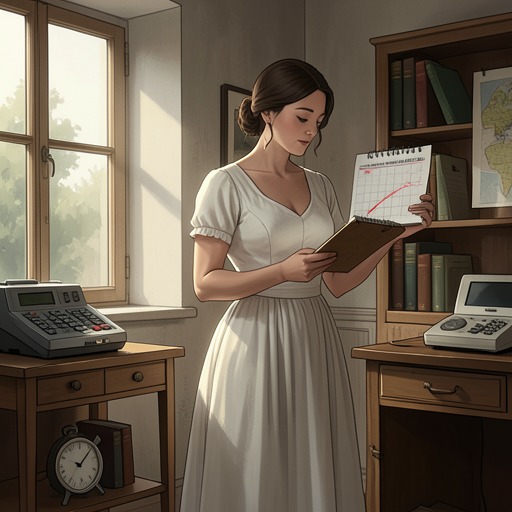
Maori’s accident and onset of anterograde amnesia
Even If This Love Disappears From the World TonightMaori’s accident and onset of anterograde amnesia turns memory into a daily boundary: she can experience a day, but sleep erases it before the next one begins. The condition reaches beyond recollection, shaping her privacy, education, relationships, and plans for the future. Yet the story also distinguishes what she cannot consciously remember from what she can still build through written records, accumulated practice, and the care of others.
The accident and its daily time limit
After waking with questions about the notes around her, Maori learns from her mother that she had an accident and lost her memory. Maori remembers the accident as having happened the day before; her family explains that weeks have passed. She can recall no intervening days, and the mismatch between her own sense of time and everyone else’s leaves her wondering whether her mother is telling the truth. The event therefore introduces the condition not as an abstract diagnosis but as a rupture between Maori’s remembered yesterday and the calendar everyone else inhabits.
The explanation is anterograde amnesia caused by brain trauma affecting the part responsible for storing memories. Maori can retain the events of a day while awake, but when she sleeps, the memories from that day are erased rather than stored. She wakes with her memories returned to the point before the accident. This reset does not mean she has lost her earlier life; it prevents her from carrying newly lived days forward as conscious recollection.
The story makes the limits of memory more specific by distinguishing short-term from long-term memory, and declarative from procedural memory. Repeatedly recalling information can establish long-term memories, but Maori cannot form new ones in the usual way. Procedural memory works differently: it includes skills such as riding a bicycle, held in practiced bodily knowledge rather than conscious recollection of particular events. The distinction allows the condition to organize the plot without reducing every form of learning, feeling, or development to the same daily reset.
Records, privacy, and education
A binder becomes one of the means by which Maori can encounter the facts of her own life. Her mother explains that Maori usually takes notes on her phone and writes the important information in the binder so it will not be lost if phone data disappears. Its first tab, marked “Important,” identifies the accident, the nature of her disability, and who knows about it: her parents, Izumi, and her teachers. Maori has not told her classmates.
That secrecy is connected to a concrete concern rather than a claim that classmates would necessarily mistreat her. When her parents consulted the school, administrators explained that a national law would allow her to graduate if she attended school for the required number of days. They also raised the risks of rumors: if others learned that Maori would forget what happened to her, people might come to see her, and information could spread beyond school. Even well-meaning classmates could not be relied on to keep the matter private, while the prospect of unwanted attention could add stress. Her doctor’s advice, as recorded in the binder, is to avoid stress, enjoy life, and remain calm; during this period, she limits her social circle to Izumi.
The journal supplies a different kind of record. Unlike the binder’s concise reference notes, it is written freely and covers the days after the accident, with weekly summaries that let Maori review events quickly. She reads those summaries before reaching the entries from May 27, when her relationship with her boyfriend becomes part of the record. The journal preserves both ordinary markers—dates, school, Izumi, and black tea—and difficulties, including the loss of meaning she feels after working hard to enter the advanced class and the fact that her memory has not improved. Reading it is not the same as remembering: the life is documented, but its days remain unfamiliar to her.
The school arrangement makes the cost and the accommodation visible together. Her teachers, including her homeroom teacher, know about the condition and do not call on her. Maori turns in blank homework and sits her tests even though she may answer everything incorrectly. Discovering the reset again and again is hard, but attending class is enough to meet the requirement for graduation. At this point she has not yet decided what she will do afterward. The arrangement protects her path through school without pretending that she is learning or being assessed in the usual way.
Relationships and the experience of continuity
Her parents help explain the accident and sustain the routines that follow it. When Maori apologizes to her father, he rejects the idea that she has anything to apologize for. He tells her she saved a child who might otherwise have died, says similar cases have occurred, and encourages her to take recovery slowly. Maori thinks about how often her parents must repeat such reassurance. She tries to respond cheerfully, partly to avoid making the situation harder for them, while her father gives her a smile that she recognizes as slightly unnatural.
Her relationship with Tooru gives the condition another dimension. Maori can meet him as a stranger even when her records identify him as her boyfriend and he remembers the time they have spent together. Still, she feels at ease in his presence and is comfortable with silences between them. She describes the connection as strange precisely because it feels natural: although she knows him through written information and cannot carry shared days into the next morning, she senses that they have been quietly accumulating those days together. Their relationship thus makes emotional continuity visible without claiming that Maori has recovered the memories themselves.
The contrast between recorded experience and present feeling also appears when Maori watches a video of a bicycle ride. The footage shows a day when she and Tooru were laughing together, but the person in the video does not feel like the person she is that day. She experiences a sadness close to longing for her own previous-day self. At the same time, the video does not foreclose the possibility of a new day’s happiness: she thinks she may have just as much fun again with Tooru, whose name she hardly recognizes. The scene holds loss and possibility together rather than treating one as proof against the other.
Skill, achievement, and recovery
Maori’s return to drawing demonstrates why procedural memory matters to the event’s longer arc. She had stopped making art when she started high school to focus on studying, but during summer vacation she begins drawing every day. A sketchpad on her desk contains a portrait of the teenage boy she barely recognizes as her boyfriend, as well as figure drawings. She notices that her drawing is improving gradually and that the callus from drawing has not disappeared.
The explanation recorded in her own reflections is that repeated practice may endure even when episodes do not. After learning about procedural memory, she and her earlier selves have reasoned that drawing could still improve because the skill is practiced rather than merely recalled. When she sketches an actor from a paused foreign film, she concentrates on the sensations of drawing instead of consciously planning each line. The resulting marks are more confident than those in her earliest drawings. They register the work of previous days, even though she cannot remember doing it, and give her evidence that she can continue to develop over time.
The effect of the condition is measured across school years as well as individual mornings. Maori eventually graduates from high school despite the memory loss; her graduation matters to her because she had not believed she could remain in school long enough to finish. Years later, she describes the period as beginning near the end of April in her second year and lasting about three years. She has recovered in April, roughly three months before the account in which she reflects on the change. She can now remember what happened the day before, and the fact that she graduated despite her condition gives her hope, though anxiety remains.
Recovery changes the temporal rule, but it does not restore the autobiographical memories that were lost during the years of amnesia. Maori can reread her high school journal and feel that the person in it was genuinely her, while still having no recollection of the events it records. Later, listening to an audio file extracted from a video gives her a different route toward the past: she recognizes the sound of a bicycle ride she had insisted on taking with Tooru and begins to remember when it was recorded. The contrast between the journal, which can be read without recall, and the voice recording, which helps memories return, shows that recovered continuity does not arrive through every record in the same way.
Narrative significance
The accident establishes a recurring tension between lived experience and conscious recollection. Each day is real to Maori while it lasts, but the next morning removes her access to it; the binder and journal make parts of that life legible, while photographs, video, sound, practiced skills, and sensation offer other, distinct kinds of connection. The story’s structure consequently distinguishes remembering a particular event from knowing facts about it, and both from retaining a learned ability.
That distinction also gives Maori agency within a condition she cannot simply will away. She helps manage what others know, reads and uses her records, chooses how to spend days she will not remember, and returns to drawing through practice. Her achievement is not presented only as a cure: graduation, artistic growth, and the moments of ease she experiences with Tooru are consequential while the amnesia is still present. Recovery matters, but so does the life she builds before it, one day at a time.