Maori’s binder
Even If This Love Disappears From the World TonightMaori’s binder is the expandable record Maori relies on to understand her life after an accident causes anterograde amnesia. It gives her a way to reconstruct essential facts each morning, when memories formed after the accident have been erased, and to make choices with knowledge that her unaided memory cannot preserve. Alongside the more personal journal, the binder turns continuity into something she can consult, organize, and gradually make her own.
Design and Purpose
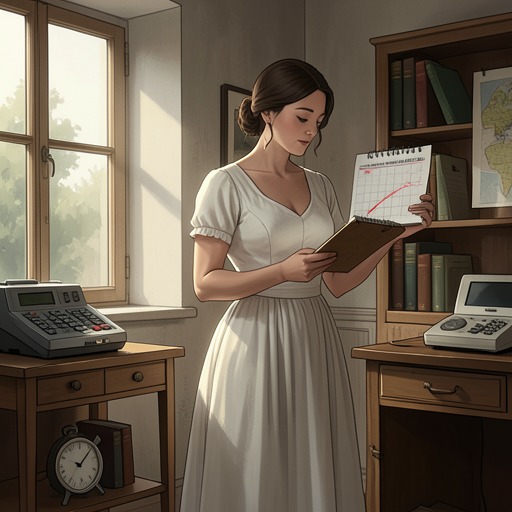
The binder has a simple design Maori likes, removable pages, and protruding tabs that let her find particular topics quickly. She does not recognize it when she first reads it, but she understands that it is meant to be a dependable reference. According to her mother, Maori usually records notes on her phone and transfers important information into the binder so that it will not be lost if she loses access to the data.
Its entries are summaries rather than a diary of every day. The distinction matters: Maori uses the binder to locate stable information and practical explanations, while her journal preserves the sequence and changing tone of daily experience. The binder is the first place she is instructed to turn after being reminded that she has memory loss from an accident. It functions as a deliberately organized guide to a life that otherwise meets her each morning as unfamiliar.
Information About Her Condition and Privacy
The binder’s “Important” tab gathers facts Maori needs to know, including that she was in an accident, the nature of her disability, and who knows about it. Her parents, Izumi, and her teachers have been told; her classmates have not. The notes explain that her family consulted the school and learned that, under the applicable national law for disabled students, she can graduate if she attends school and meets the required number of days.
The same section records why the family and school have kept her condition private. Administrators raised the possibility that knowledge of her memory loss could expose her to unwanted attention or exploitation: someone might take advantage of the fact that she would not remember what had happened the next day, and information could spread beyond the school. The binder also preserves the counterpoint that disclosure might bring consideration from classmates, but could not guarantee confidentiality. For Maori, the decision is framed not as proof that others are unkind, but as a precaution against risks she might be unable to remember or address afterward.
Reading this material makes the future she had assumed seem suddenly closed off, and she struggles to continue. The binder does not make the information painless; it gives her a way to face it in an organized form. The hope it records is that, despite her condition, she has a boyfriend, prompting her to turn to the section about him and to the journal entries beginning on May 27.
The Relationship Record and the Journal
The binder explains the conditions Maori set for her relationship with Tooru Kamiya. They needed to see each other only once a week, keep their communications short, and avoid falling in love. Her notes supply the reasoning: she needs time each day to review her records while continuing to attend school; a flood of messages would be difficult to answer and could refer to events she could not remember; and she expected the relationship eventually to end because of her situation. She therefore understood it as a pretend relationship, not a promise of lasting romance.
A profile of Tooru collects personal details, including his birthday, family structure, blood type, favorite author, and personality. The notes also preserve distinctive phrases and values associated with him, including “Downfallen aristocrat,” “Mum,” and his emphasis on sanitation. His explanation that cleanliness can be faked but sanitation cannot leaves Maori mildly impressed and curious about him, despite her limited familiarity with his name. The profile lets her encounter Tooru first through accumulated description, before the journal supplies the lived moments behind it.
The journal begins the day after the accident and continues to the present, with weekly summaries that allow Maori to review events quickly. Its informal voice contrasts with the binder’s concise reference style. Reading the summaries, she sees that she has tried to maintain her previous routine so that others will not notice how much she has changed; when she reaches May 27, she begins reading the individual entries about her boyfriend. Together, the two records provide different kinds of access: the binder tells her what to know, while the journal shows how those facts have felt and unfolded.
Daily Use, Learning, and What Records Cannot Hold
Maori’s need to consult the binder is part of a repeated daily routine. She gets up early to read her notes and needs to go to bed by ten, and her mother has adjusted her own schedule to support this pattern. The routine is not a cure for the memory loss. It is a means of organizing each day around it, giving Maori time to regain context before she returns to school and ordinary activities.
The novel also distinguishes the information a binder can store from skills that may persist without conscious recollection. Tooru researches the difference between declarative and procedural memory: facts and recollections can be written down, whereas learned bodily abilities, such as riding a bike, cannot simply be entered as instructions. The distinction becomes visible in Maori’s drawing. Following a scene in a film and focusing on the sensations of sketching, she finds that her hand can still produce confident lines. The drawings demonstrate development across days even when she cannot consciously remember practicing; the binder can document her life, but her growing skill is carried in the work itself.
This contrast keeps the binder from standing for memory as a single, all-or-nothing faculty. It preserves facts and helps Maori orient herself, while emotional responses and practiced abilities may survive or reappear by other routes. A video of a bicycle ride, for example, makes her smile but also leaves her longing for the earlier version of herself who appears in it. The written record can identify the event; it cannot make the present Maori feel that she is the person in the image.
From Reference to Deliberate Remembering
The binder remains important after Maori recovers from amnesia, but the terms of her relationship to it change. When Izumi considers whether to tell her about Tooru, she thinks the risk associated with Maori’s former condition is gone, yet initially gives a misleading account of him as someone Maori had seen only a few times at the library. Later, Maori agrees to listen to audio extracted from a video rather than look through photographs, fearing that images might replace the version of Tooru she has begun to form. Hearing her own happy voice and the sounds of the bicycle ride brings back the circumstances of the recording. Memory returns through a sensory trace as well as through written explanation.
Maori eventually chooses to recover what she can, even knowing that the process may hurt. She tells Tooru’s sister that if other people are gradually forgetting him, she wants to remember and reclaim what was important to her. She promises not to become captive to the past or neglect her own life. The choice does not mean that the binder or other records can restore every missing moment at once; over the following years, she uses her journal and other people’s accounts as guides, revisits places, repeats activities, and remembers Tooru little by little.
The binder’s significance therefore develops beyond its original role as a morning reference. It first helps Maori live with a daily reset by separating essential facts from information she cannot reliably retain. Later, as she searches for Tooru, it belongs to a wider network of records, testimony, sounds, places, and drawings through which the past can be approached without being reduced to a list of facts. The book’s final movement toward remembered experience and drawing suggests the limit and value of such an object: the binder can preserve the path toward memory, while the feeling of that memory must still be lived and recovered by Maori.