Maori’s memory reminder notes
Even If This Love Disappears From the World TonightMaori’s memory reminder notes are both a daily guide and a record of how memory is supported, managed, and sometimes withheld. First used to direct Maori to the written materials that explain her anterograde amnesia, the notes later become part of Izumi Wataya’s effort to remove Tooru Kamiya from her records after his death. Yet an instruction hidden on the back of one sheet escapes that revision: it asks Maori to remember Tooru even if she recovers. The notes thus carry two competing intentions, one designed to let her resume daily life without knowing about her loss, the other preserving a route back to a relationship she once chose to remember.
Purpose and Daily Use
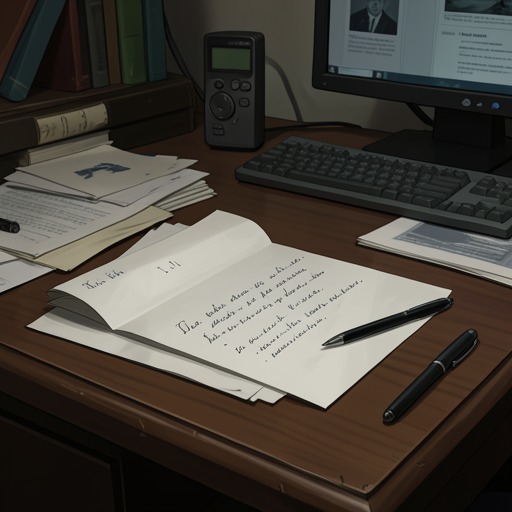
Maori’s notes answer a specific consequence of her condition. She can retain the day’s experiences while awake, but after sleep those newly formed memories are erased; she wakes with the identity and memories she had before the accident. To help her orient herself, she keeps written materials that explain what happened and direct her to information about her life. In one instance, a note tells the reader that she has suffered memory loss in an accident and to read the notebook on her desk. When Izumi Wataya finds this instruction among papers in a drawer, she understands that Maori’s written system includes not only a binder and notebooks but also individual reminders placed where Maori can encounter them.
The notes are not just medical directions. After graduating from high school, Maori wakes to instructions on her wall and reads that she has worked hard to graduate, should put her heart and soul into each day, and should remember to be grateful for her family. These brief statements connect an explanation of disability to a record of achievement and a prompt for how to live. On the morning she reads them, Maori realizes that she remembers the preceding day, an unexpected break in the daily reset. The reminders provide continuity, but they also make visible how remarkable continuity has become for her.
Revision After Tooru’s Death
After Tooru dies, Izumi and Keiko Nishikawa undertake to remove him from Maori’s journal, binder, and digital records. The task extends to the reminder notes on the wall. Izumi has already arranged for Keiko to help transfer and revise the written materials, and on the morning of the third day after Tooru’s funeral, she visits Maori’s room while Maori is sleeping elsewhere with her parents. She replaces the paper records with typed versions, changes the note directing Maori to read materials on her desk so it refers instead to her laptop, and installs the revised sheets on the wall.
The replacement is deliberate and comprehensive: Izumi changes all the notes, not just the one whose wording must be updated, because she worries that a single visibly different sheet might make Maori suspicious. She knows the words by heart, but their familiarity does not make the act feel neutral. The original papers had accompanied Maori day after day, and Izumi feels that replacing them violates something she has watched over her. The new instructions direct Maori to a digital journal and notes that have been edited to conceal Tooru. Her mother is to tell her that she has always used the laptop in this way. The practical result is a carefully reconstructed account of daily life, supported by a changed explanation of where that life has been recorded.
The Hidden Instruction
One piece of paper remains outside the revision. On the back of one of the original notes, Izumi discovers a sticky note written in Maori’s hand: “Even if I recover, always remember Tooru Kamiya. The important things will always be in an important place.” Izumi guesses that Maori placed it there so she would find the message when taking down the reminder after recovering from amnesia. She also considers that it may express the strength of Maori’s feelings for Tooru. The note’s position matters: its message is not part of the instructions facing Maori each morning, but is attached to their reverse, waiting to be found at a later moment.
Izumi does not destroy it or incorporate it into the replacement set. She puts the original paper in her bag with the sticky note still attached, preserving the message while continuing the concealment Tooru had requested. This separates the notes’ functions. The printed sheets maintain the cover story and direct Maori through her present routine; the saved original retains evidence of a past intention that the new account omits. The text does not establish that Maori knew about the editing, but her hidden words ensure that the possibility of remembering Tooru remains materially preserved.
Continuity Beyond the Notes
The notes belong to a wider system of memory supports that includes Maori’s binder, journals, phone media, and sketchbooks. Earlier, she reviews a binder section about her boyfriend and finds a phone folder full of photographs and videos of Tooru. Watching a recording of a bicycle ride, she recognizes the happiness of the person onscreen while feeling that the self in the video is not the self watching it. The written reminders and other records can tell her what happened, but their information does not automatically reproduce the emotions of the earlier experience.
That difference becomes important after the records are altered. Izumi gathers the binder and journals, transfers Keiko’s edited digital materials to Maori’s laptop, and removes Tooru’s pictures from the sketchbooks, keeping the torn-out drawings separately. Later, an audio file extracted from a video helps Maori begin to recall a shared bicycle ride; a remembered aquarium outing also returns through a description of tea and its smell. In the final movement, drawings of Tooru appear as Maori remembers him. Against these other media, the reminder notes are a particularly direct form of instruction: they can orient, exhort, and conceal, but the story’s return to memory depends on more than written directions. Their significance lies in that tension. They make daily life navigable while showing how easily a record can be revised—and how a single preserved scrap can keep an important choice from disappearing with it.