Maori’s sketchbook
Even If This Love Disappears From the World TonightMaori’s sketchbook is a record of affection made through drawing, but its significance changes as Maori Hino’s memory fails, recovers, and begins to reach beyond what she can consciously recall. Its pages first reveal that she drew Tooru Kamiya during her life with amnesia; after others remove those drawings to protect her from reminders of him, a sketchbook becomes the medium through which Maori eventually depicts Tooru as she remembers him. The contrast between the concealed earlier portraits and the later image under the cherry blossoms makes the object a measure of both lost and renewed memory.
Discovery and Hidden Drawings
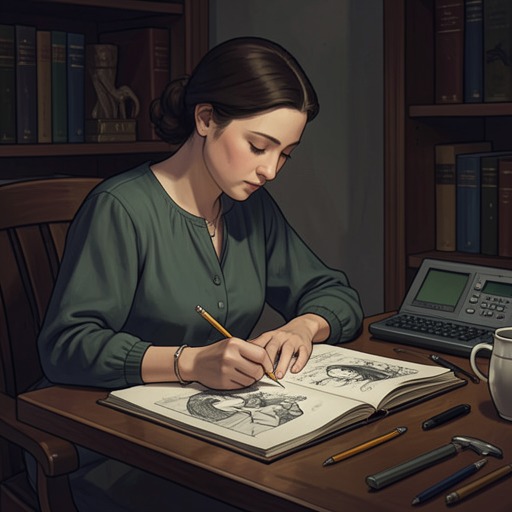
During a visit to Maori’s room, Tooru notices a sketchbook on her desk beside a pencil, sharpener, and small utility knife. Though he knows it is wrong to look through it, curiosity about Maori leads him to open it. He finds several line drawings of people, then recognizes his own face. One picture recalls an expression he had made in a photograph; other sketches show him smiling faintly or looking away. A further drawing shows him from behind, pushing Maori on her bicycle in the library parking lot. These are not simply studies of an unknown subject: the poses connect the drawings to shared moments, including their bicycle rides.
The sketchbook gives Tooru a view of his place in Maori’s imagination that neither her binder nor her journal provides in the same form. The portraits register specific expressions and gestures, while their unfinished state suggests an ongoing practice rather than a single commemorative image. As Tooru turns the pages, he wonders how Maori sees him. The drawings thus make his presence tangible to him, even as their shy, indirect portrayals leave her feelings open to interpretation.
A Memory Unearthed
After recovering from amnesia, Maori resumes ordinary routines: she studies at prep school, makes friends, and sometimes draws at night for her own enjoyment. She had once taken drawing classes but had not been good enough to apply to art school; now drawing is a private pleasure. As the seasons change and the leaves begin to turn, a substantial cleaning of her room brings an unfamiliar sketchbook out from behind a bookshelf. It had been hidden rather than left among the materials she used openly.
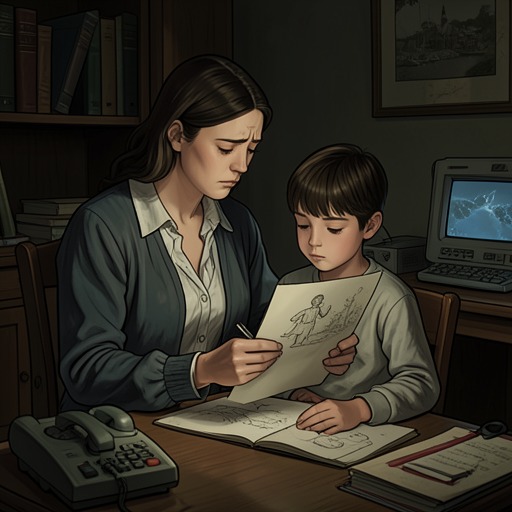
Inside, Maori finds drawings of a boy she does not recognize. The sight produces a sharp pain in her chest and a pounding heart before she can explain why. She recognizes the drawings as hers, made during the period of amnesia, but cannot remember making them or why she hid them. Their concealment prompts a possibility she immediately dismisses: perhaps she had liked the boy. She doubts that she could have fallen for someone while living with amnesia, and notes that even the men at prep school awaken no romantic interest in her. Yet her body reacts before her reasoning can settle the question. The boy appears weak but kind, and the old sketches repeatedly show him turned aside, smiling vaguely or shyly rather than facing forward. The unidentified face has become a clue her feelings can recognize before her conscious memory can.
Erasure and Preservation
After Tooru’s death, Izumi Wataya and Tooru’s sister alter Maori’s records in accordance with Tooru’s request that he be erased from her journal and binder. They also remove his traces from her phone and prepare replacement digital records. The sketchbook presents a more intimate problem: its drawings are not just references to Tooru but evidence of Maori’s own attachment. Izumi carefully tears out the pages depicting him and trims the ragged edges left behind, while keeping the removed pages in a folder. The act is deliberate, but it cannot make the drawings cease to exist; it transfers them from Maori’s books into the custody of someone who knows what they mean.
That intervention is complicated by a note found on the back of one of Maori’s wall reminders: “Even if I recover, always remember Tooru Kamiya. The important things will always be in an important place.” The note suggests Maori anticipated that she might regain her memory and wanted her future self to remember Tooru. Against the careful removal of his image from her records, the hidden message and retained sketchbook pages form competing acts of preservation: one conceals the past from her daily life, while the other keeps its traces available.
Drawing Tooru Again
At the cherry-blossom park, Izumi sees Maori absorbed in looking at the row of trees, a look she recognizes from Maori’s attempts to recall something. Izumi gives her the sketchbook. Maori takes a pencil and quickly begins drawing beneath the blossoms. The figure is Tooru, seated under a cherry tree on the day the three of them picnicked there, looking at Maori with tenderness in his eyes. Izumi understands that no video or photograph preserved that particular expression; the drawing could capture it because Maori had been there with him.
The new drawings differ from the earlier ones. In the sketchbook she found after her recovery, Tooru repeatedly looked away, smiling shyly or faintly. In these images, he appears as Maori remembers him, and his expression recurs across multiple versions. The shift is more than a change in likeness: the earlier images were made when she could not retain new memories, while the later portrait gives visible form to a memory she has recovered. The sketchbook’s journey—from desk, to hiding place, to deliberate removal, and finally back into Maori’s hands—turns drawing into a record of what photographs, messages, and edited journals could not secure. Maori’s hand restores Tooru to the page not as an entry supplied by someone else, but as the person she herself remembers.