Maori’s sketchpad
Even If This Love Disappears From the World TonightMaori’s sketchpad is a record of an ability that survives where conscious recollection fails. Its pages chart Maori’s return to drawing during summer vacation, preserve the gradual improvement enabled by practice, and become an intimate visual record of Tooru Kamiya: first a boy she scarcely recognizes, later the person she remembers and draws anew. The sketchpad therefore holds both evidence of continuity across her daily memory resets and the changing relationship between a person, her records, and what she can remember for herself.
A practice preserved in the pages
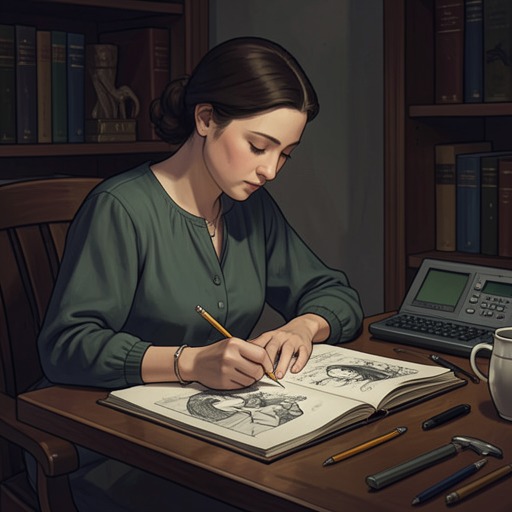
After an accident, Maori has anterograde amnesia: memories from each day are lost when she sleeps, while memories from before the accident remain. Her journal and binder help her reconstruct her circumstances each morning, but information in those records is not the same as remembering the day as her own experience. Drawing offers another kind of continuity. Maori had stopped making art when she entered high school to concentrate on studying, yet during summer vacation she begins drawing every day again.
The sketchpad on her desk contains a few dozen pages of drawings, including figure studies and a portrait of a teenage boy she barely recognizes. Although the visible improvement is modest, she can see that she is progressing slowly. A physical mark on her right middle finger—the callus left by years of holding a pen while studying—has begun to fade, but has not disappeared completely. The sketchpad’s new pages suggest a different use for her hand: drawing, rather than the study routine that once helped her enter the advanced class in her second year.
Practice and procedural memory
The idea that drawing might remain possible comes from a distinction Maori learns about memory. Anterograde amnesia prevents her from forming new long-term declarative memories, but does not erase everything she already knows or can do. When she and Tooru study together, they discuss procedural memory, the kind of learning that cannot simply be written down and includes knowing how to ride a bicycle. Maori’s past selves connect that bodily, practiced form of memory to drawing: if the skill is built through repeated action, it might continue to develop even when daily events do not remain accessible.
Tooru supports this return to art in practical ways. At the library, he looks through art books during breaks from studying, shows Maori selections, and summarizes techniques for her. He explains croquis, or rapid sketching, as a way to draw before deliberation takes over and to use the senses fully, particularly when drawing moving subjects. Maori records the advice on an Art page in her binder. The notes make the technique available to a future self, while the sketchpad gives that self somewhere to try it.
She practices croquis by pausing a foreign film at a scene she likes and using an actor as a model. Rather than concentrating on what she may have forgotten, she attends to the sensations of drawing and lets her hand work. The resulting lines are more confident than those in her first drawings. Comparing the pages makes practice visible: the skill belongs not to one remembered session but to repeated effort across days she cannot later recall. The sketchpad thus documents an accumulation that her autobiographical memory cannot hold in the usual way.
Tooru in photographs, notes, and drawings
The sketchpad’s portrait of Tooru is one part of a larger set of records identifying him as Maori’s boyfriend. Her binder tells her to read the section about him, and her phone contains a folder titled My Boyfriend filled with photographs and videos of Tooru. When she watches a video of them riding together, she can see how much fun the people in it are having, but feels a sadness that belongs to the present self watching an earlier self. The video gives her evidence of a past relationship without restoring that day as a lived memory.
The sketchpad likewise supplies an image she can inspect without fully recognizing the person it depicts. On finding the portrait, Maori understands from her records that the barely familiar boy is her boyfriend. Yet the drawing does not make her feel that she is the same person who made it. The difference between looking at an image and remembering the experience behind it is central to the object’s role: the pages can preserve traces of a life, but they cannot by themselves guarantee access to its emotional or autobiographical context.
Preservation, concealment, and recovery
After Tooru dies, Izumi and Keiko work to remove him from Maori’s records, following the request Tooru had made. They plan to edit the binder and journal, replace the phone, and transfer a revised digital record to Maori’s laptop. Izumi gathers the physical binder and the many journal volumes from Maori’s room and transfers the revised digital materials, including entries covering the days since Tooru’s death. The attempt to remove every trace from the written and digital record cannot account for the sketchpad that has been overlooked.
A note hidden on the back of one of Maori’s reminder slips instructs her to remember Tooru even if she recovers, and says that important things will always be in an important place. Izumi finds the message while replacing the notes with typed copies. She later discovers that Maori has kept a sketchbook she thought she had collected. When Maori asks who the boy in it is, Izumi conceals the truth, saying he was only someone Maori saw a couple of times at the library during high school. By then, Maori no longer has amnesia, and Izumi believes she could tell her the truth, but still hesitates over what would be best for her.
The route back to Tooru begins not with a visual record but with his voice. Maori worries that photographs and videos might replace the image of him she has formed for herself, and agrees instead to listen to audio Izumi extracts from a video. Hearing her own happy sounds in the recording helps her remember the bicycle ride on which it was made. Later, the smell of tea at the aquarium recalls an earlier occasion when Tooru had made the same tea, although the memory remains difficult to grasp. These partial returns establish that records and sensory cues can prompt recognition without making recovery immediate or complete.
At the cherry-blossom park, the sketchbook finally shows Tooru as Maori remembers him. Its drawings differ from the older sketches, in which he looks aside, frowns shyly, or smiles faintly. The new images repeatedly give him the same expression, rendered with a confidence that makes clear these are not merely copies of an earlier picture: they are drawings made from recovered memory. As Izumi watches Maori look toward the row of cherry trees, the sketchpad brings together the object’s two forms of continuity—practice retained through repetition and a personal past regained through remembrance.