No memory disappears completely
Even If This Love Disappears From the World Tonight“No memory disappears completely” is a recurring idea in the story and a promise that forgotten experience may endure in forms other than conscious recollection. Tooru Kamiya first offers it to Maori Hino during a summer fireworks date, when she fears that the day’s happiness will vanish with her daily memory reset. After Tooru’s death and Maori’s recovery from amnesia, the phrase’s meaning shifts: she chooses to seek the history she cannot remember, finding that a voice, a remembered saying, and the act of drawing can bring her closer to him without making grief the whole of her future.
The phrase in context
Maori’s anterograde amnesia prevents her from forming lasting memories of each day. She can retain experiences while awake, but after sleep those newly formed memories are erased, leaving her to begin each morning without them. She reads her binder and journal to reconstruct her recent life; the binder preserves selected important information, while her mother adjusts her schedule so Maori can read it each morning. These records can tell her what happened, but they cannot make her feel that she is the person who experienced it.
The difference becomes clear when Maori watches a video from a bicycle ride with Tooru. She can see herself laughing and enjoying the ride, yet the woman in the video feels separate from her present self. Her response is neither a simple recovery of the day nor a complete lack of feeling: she experiences a sadness resembling longing for the version of herself who lived it. Even so, she turns toward the present, thinking that she may have another joyful day with Tooru. Memory here is not treated as a single storehouse that is either full or empty; recorded facts, emotional responses, and the lived sense of being oneself do not return together.
Tooru’s reassurance
During the fireworks date, Maori becomes distressed by the thought that she will not remember the day. Tooru watches as she wipes away tears while holding his hand, and tells her, “I won’t forget this day.” She replies that she will not forget it either, while admitting that the intensity of her happiness has made her cry. Tooru squeezes her hand and offers the central reassurance: “It’s human nature to forget. But don’t worry. No memory disappears completely. I believe that.”
The words answer a fear grounded in the way Maori’s condition works. She suspects that Tooru may know about her amnesia and be acting as though he does not, but she cannot be sure. His kindness gives her a reason to believe she may have nothing to fear, even while the prospect of forgetting remains real. The moment therefore makes the phrase more than an abstract claim about memory: it becomes a promise offered within a relationship whose shared experiences Maori may not be able to retain.
What survives the daily reset
The story distinguishes conscious, reportable recollection from other kinds of persistence. Tooru researches amnesia and learns that it can prevent the formation of new long-term memories without erasing all earlier ones. He also considers procedural memory: the body’s retained ability to perform skills such as riding a bicycle, which cannot simply be replaced by a written account. The distinction helps explain why the daily loss of autobiographical memory does not mean that every capacity or trace of the past disappears.
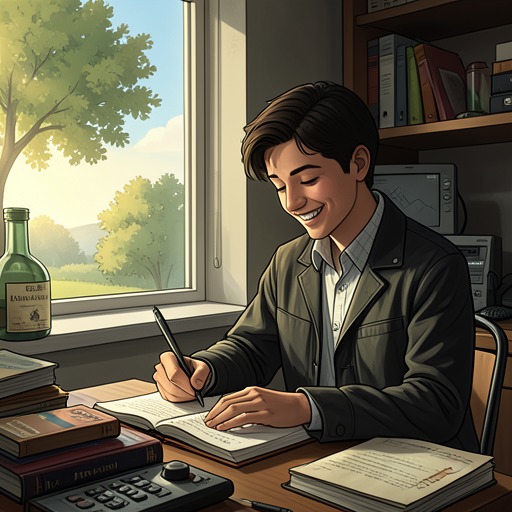
Drawing provides a particularly concrete example. Maori’s binder contains an art section, and she finds that she has been practicing croquis sketches in her sketchbook. When she draws from an actor in a film, she can focus on the sensations of sketching rather than consciously reason through each movement. Her lines are more confident than in her earlier pictures, and the drawing comes together with an ease she recognizes from junior high, when she drew every day. She understands the skill as something her previous selves have continued to build: a visible record of effort and growth carried through days she cannot later remember.
Other traces return through sound and smell, but neither works as a simple key that restores everything at once. After Tooru’s death, Maori hesitates to view photographs and videos because she fears that mediated images might replace whatever image of him she has already formed. At Izumi Wataya’s suggestion, she agrees instead to listen to audio extracted from a video. The file contains the sound of a bicycle ride and Maori’s own delighted cries; as she listens, she gradually recalls that she had insisted on riding together. The sound makes a fragment of their shared past accessible without resolving the whole history.
A smell also approaches memory without guaranteeing it. At the aquarium, Maori had recognized tea Tooru made, connecting its familiarity to an earlier visit to his home. Later, when the episode is recounted to her, the explanation that smell can evoke memories accompanies her attention to the tea, but recollection remains just out of reach. The image of a falling petal drifting aside becomes an expression of that near-recall: the clue comes close, yet does not immediately restore the person she wants to remember.
From reassurance to a choice
After Maori recovers from amnesia, Izumi believes there is no longer a need to hide the truth about Tooru. She thinks Maori may feel pain on learning about him but will eventually move through it. Nevertheless, when Maori asks about a drawing, Izumi describes Tooru as someone she saw a couple of times at the library during summer break in high school. Her answer reflects uncertainty about what will help Maori, and fear that the truth might complicate the life she is rebuilding. The discrepancy between what Izumi believes Maori can bear and what she actually tells her makes the later recovery of Tooru’s story a matter of choice as well as recollection.
When the truth is discussed, Tooru’s sister warns Maori against becoming a captive of the past or neglecting her own life. She also says that, if someone who loves Maori enters her life, Maori should love that person wholeheartedly and put Tooru behind her. Maori accepts the need to keep living, but she distinguishes moving forward from consenting to forget. She explains that if everyone else is gradually forgetting Tooru, she wants gradually to remember him and regain what is important to her. Her decision does not deny that remembering may hurt; it gives her a way to approach the loss on her own terms.
The statement that she is alive, and will remember one day, becomes a repeated declaration rather than a claim that recovery is already complete. When a familiar voice rises in her mind, she recognizes it as the voice of someone laughing and saying he would show tomorrow’s Maori a good time. She still cannot remember everything, but she insists that the important things are within her. The recovered phrase arrives first as an uncertain fragment; its force lies in Maori’s determination to keep looking, not in a sudden, total return of memory.
Remembering without being held by the past
Three years after Maori declares that she will remember, she is still trying. By then she is in her fourth year of university and uses her journal and Izumi’s stories to revisit the places she and Tooru went and repeat things they did together. The process is not as straightforward as the earlier tea-associated recollection: returning to a place or reenacting an activity does not automatically restore a memory. Nevertheless, she persists, and little by little she remembers him. The interval matters because the story presents recovery as gradual work rather than a single revelation.
Drawing eventually joins those records and recollections as a way of sustaining the connection. At the cherry-blossom park, Maori sketches Tooru and says that she has remembered something else but is sure she has not remembered everything. She describes her memories as sleeping in her body and heart, and remembering him as a way they can continue to live together. Her words connect emotional persistence with the bodily traces and creative practice that have survived the gaps in conscious recall. The drawing does not make Tooru present again; it gives Maori a form in which to encounter what remains.
The phrase’s final significance is therefore not that loss can be reversed or that every memory must return intact. Maori acknowledges that she loved Tooru and that he is gone, while also imagining a future in which she will reach for happiness and fall in love again. Tears and warmth coexist as she continues drawing. “No memory disappears completely” comes to name a continuing bond: remembering can honor a lost relationship without requiring a life organized solely around it. The story’s final image of the world drawn by the heart makes that persistence an act of creation as well as recovery.