Pretend relationship
Even If This Love Disappears From the World TonightThe pretend relationship between Maori Hino and Tooru Kamiya is a carefully bounded arrangement that becomes emotionally real without losing sight of the limits imposed by Hino’s anterograde amnesia. Its three rules begin as protection against intimacy and accumulated history; Tooru’s willingness to honor them, even after falling in love, turns the arrangement into a form of care. The fiction is not simply a disguise for dating: it gives Hino a way to choose something new while she knows that her memory may not carry it forward.
Rules and Rationale
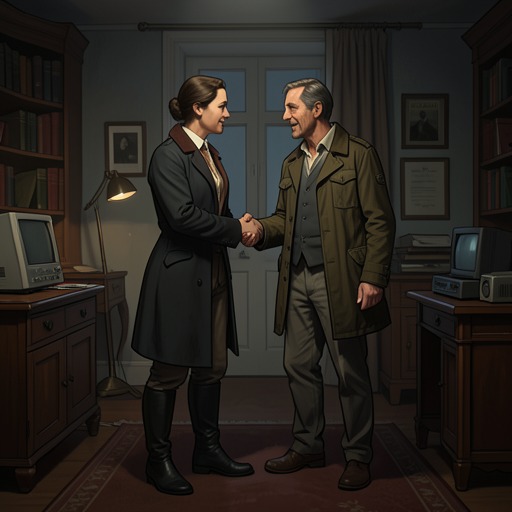
Hino proposes the terms after Tooru stops her in a hallway after class, asks her to go behind the school, and confesses that he likes her. Her notes say that the confession seemed forced rather than an expression of genuine feeling. Ordinarily she would have rejected him, but she decides to use the unexpected opening to try something new despite her memory loss. The relationship begins, then, not with certainty about Tooru but with Hino’s decision to act rather than let each day pass without building anything.
Her conditions are specific: they must not talk until after school, keep contact brief, and not fall in love. Hino explains their practical purpose in light of her daily routine. She needs time at school to read her notes and organize her thoughts; a flood of messages would take time she cannot spare, and references to past events could leave her in trouble. The limits on conversation make room for the work of reorienting herself each day.
The prohibition on love has a different weight. Hino expects that her circumstances will eventually end the relationship, and does not want either of them to develop feelings that would make that ending more painful. She calls the arrangement a fake relationship, but the rules are not playful conditions detached from her illness: they are an attempt to control the emotional and practical risks of a future she cannot reliably remember.
Tooru accepts the proposal by distinguishing the arrangement from what people ordinarily mean by boyfriend and girlfriend. He suggests that the rules make them more like a fake couple, since they are not allowed to fall in love. Hino agrees, adding that they will have to tell other people they are dating for real so that Izumi Wataya will not worry; she has not told Wataya about the conditions. The pair therefore maintains two versions of the relationship: a private agreement with strict limits and a public account that sounds ordinary.
Living Inside the Arrangement
Hino’s written records help make the arrangement navigable. When she reviews Tooru’s profile, it includes not only personal details such as his birthday, family structure, blood type, and favorite author, but also compact descriptions of his personality. One note calls him a “Downfallen aristocrat”; another records his emphasis on sanitation and explains that cleanliness can be faked, but sanitation cannot. These details give Hino material from which to approach a boy she barely remembers seeing before. Photographs and videos on her phone show them close together like a typical couple, while her notes supply the timeline that her memory cannot provide.
The relationship consequently depends on a division between remembered experience and recorded information. Hino can learn from her notes that she and Tooru have been together, but the written timeline does not itself make the past feel familiar. The brief-contact rule and the records work alongside one another: one keeps the present manageable, while the other lets her reconstruct enough context to decide how to meet it.
For Tooru, the arrangement changes as his own feelings deepen. After he recognizes that he has fallen in love with Hino, he tells her that he has broken the rules, but he does not ask her to abandon them. Instead, he offers to pretend he has not noticed her illness and says that she can forget she told him if the disclosure makes her uneasy. He understands that knowledge of her condition could itself become a burden: she had not intended to tell him, and he does not want his feelings or awareness to force her into a different relationship than the one she chose.
When Hino questions whether this leaves her with the advantage, Tooru explains that his life before meeting her had been boring and that spending time with her matters more to him than being recognized as a real boyfriend. His response preserves the arrangement’s terms at the cost of concealing his emotional change. He has crossed the rule against falling in love, but tries not to make that breach Hino’s responsibility.
Care Beyond Romance
The relationship is also set beside Wataya’s friendship with Hino. Wataya tells Hino that she does only what she can and what she wants to do, answering Hino’s apology for having drawn her into the difficulties of memory loss. Hino’s gratitude reflects how deliberately Wataya has chosen to help: she is not easily drawn into closeness, but once she admits someone into her world, she is exceptionally kind. The support around Hino is therefore presented as chosen effort rather than effortless obligation.
Tooru describes his own approach in similar terms. He says that he does not attempt the impossible, but is glad to do something that takes a little extra effort or that he wants to do. Hino hears this as a description of someone who pushes himself for her, and later asks Wataya whether she helps Hino because she cares. Wataya admits that her reasons may be partly selfish and that Hino’s unusual circumstances interest her, but also acknowledges how deeply she cares and how powerless she sometimes feels. Tooru answers that this cannot be the whole story. The exchange complicates any simple division between pure self-sacrifice and self-interest: the people helping Hino can have their own reasons and limits while still caring for her.
That care has concrete consequences. Hino’s notes and journal explain that her parents’ and Wataya’s devotion and self-sacrifice enabled her to graduate from high school and attend art classes several times a week, a pursuit she had given up before the accident. Her relationship with Tooru belongs to this wider network of support, but its distinctive feature is his effort to be present without claiming that affection gives him the right to override her conditions.
Meaning and Afterlife of the Rules
The pretend relationship’s central contradiction is that its rules are meant to prevent emotional attachment, yet respecting them becomes one of Tooru’s most intimate acts. He does not ask Hino to remember him, reciprocate his feelings, or convert their public label into a private promise. Even after his feelings make the “fake boyfriend” description inadequate for him, he offers continued companionship on Hino’s terms. The arrangement makes tenderness visible through restraint: what he does not demand matters as much as what he gives.
The rules also sit within a story where written records carry what personal memory cannot. Hino’s daily rereading of notes and journals lets her learn her own recent history, while her procedural memory—the physical knowledge retained through sensation—helps her develop as an artist. In that setting, the relationship cannot rely on the usual assumption that shared days will accumulate into a stable private past. Its conditions recognize this fragility rather than pretending it away.
The arrangement’s ethical tension returns after Tooru’s death. Wataya and Tooru’s sister discuss his request that he be erased from Hino’s journal if he dies. His sister insists that there is no certain answer: keeping him in the journal might cause Hino pain, while erasing him might help her but leave the others with guilty consciences. She believes that Wataya must decide because Tooru entrusted the choice to her, and offers to support her decision. The discussion makes the question of care more difficult than simply preserving or withholding a relationship’s record; either choice has consequences for Hino and for those who act on her behalf.
At that point, Wataya leaves without deciding and goes to Hino’s home. She imagines the next morning, when Hino would wake to learn again that she has amnesia and that she had a boyfriend who died, with only her journal preserving happier days. The pretend relationship thus opens onto the book’s larger conflict between protecting someone from pain and allowing her to live with the truth of what mattered. Its original boundaries cannot resolve that later choice, but they establish the principle at stake: Hino’s vulnerability calls for care, not for assuming that others may decide her life without cost.