Sanae Kamiya
Even If This Love Disappears From the World TonightSanae Kamiya is Tooru Kamiya’s older sister and the novelist who publishes under the pen name Keiko Nishikawa. Her career moves from a secret kept within the family to public recognition with the Akutagawa Prize; her return home then helps reopen a strained relationship with her father. Later, after Tooru’s sudden death, she uses her skill with words to revise Maori Hino’s journal and binder, intervening in the record of a life shaped by memory loss. Across these roles, Sanae’s writing is at once a path toward self-understanding and a practical means of caring for others.
Identity and Writing
Sanae’s literary identity first comes into view publicly when Keiko Nishikawa is announced as the winner of the Akutagawa Prize for Dregs. Tooru’s father recognizes her in the press-conference photograph, but Tooru already knows that Nishikawa is Sanae’s pen name and that she began writing novels long before the award. The gap between public author and private daughter matters: her success is not a sudden reinvention, but the arrival of a hidden part of her life into the family’s shared view.
Sanae explains that she began writing in close proximity to her father, watching him write novels. At first, she wrote to escape reality, as he had; eventually, she came to understand writing differently, as a way to grow and encounter new words and ideas. Her account sets artistic ambition apart from flight. Writing begins as refuge, but becomes a practice through which she can meet herself rather than simply evade her circumstances.
Recognition and Return Home
When Tooru’s father learns that Keiko Nishikawa has won the prize, he asks Tooru whether he knew the novelist was Sanae. Tooru confirms that the family had kept her identity as a writer secret from him. The conversation marks a turn in the household: the father’s knowledge of Sanae’s success leads him to reflect on the separation between them, while the recognition of her achievement makes renewed contact possible.
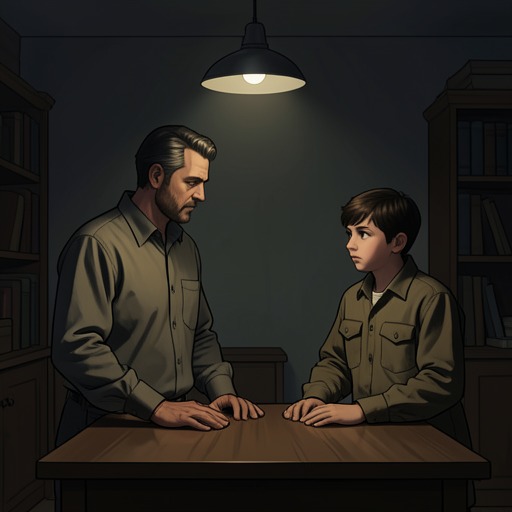
About ten days after the award announcement, Sanae visits home. Her arrival follows a second phone call that has left her father in high spirits. Since his conversation with Tooru, he has begun helping with household chores: he tries cooking, makes mistakes, and tries again with Tooru’s help. On the morning of Sanae’s visit, he has been cleaning and is eager to prepare dinner. The changes are modest and domestic, but they give the reunion a visible form: reconciliation begins not with a grand declaration, but with renewed participation in ordinary work.
Her father tells Sanae that he is taking a break from writing, not as an escape, but until he can face himself in his work again. He also offers her books from his collection, including first editions. Sanae answers by telling him what his example gave her. She credits watching him write with starting her own literary life, while distinguishing the purpose she eventually found in writing from its earlier use as escape. Her father is visibly moved; she then lightens the mood by agreeing that the house has too many books and asking to take some. The exchange joins affection, artistic inheritance, and the everyday business of making room for a relationship to resume.
Family and Care
Sanae’s connection to Tooru is both familial and consequential. She is the sister whose literary success prompts their father’s recognition and whose return gives the family a chance to act differently toward one another. Their homecoming is not presented as a complete resolution of the past; instead, the visit shows the first concrete changes around it, especially their father’s willingness to help at home and to speak about his writing honestly.
Sanae’s relation to Maori is formed through Tooru and becomes important after his death. When Izumi goes with Maori to meet Tooru’s family, Sanae welcomes them into the kitchen where Tooru and his friends had often shared tea. She tells them that Tooru’s body is at the hospital while preparations are made for the wake and funeral, and recounts the events leading to his death. Her presence connects Maori’s personal loss with the family and history she had not yet encountered directly.
Editing the Record
After Tooru’s death, Izumi faces a painful choice: Tooru had asked her to erase him from Maori’s journal and binder, but removing him might cause Maori suffering, while leaving the records intact might expose her to repeated grief. Sanae does not claim that one outcome is certainly right. She recognizes that either choice may hurt someone and tells Izumi that Tooru entrusted the decision to her. Sanae offers to help if Izumi chooses to proceed, explaining that she can transfer the records to a computer and repair the passages where Tooru is removed.
Sanae then does more than delete a name. She stays up through the night typing the contents of Maori’s binder and diary into her laptop and substitutes Izumi for Tooru, adjusting related details so the revised account reads smoothly. For instance, she changes the account of Maori and Izumi’s third year of high school to say that they were in the same class, consistent with the previous year, and adapts references to other people. Her intervention is careful, skilled, and ethically unsettled: she helps carry out Tooru’s request, but the resulting record also changes the story Maori can read about her own life.
The act links Sanae’s authorship to the novel’s concern with written memory. In the records she edits, daily experiences have been preserved for a person who could not reliably remember them; after Tooru’s death, those same documents become material that others may copy, alter, and curate. Sanae’s fluency makes that alteration possible, but it does not remove its cost. While Izumi checks the rewritten account, Sanae goes to Tooru’s room to lie down and sobs where she cannot be seen. Her composure as an editor does not mean she is untouched by what she is changing.
Narrative Significance
Sanae’s story repeatedly turns on the difference between hiding and shaping a truth. Her pen name once concealed her identity as a novelist from her father; the prize makes that concealed identity visible and helps bring the family together. Later, she participates in rewriting Maori’s records, where concealment is intended to spare pain but risks erasing an important relationship. These actions are not equivalent, but together they show how words can protect, disclose, or revise a life, depending on who controls them and what consequences follow.
Her role also complicates the idea of writing as purely personal expression. The practice that began for Sanae as escape became a means of growth, and her command of language later becomes a form of labor on behalf of Izumi and Maori. Yet the rewritten journal cannot make Tooru’s absence harmless, just as Sanae’s father cannot repair a family history through good intentions alone. Her significance lies in working within that uncertainty: she offers her ability and support without pretending that either words or care can guarantee an undamaged outcome.