Shimokawa reports bullying and extortion to the school
Even If This Love Disappears From the World TonightShimokawa reports the bullying and extortion he has endured to the school, turning a private pattern of coercion into a matter teachers can address. His decision is an act of belated self-protection, but also of protection for other students: he tells the counselor he fears the bully might target them after Shimokawa leaves. The disclosure reveals both the extent of the harassment and the unexpectedly generous concern that makes Shimokawa an irreplaceable friend to Tooru Kamiya.
Background and Decision
The report follows repeated demands for money. The bully admits that Shimokawa recorded one of the second or third incidents, a detail that punctures his dismissive image of Shimokawa as passive. The recording gives the school a concrete account of the harassment, while the bully’s dry, resigned manner suggests he understands that the situation has changed.
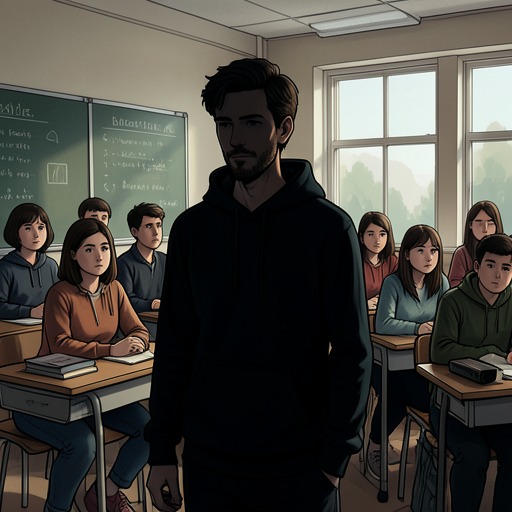
Shimokawa’s mother had come to school the previous day to complete his transfer paperwork. Afterward, Shimokawa stayed behind to speak with the homeroom teacher and guidance counselor. He had delayed telling anyone because he was embarrassed about being picked on; later, he explains that he thought his own appearance and intelligence might be reasons he remained a target. His decision to speak up is therefore a break with the shame that had kept him silent, made especially urgent by his impending departure.
The Report and Its Motive
The bully recounts what Shimokawa told the counselor: he did not care what happened to him, but was worried that, after he left, the bully might take money from Tooru or other students. He had made up his mind to report the extortion for their sake. The account leaves Tooru stunned: he had not known Shimokawa cared so much about him.
The disclosure also corrects the impression that Shimokawa’s quietness means indifference or weakness. He had recorded the harassment, waited until he could bring the matter to school staff, and considered what might happen to other students once he was gone. The report is at once a response to what had been done to him and an intervention on behalf of people who could otherwise have faced the same pressure.
Consequences for the Bully
The school’s warning is followed by restitution. On the day Shimokawa is leaving for a new school overseas, he tells Tooru that the bully came to return the money after Shimokawa spoke to the teachers. Although Shimokawa had told him that the cash came from his New Year’s money and was not needed, the bully insisted on paying it back. He had gathered the money from a part-time job and borrowed some from his brother.
Shimokawa also reports that the bully’s friends abandoned him and that he was now alone in class. He does not present this as a satisfying punishment. Although he says it was time for him to be brave, he worries that he has caused the bully trouble and recognizes the effect the report has had on him. Tooru is struck by Shimokawa’s reluctance to say that the bully deserved what happened. The aftermath thus refuses an easy reversal in which speaking up makes Shimokawa indifferent to the person he reported.
Friendship and Significance
The report changes Tooru’s understanding of Shimokawa. He had known him for only a short time, yet now sees him as an important, irreplaceable friend. That recognition arrives on the day they meet near the station where Shimokawa can catch the express train to his overseas school. Tooru had wanted to see him off at the airport, but Shimokawa felt bad about making him spend the train fare and suggested the nearer meeting instead. The modest farewell setting sharpens the sense of a friendship that has become important quickly, just as it is about to be interrupted by Shimokawa’s move.
The episode’s consequences extend beyond the immediate school response. Shimokawa’s report helps return the extorted money and exposes how fear and embarrassment had prolonged the harassment; his concern for the bully, meanwhile, complicates the moral aftermath without undoing the need to report. For Tooru, the decisive result is personal as well as practical: he sees that courage can coexist with compassion, and that a friend’s quiet attention may become clearest at the moment of parting.