International Confederation of Wizards
Fantastic Beasts and Where to Find ThemThe International Confederation of Wizards is the international body responsible for coordinating wizarding secrecy across national boundaries and holding wizarding governments to account when magical creatures become visible to Muggles. Its work on concealment joins deliberation to enforcement: the 1692 summit addressed which creatures could be hidden and how, while Clause 73 later imposed a continuing duty on each wizarding governing body to conceal, care for, and control the magical creatures within its community. The arrangement is international in authority but local in execution, and it depends on both negotiated participation and practical measures on the ground.
International debate and the 1692 summit
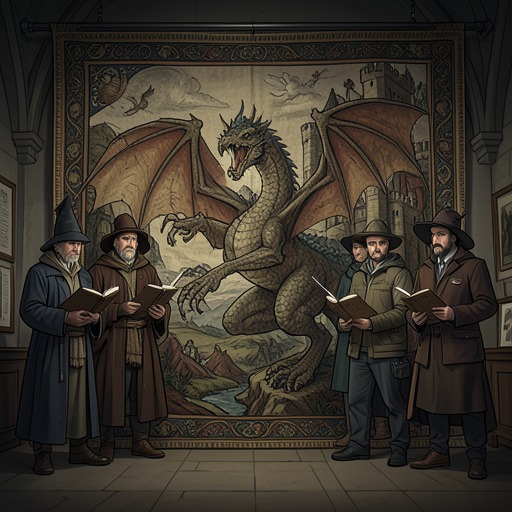
The Confederation argued over the fate of magical creatures at its famous summit of 1692. The issue was not simply how to hide individual animals: delegates confronted the larger question of how many species could be kept from Muggle notice, which species to conceal, and where and by what means to do so. The debate lasted seven weeks and could become acrimonious. Its stakes reached beyond administrative convenience, since the chosen policy was meant to make creatures appear never to have existed except in human imagination.
The summit was not a discussion among wizards alone. Delegations of centaurs, merpeople, and goblins were persuaded to attend, even as the Confederation’s deliberations bore on the status and future of magical peoples and creatures. The result was not universal agreement: an accompanying account notes that the goblins did not accept the final arrangement. The episode therefore presents international policy as negotiated but not unanimously endorsed, with participation no guarantee of consent.
At last the summit agreed that twenty-seven species, ranging in size from dragons to Bundimuns, should be hidden from Muggles. That decision established a collective concealment programme on a defined scale. The number grew over the following century as wizards became more confident in their methods, indicating that the policy’s reach expanded alongside the perceived effectiveness of concealment.
Clause 73 and the division of responsibility
In 1750, Clause 73 was inserted into the International Code of Wizarding Secrecy, to which wizarding ministries worldwide conform. It assigns each wizarding governing body responsibility for the concealment, care, and control of all magical beasts, beings, and spirits dwelling within its community. The clause thus gives the secrecy regime an international framework while placing the day-to-day obligation on national authorities: the Confederation sets the standard, and local governing bodies must administer it.
The rule’s scope is broader than concealment alone. By coupling concealment with care and control, Clause 73 treats the presence of magical creatures as an ongoing administrative responsibility, not merely a problem to be solved after a Muggle sighting. Its subjects include beasts, beings, and spirits, and its jurisdiction is framed around the community in which they dwell. The broad assignment of responsibility leaves implementation to wizarding governments, but it also makes their conduct answerable to the Confederation.
Enforcement and breaches of secrecy
The Confederation’s authority has consequences when national practice falls short. Since Clause 73 was introduced, breaches have occurred occasionally, and the Confederation has repeatedly fined certain nations for contravening it. Tibet and Scotland are identified as persistent offenders. Fines give the international obligation a formal means of enforcement, but the repeated penalties also show that a binding rule does not eliminate the conditions that produce violations.
Some breaches create sustained rather than momentary problems. Muggle sightings of the yeti became numerous enough that the Confederation stationed an International Task Force permanently in the mountains. The response moves beyond sanction after the fact: it commits personnel to a continuing effort in a location where sightings threaten secrecy. Meanwhile, the world’s largest kelpie continued to evade capture in Loch Ness, offering a contrasting case in which concealment and control remained unresolved despite the authorities’ efforts.
The Confederation’s measures belong to a wider system of administration. At the Ministry of Magic, conspicuous magical creatures generate work for the Department for the Regulation and Control of Magical Creatures, the Ministry’s second-largest department. Habitat protections, controls on the sale and breeding of creatures, and the 1965 Ban on Experimental Breeding form part of the practical machinery surrounding secrecy and creature management. When a Muggle does see something they should not, memory charms may be used, and trained Obliviators can be sent in; the Office of Misinformation handles the worst collisions, sometimes working with the Muggle prime minister to produce a plausible non-magical explanation. The Confederation’s international rules therefore depend on domestic institutions and measures that range from routine regulation to emergency repair.
Authority, autonomy, and the limits of control
International secrecy policy exists alongside claims by magical peoples to govern themselves. Centaurs objected to being granted the same “being” status as creatures such as hags and vampires, and declared that they would manage their affairs separately from wizards. The merpeople made the same request a year later. The Ministry of Magic reluctantly accepted both demands. These negotiations reveal a limit to any simple account of creature governance: categorization and administration do not automatically confer legitimate authority over those being classified.
The centaur case makes that limit visible in bureaucratic practice. A Centaur Liaison Office exists within the Beast Division of the Department for the Regulation and Control of Magical Creatures, but no centaur has ever used it. Among Department staff, being sent to the Centaur Office became an in-joke meaning that someone was about to be fired. The contrast between an official office and its complete non-use turns an institutional provision into an emblem of failed engagement: a channel exists on paper, but the centaurs’ insistence on self-management leaves it without the people it is meant to serve.
The Confederation’s significance lies in the scale and limits of the system it helps maintain. It can convene international debate, set a common obligation through Clause 73, fine governments, and organize a permanent response to recurring exposure. Yet implementation remains dependent on national departments, concealment practices, and the cooperation—or resistance—of the beings subject to magical administration. The resulting regime seeks to make magical life invisible to Muggles, but its history shows that neither rules nor offices can fully settle the questions of enforcement, consent, and control.