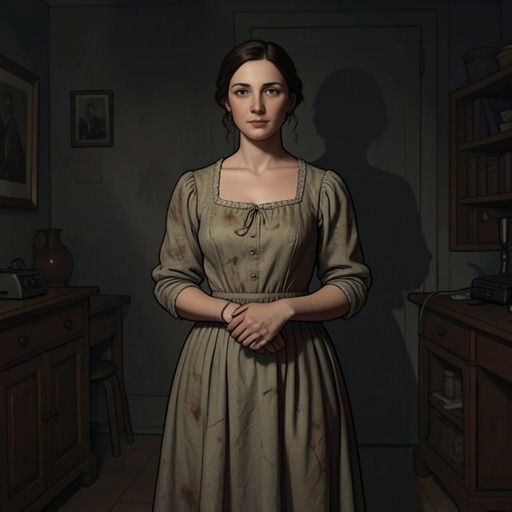
Bathsheba and Troy’s troubled marriage
Far from the Madding CrowdBathsheba and Troy’s troubled marriage turns Bathsheba’s self-governing life at Weatherbury Upper Farm into a relationship marked by unequal commitment and diminishing security. She enters marriage with an independent farming identity and deep devotion to her husband, while Troy’s financial risks and emotional allegiance to Fanny Robin reveal that the marriage does not command the same loyalty from him. The break becomes explicit when Troy rejects Bathsheba beside Fanny’s body, leaving her to flee and face an uncertain future alone.
From farm mistress to wife
Bathsheba’s authority at the farm is established before the marriage transforms her domestic and financial circumstances. At a meeting with the farm workers, she announces that the thieving bailiff has been dismissed and that she will manage the business herself. She promises to serve the workers fairly if they serve her well, and insists that being a woman does not prevent her from understanding the difference between good and bad conduct. Her confidence rests on practical responsibility as well as personal independence: she keeps the time-book, distributes wages, and intends to be in the fields before the men have risen.
That authority is not merely a public pose. During sheep-shearing, Bathsheba watches the workers to prevent careless cuts and ensure that the sheep are shorn closely; she also checks that each animal is marked with her initials. Gabriel Oak supervises and tends the work, while Bathsheba scrutinizes it and manages its standards. Her attention to labor and livestock demonstrates a working competence that the marriage will put at risk rather than simply erase.
Before marrying Troy, Bathsheba weighs a different prospect: Boldwood’s offer. She recognizes that he is respected, prosperous, close by, and in many ways a suitable husband, and she esteems him. But she does not love him or want marriage for its own sake. The contrast helps define what follows: Bathsheba does not choose Troy because she has abandoned independence as an ideal, but because an intense attachment leads her to marry despite the reservations that her judgment can identify.
Shared farm life and unequal stakes
The marriage initially places Troy in the position of ruling at the farm, although Bathsheba’s financial resources remain exposed to his decisions. In late summer, while Bathsheba’s experience as a married woman is still new, Troy arranges a harvest supper and dance at Weatherbury Upper Farm. Gabriel Oak notices the threatening weather and warns that the harvest ricks need protection. Troy dismisses the warning, and the party instead becomes a public wedding celebration. When Troy proposes serving the workers more drink, Bathsheba tries to stop him, arguing that they have already had enough. He overrides her objection and sends the women and children away so the men can continue drinking. The episode makes the change in authority visible: Bathsheba is present as mistress, but Troy can direct the gathering and disregard her judgment.
The later consequences of that imbalance emerge on the road back from market. Troy has bought his discharge with Bathsheba’s money and is trying to turn himself into a modern farmer, but his attention is also fixed on horse-racing. He recounts a race near Budmouth in terrible weather and admits losing more than a hundred pounds in a month. Bathsheba fears that his use of her money will force them to leave the farm. She asks him not to attend the next meeting; he refuses to promise and makes light of her distress. Her anxiety is practical as well as emotional: their household’s financial stability and the continuation of her farming life depend in part on choices she cannot control.
Bathsheba’s marriage therefore unsettles the relationship between ownership, work, and authority that she had established as an unmarried farm mistress. Before the marriage, she personally supervises agricultural work and makes decisions for herself. Afterward, Troy’s spending exposes her resources to risk, while his behavior at the harvest gathering shows that her objections may not prevail within the household. The evidence does not describe a formal transfer of the farm, but it does show Bathsheba fearing that her husband’s conduct could end their tenancy and bring poverty.
The exposure of Troy’s attachment to Fanny
Troy’s request for twenty pounds intensifies Bathsheba’s concern. She assumes the money is for the races and pleads with him to give up that pleasure, recalling that he had once said he would relinquish his other pleasures for her. Her appeal is intimate and conciliatory, but it does not produce the reassurance she seeks. Troy says that he needs the money for something else and initially avoids explaining what.
In the course of their conversation, Bathsheba sees him open his watch and glimpse a small coil of hair kept inside. He first claims that the hair is hers, then admits it belongs to a young woman he had intended to marry before meeting Bathsheba. He identifies the woman as alive and unmarried, and the conversation establishes that their recent encounter reminded him of the lock. Troy dismisses his earlier reference to other ties as a joke, but his evasions deepen rather than settle Bathsheba’s suspicions. The keepsake makes his previous relationship materially present in their home, while his refusal to treat Bathsheba’s questions seriously turns her demand for honesty into another occasion for hurt.
Bathsheba tells Troy that she once loved him so deeply she would have died for him, and that she feels humiliated when he mocks her for having married him. She asks him to burn the hair, but he does not agree. As he leaves, she recognizes how far her pride and confidence have fallen: she had once valued her independence and felt no need to make marriage the measure of her life. Now, she feels that she has placed herself in the power of a husband whose devotion is uncertain. Her grief does not cancel the earlier independence; it makes the loss of its security newly legible.
Fanny’s return and the break
The concealed attachment becomes an immediate crisis when Bathsheba and Troy confront Fanny Robin’s body. Troy’s response to Fanny is remorseful and reverent: he kneels and kisses her. Bathsheba, watching, reacts from the force of her own attachment and asks Troy to kiss her as well, saying that she loves him more than Fanny did. The appeal reveals how completely she still wants affirmation from him, even after the painful discoveries that have undermined her confidence.
Troy refuses her and declares that Fanny means more to him than Bathsheba does. He calls himself a bad man, then denies that the ceremony before a priest makes Bathsheba morally his wife. The exchange turns the marriage’s central inequality into an explicit repudiation: Bathsheba understands herself as Troy’s wife, but he denies that her claim has moral force and places his dead former beloved above her. Bathsheba cries out in despair and leaves immediately. Her flight is the decisive rupture in the relationship, not a resolution of it.
Absence, uncertainty, and narrative significance
After Troy’s departure, Bathsheba’s first response is neither dramatic hope nor a clear plan for escape. His absence grows from hours to days, producing a slight surprise and a slight relief, but not enough to overcome her sense that her alternatives have narrowed. She expects him to return and assumes that their tenancy of the Upper Farm may then end. The estate’s agent had initially questioned her suitability as James Everdene’s successor because of her sex, youth, and beauty, although her uncle’s will, testimony of her farming ability, and successful management of livestock won confidence. Bathsheba now worries about the legal effect of her marriage on that position. The forthcoming January rent-day becomes a concrete measure of her vulnerability: if she or Troy cannot meet the agent, little consideration will be shown, and leaving the farm would bring poverty.
The marriage’s trouble is thus more than a contrast between a devoted wife and a wayward husband. It presses on Bathsheba’s practical independence, since the farm is at once her work, her standing, and the basis of her livelihood. Her early claim that she will manage with her own head and hands stands against later uncertainty about whether she can retain her place after marriage. That tension is sharpened by the difference between her stewardship of workers and animals and Troy’s spending and disregard of her judgment.
The relationship also links emotional betrayal to the story’s recurring agricultural world. At shearing, Bathsheba watches the work closely, while Gabriel supervises the skilled handling of the sheep; at the harvest gathering, Gabriel reads signs of storm and tries to protect the ricks, while Troy rejects his warning. These scenes set practical attention and responsibility against Troy’s self-assurance. Bathsheba’s marriage does not remove her from the farm’s realities, but it places her in a household where her judgment can be overruled even as she remains answerable to the farm’s risks. When the bond finally breaks beside Fanny, Bathsheba is left with both private grief and public uncertainty about the home and livelihood she had once governed independently.