Bathsheba sends "I will marry you" Valentine's Day card
Far from the Madding CrowdBathsheba’s Valentine to Boldwood begins as a playful, nearly arbitrary gesture and becomes, in Boldwood’s mind, a serious invitation to marriage. Its red seal and brief words acquire a gravity their sender never intended: a trivial choice enters the ordered life of a reserved farmer and opens the way to an ideal passion. The episode’s decisive force lies in that gap between the card’s casual origin and the meaning Boldwood gives it.
The Card’s Accidental Address
Bathsheba has bought an ornate Valentine in Casterbridge, with a blank oval space for a personal message. At first she says the card is for Teddy Coggan, a child to whom she has promised a surprise. Liddy suggests sending it instead to Boldwood, who has attracted notice by not looking toward Bathsheba in church. She is faintly unsettled by the thought that the parish’s most dignified and valuable farmer withholds the admiration she expects, but she is not seriously distressed by his indifference.
The idea of addressing the card to Boldwood amuses Bathsheba because she imagines that it would disturb his solemnity. She briefly considers the effect, then rejects Liddy’s suggestion on the ground that he would not see the humour. When she admits that she does not particularly care to send it to Teddy either, she proposes deciding by chance. She and Liddy use a hymn-book rather than toss a coin; Bathsheba assigns one side to Boldwood and the other to Teddy, and the book falls on the side that makes Boldwood the recipient. The choice is not a considered declaration but the outcome of a lighthearted game.
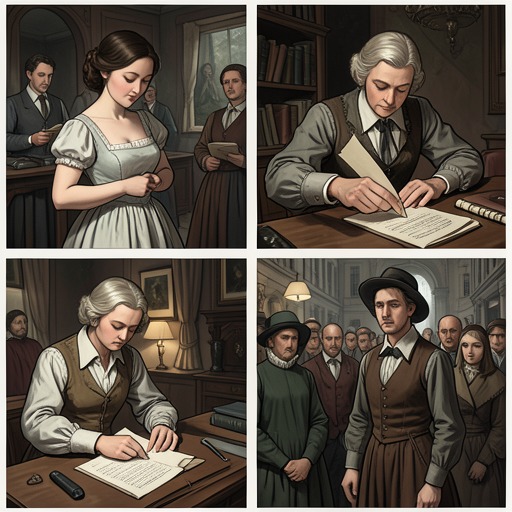
Bathsheba writes a conventional verse in the blank space, seals the card with a large red seal, and addresses it to Boldwood. She chooses a motto seal without first reading its words. Only after the wax has been applied does she discover the message, “MARRY ME.” She finds this an entertaining addition to the prank and sends the Valentine that evening. It returns to Weatherbury the following morning, but its return does not prevent Boldwood from taking its message to heart.
Boldwood’s Reading of the Message
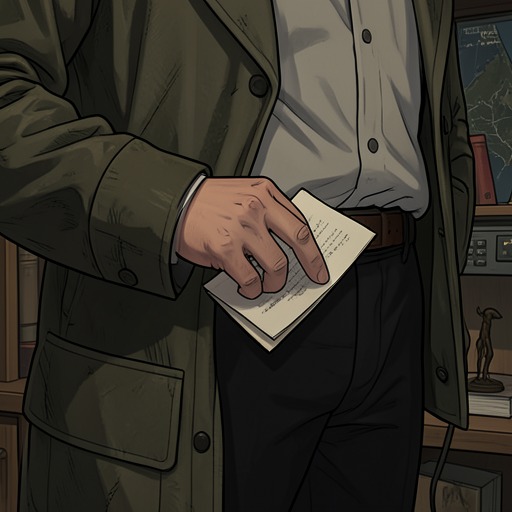
The narrative shifts from Bathsheba’s casual decision to Boldwood’s private response. On the evening of St. Valentine’s Day, the card rests on the wings of a spread eagle above his mantelpiece. Its red seal holds his attention until it seems like a mark of blood against his vision. Though he cannot clearly read the writing from where he sits, he imagines its words as “MARRY ME.” In the grave quiet of his house, the impersonal seal and its command seem to belong to a deliberate courtship rather than a joke.
Boldwood assumes the message must have had a substantial motive because he cannot imagine how slight its real origin was. Its arrival begins to unsettle the established pattern of his life: he regards it as the first indication of an ideal passion. The letter’s central mystery for him is not simply what it says, but who sent it and why. He imagines a woman’s hand forming his name and invents an unseen woman behind the writing, although the sender is Bathsheba, asleep and unaware of the romantic significance he assigns to her act.
At night he puts the Valentine beside his looking-glass, then rises to examine it again. He searches the envelope for an additional message, finds nothing, and returns the card to its place. The seal remains the focus of his attention. He says its words aloud, sees his own unsettled expression in the mirror, and recognizes his nervous excitement without understanding its cause. The episode thus presents the card not as a mutual exchange but as a prompt for Boldwood’s imagination: Bathsheba’s name and intentions remain absent from the scene, while the imagined sender grows vivid in his mind.
Misunderstanding and Consequence
The same physical message therefore carries two opposed meanings. For Bathsheba, it is an idle amusement whose destination was settled by a tossed hymn-book; for Boldwood, it appears to be evidence that a woman has deliberately chosen him. The card does not disclose its actual circumstances to its recipient, and Boldwood does not consider that a jest or chance might explain it. His serious disposition supplies the gravity the sender did not intend.
The consequence is more than a momentary surprise. Boldwood’s fixation makes the Valentine an initiating cause of his growing attachment to Bathsheba, while the reader knows that she had neither planned nor understood such an outcome. The return of the card to Weatherbury the next morning gives the gesture a physical afterlife, but its essential continuation is psychological: Boldwood keeps revisiting its message and imagining the person who wrote to him. The episode makes chance consequential by showing how a small act, misread through desire and expectation, can redirect a relationship.
Narrative Significance
The scene is structured around unequal knowledge. Bathsheba’s actions are shown first, including the coinless game, the accidental choice, and her amusement at the seal. Boldwood’s response then reveals how completely he lacks that context. The shift from her brisk, playful perspective to his prolonged scrutiny transforms the same card without changing a word on it. The reader sees both its origin and its effect; Boldwood sees only the effect and mistakes it for intention.
The Valentine also marks a distinction between love as a spectacle and love as a lived relation. Bathsheba can handle the conventions of a romantic message as entertainment, while Boldwood receives the card as a personal promise. Neither the printed sentiment nor the sealed paper makes their understanding mutual. The episode’s irony lies in its disproportion: an act Bathsheba barely takes seriously becomes, for Boldwood, the beginning of an emotional disturbance with lasting consequences.