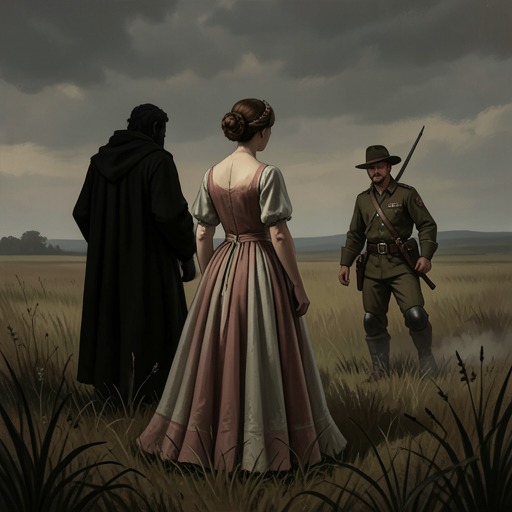
Bathsheba’s first encounter with Sergeant Troy
Far from the Madding CrowdBathsheba’s first encounter with Sergeant Troy occurs during her nightly inspection of the farm, in a dark fir plantation just outside her home. An accidental snag of his spur in her skirt turns a routine walk into a private conversation in which Troy’s gallantry and praise unsettle her; by the end, she is reconsidering her initial displeasure. The meeting makes flattery an immediate force in the novel’s romantic plot and places Troy’s forceful attentions against Gabriel Oak’s largely unrecognized constancy.
Causes and Setting
Bathsheba has taken on the work of inspecting the homestead before bed since dispensing with a bailiff. Gabriel commonly makes the rounds ahead of her, keeping watch over her affairs without receiving much acknowledgment for his care. Bathsheba usually carries a dark lantern, less because she expects danger than because she is checking practical matters such as the animals’ bedding and whether doors have been secured.
On this night, her return path runs through a young fir plantation planted to shelter the premises from the north wind. Its closely interwoven branches make the route unusually dark, and Bathsheba considers that stretch the most difficult part of her nightly walk. Hearing someone approach, she moves quietly and tells herself that the path is public and the stranger probably a villager. The setting thus makes an ordinary meeting seem threatening before the lantern reveals who has come near her.
The Encounter
As the approaching figure passes, something catches Bathsheba’s skirt and holds it fast. The obstacle is Sergeant Troy’s spur, wound into the decorative cords of her dress. The two try to free the entanglement; when Troy opens Bathsheba’s lantern, its light reveals his scarlet-and-brass uniform and the cause of her predicament. The sudden sight of a soldier replaces her expectation of a sinister stranger with surprise.
The release takes time, giving Troy room to address Bathsheba directly. He compliments her beauty, and she replies stiffly that she did not intend to show herself to him. When she objects to his conduct, he continues in a playful, self-assured manner, at one point offering to cut the dress if she is in a hurry. Bathsheba is vexed and suspects that he has made the knot worse deliberately, but she cannot simply leave without risking damage to the dress she had put on for the supper. The practical inconvenience keeps her in the exchange even as she resists its flirtatious direction.
Once the cords are finally unwound, Troy introduces himself as Sergeant Troy and says he is staying in the place. Bathsheba withdraws without answering his farewell, then runs indoors. The episode’s immediate turn is not a declaration or an agreement, but a shift from a routine inspection to an encounter that leaves his attention occupying her thoughts.
Bathsheba’s Response and Troy’s Reputation
Bathsheba goes to Liddy Smallbury’s room to ask whether a soldier is staying in the village. Liddy thinks it may be Troy, home on furlough after the regiment had been at Casterbridge. She describes him as an attractive, lively man, the son of a doctor, and repeats extravagant reports about his education and supposed natural nobility while admitting that at least one of those stories is hearsay. Her account gives Bathsheba a social portrait of the stranger, but not a reliable measure of his character.
Alone in her room, Bathsheba reconsiders the encounter. She had first felt that Troy had insulted her, but his handsome appearance and praise make that judgment less certain. She reproaches herself for leaving so abruptly and decides that his manner may have been civil and kind. The narrator identifies the importance of the compliment: Boldwood has never told her that she is beautiful. Troy’s attention therefore answers a desire that the more constant Boldwood has not addressed, even though the attention itself does not establish trust or affection.
Place in the Plot and Character Contrast
The first meeting follows the sheep-shearing, where Bathsheba watches the work closely and Gabriel serves as general supervisor, attending to the shearers and selecting sheep for them. During one pause, Bathsheba watches Gabriel’s skilful work and praises the speed with which he finishes a sheep. He is content simply to share her attention, while her conversation fills the silence. The contrast prepares the ground for the plantation scene: Gabriel’s devotion is steady and largely unspoken; Troy’s presence becomes vivid through direct praise and teasing.
Troy’s later conduct in Weatherbury gives the encounter its broader significance. The narrator presents him as a fluent, highly educated man who can speak persuasively, and observes that he regards flattery as a means of influencing women. A week or two after the shearing, he appears in Bathsheba’s hayfield and joins the workers voluntarily, making his scarlet uniform visible among them before approaching her. His attentions thus continue beyond the chance meeting and take place amid the farm’s working life, where Bathsheba is both its mistress and a public presence.
The encounter is a turning point in attention rather than a settled relationship: Bathsheba’s first displeasure gives way to uncertainty, then to a more receptive reading of Troy’s praise. Its importance lies in how readily a small, accidental circumstance creates intimacy, and how differently that intimacy feels from Gabriel’s patient service. The novel’s later sheep fair chapter, titled “THE SHEEP FAIR -- TROY TOUCHES HIS WIFE'S HAND,” marks the further development of the connection first opened here.