Bathsheba’s grief and withdrawal after Troy’s death
Far from the Madding CrowdBathsheba’s grief and withdrawal after Troy’s death begin in the immediate aftermath of Boldwood shooting her husband and persist through a prolonged period of illness, seclusion, and estrangement from ordinary life. She can act with startling composure in the crisis itself, but that self-command gives way once the practical demands end; recovery comes gradually, and the loss leaves her newly conscious of her dependence on Gabriel Oak and the possibility of losing him too.
Crisis and the collapse after it
When Gabriel Oak enters the room after the shooting, he finds Bathsheba seated beside Troy, holding his hand and supporting his head. She asks Oak to ride for a surgeon, while plainly stating that she believes medical help will be useless and identifying Boldwood as the person who shot her husband. The other guests are bewildered, but Bathsheba’s simple account helps restore order to a room still shaken by the event.
The composure is practical rather than an absence of grief. In the emergency, necessity brings her back to action: she arranges the response and takes responsibility while others hesitate. The narrative presents this as a capacity to do what she considers necessary, not as proof that she is untouched by Troy’s death. Once the immediate crisis passes, her strength does not hold.
After Troy’s body is brought home, Bathsheba asks the men to leave her alone with him. She has Liddy Smallbury prepare a bath, then sends her away to rest, and keeps the room closed to everyone else. For more than an hour she moves about inside, coming out once to ask for additional candles. When Oak, the parson, and the surgeon arrive, she opens the room and says the work is done. Troy has been undressed and laid out in grave clothes, and the room is orderly. The doctor’s subdued acknowledgment confirms that Bathsheba has managed the task herself.
Only when she has finished does her control fail. Bathsheba silently collapses among the men, and they take her to another room; unlike the medical attention that could not save Troy, care is now needed for her, as she suffers a serious-seeming series of fainting fits. That night, Liddy keeps watch and hears Bathsheba whispering that Troy’s death is her fault and that she does not know how she can go on living. Her guilt enters the narrative not as a public declaration but as a private refrain heard through the long night.
Seclusion and gradual return
The period following the shooting is marked by low fever and profound exhaustion. Bathsheba revives with spring, as uncertainty about the circumstances of her life gives way to an end of uncertainty on every subject. Yet improvement in health does not at once restore her to company or work. She spends most of her time alone in the house, or at most in the garden, avoids even Liddy, and offers neither confidences nor requests for sympathy.
As summer advances, she spends more time outdoors and begins to attend to farming matters from necessity. The change is limited: she no longer rides out or personally supervises the farm as she once did. Her return to the village is delayed until a Friday evening in August, the first time she has gone there since the preceding Christmas. Her pale face and black dress make her continuing mourning visible, while her movement back into public space remains tentative.
At the churchyard, Bathsheba goes to the corner where Troy had planted flowers on Fanny Robin’s grave. She reads the inscription on the marble stone: Troy’s memorial to Fanny remains, with a new inscription recording that Troy’s remains lie in the same grave. The shared grave joins the two deaths in a single place, and Bathsheba’s visit brings her into contact with the consequences of Troy’s earlier life as well as with his own death. She then listens outside the church to children rehearsing a hymn. The words of “Lead, Kindly Light” stir feelings she had assumed dead; she allows herself to cry, and a tear falls on the stone bench. The scene marks an emotional opening after months in which she has refused sympathy and kept others at a distance.
Loss, guilt, and the fear of abandonment
Bathsheba’s return to feeling does not mean that grief has become simple or complete. During the autumn she remains lonely, and her attention turns increasingly toward Oak’s apparent withdrawal. She learns that he intends to leave England the following spring, with California in mind, and that he will finish his year managing Boldwood’s farm for the trustees but will not renew his position with her. His explanation is that he feels bound to go because of her helplessness, a choice that she hears as a further loss rather than as an offer of help.
The practical consequences of Oak’s decision deepen her distress. Since Troy’s death, Oak has attended sales and fairs for her and handled business alongside his own. As she becomes less able to manage the farm independently, she fears she may not regain the energy to bargain and sell. But the injury she feels is not only a matter of work: she comes to believe that Oak, the old friend who had supported her when others opposed her, has tired of her too.
For three weeks, she watches for signs of his distance. Instead of coming into the small parlour or farm office as he had done during her seclusion, he enters only when she is unlikely to be there. He sends messages or unsigned notes when he needs instructions, and she replies in the same impersonal manner. These small changes acquire an outsized meaning for Bathsheba: she experiences them as evidence that she is despised and that Oak is withdrawing his affection. Her grief over Troy is thus joined by a painful sense of social and emotional rejection.
Christmas Day completes a year of her legal widowhood, but it is Oak’s behavior, not the memory of the shooting at Boldwood’s house, that dominates her thoughts. Hearing his voice in church, she hopes he will wait for her as he once did. He comes down the path behind her, looks aside when she turns, and takes an opportunity to leave by another way. The next morning, his formal letter tells her that he will not renew his engagement with her for the following Lady Day. Bathsheba weeps over it, feeling that the hopeless love she had come to regard as permanently hers has been withdrawn at Oak’s own discretion.
The altered meaning of Oak’s companionship
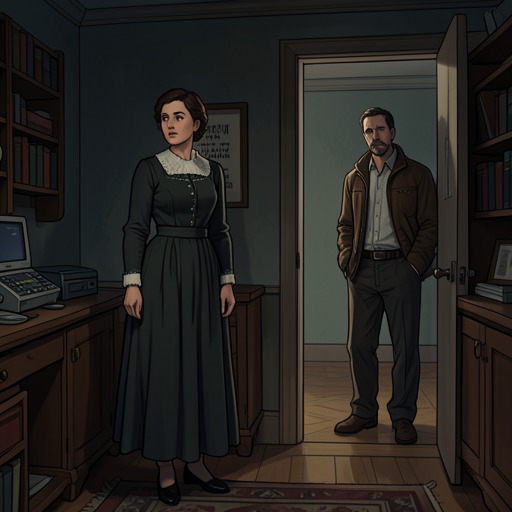
The letter brings Bathsheba’s isolation to a head. She feels that she has outlived the only true friendship she ever possessed, and that her life is becoming desolate. After sunset, she puts on her bonnet and cloak and goes to Oak’s house, guided by the light of a crescent moon. Her visit is prompted by a need for pity and sympathy, but she hesitates at the propriety of a single woman calling on a bachelor who lives alone, even though he is her manager and she might have business to discuss.
When Oak opens the door, Bathsheba tells him that she will not be his mistress much longer. The exchange exposes how grief has changed the weight she gives their relationship: the man whose loyalty she once treated as assured has become someone whose departure she fears. Across the episode, she moves from caring for Troy’s body alone to refusing all company, then slowly re-entering the world through the churchyard and village. By the time she seeks Oak, the loss of her husband has not merely left her bereaved; it has made companionship and practical support newly visible as things she may lose. The account therefore presents recovery not as a sudden return to her former confidence, but as a gradual and uneven recognition of loneliness, dependence, and the value of a friendship she had taken for granted.