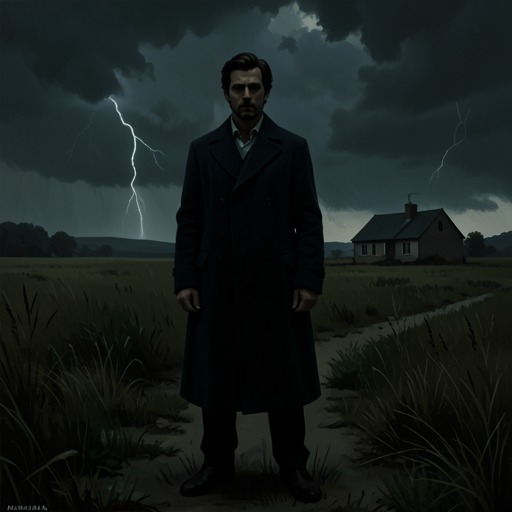
Boldwood’s obsessive emotional crisis
Far from the Madding CrowdBoldwood’s obsessive emotional crisis is the collapse of a reserved farmer’s self-command under his fixation on Bathsheba. Her love for Troy becomes, in Boldwood’s mind, a theft of the future he believes he nearly possessed; wounded pride, public shame, and jealousy then fuse into threats against Troy and despair about himself. The crisis is marked not only by violent outbursts but by a reversal of his usual reserve, culminating in neglected farm work and a confession whose candor he immediately tries to retract.
From disappointment to humiliation
Boldwood’s distress sharpens when he confronts Bathsheba about her attachment to Troy. He insists that before Troy appeared she had been inclined to accept him, and she admits that this is true. He interprets the change not as her choice but as Troy’s robbery of his happiness. His language shifts from lost affection to lost social standing: he believes people sneer at him, that the hills and sky seem to laugh, and that his good name and position are gone. He imagines retreating somewhere alone to hide and pray, while also anticipating the humiliating story others will tell about a miserable man undone by love.
The public dimension makes the rejection especially painful to him. Boldwood says he would have preferred a secret jilting that left his position intact; instead, he feels exposed without having gained the woman he wanted. His shame turns outward into accusation. He calls Bathsheba’s attraction to Troy a folly, then demands that she deny Troy has kissed her. She refuses to deny it and says, defiantly, that she is not ashamed to tell the truth. Boldwood’s anguish is therefore bound to a sharp contrast: he had wished merely to touch her hand, while Troy has kissed her and claimed her affection.
Jealousy and the threat of violence
Bathsheba’s frank declaration that she truly loves Troy intensifies Boldwood’s fixation. He curses Troy and imagines making him suffer as he himself suffers, then abruptly shifts from fury to apology, calling Bathsheba a lost coquette and blaming Troy’s lies for winning her heart. The oscillation does not restore control. He says he hopes Troy will stay away because, if they meet, he may be tempted beyond himself; he also threatens to horsewhip him. The scene makes Boldwood’s danger concrete: his grief has become an anticipated physical confrontation, while Bathsheba knows Troy is expected back in Weatherbury within days, contrary to Boldwood’s belief that he has returned to his distant barracks.
That conflict becomes physical when Boldwood learns that Troy has secretly come to meet Bathsheba. From concealment, Boldwood hears Bathsheba greet Troy tenderly and explain that she has sent everyone away so his visit will remain unknown. When Troy says he means to give her up and cannot marry her, Boldwood stops him to plead further. Troy then admits that he prefers Fanny and that Boldwood’s offer of money has influenced his choice. Boldwood suddenly grips Troy by the neck and threatens to kill him. Troy counters that killing him would ruin Bathsheba, and Boldwood loosens his hold. The abrupt release reveals the conflict operating within the crisis: even in the grip of jealousy, Boldwood can be redirected by the claim that violence would harm the woman he loves.
Exposure and the failed bargain
Boldwood tries to persuade Troy to marry Bathsheba, arguing that she is wealthy and would make a good wife; Troy answers that she has a will and temper, whereas he believes he could do what he liked with Fanny. Boldwood implores him not to desert Fanny, but Troy has already made the choice that leaves Boldwood’s attempted intervention powerless. Later, Troy shows him a newspaper paragraph announcing that Francis Troy has married Bathsheba at St. Ambrose’s Church in Bath on the seventeenth of the month. The printed notice makes the marriage indisputable, where hope and hearsay had left room for uncertainty.
Troy also exposes the attempted transaction behind Boldwood’s despair. He recalls fifty pounds offered to marry Fanny and twenty-one pounds offered not to marry her but to marry Bathsheba, then announces that he is already Bathsheba’s husband. He rejects the idea that a woman’s marriage or misery should be bought and sold, says Fanny has long since left him, and rebukes Boldwood for treating scant apparent evidence as proof of Bathsheba’s dishonour. Boldwood refuses to take the money back. Troy wraps the gold in the notes and throws the packet into the road; Boldwood clenches his fist and vows revenge. The discarded money becomes the physical remainder of a plan that cannot purchase either Troy’s choice or Bathsheba’s affection.
Grief in the ordinary world
The crisis also appears in what Boldwood fails to do. Gabriel finds that Boldwood has forgotten to have his ricks covered: the large ones on stone staddles, those under the hedge, and the little one by the stile remain exposed. Gabriel realizes that Boldwood’s lapse is more severe than the farm emergency he has been laboring to repair. For a farmer ordinarily defined by close attention to husbandry, overlooking the harvest is a visible measure of how far private suffering has displaced routine judgment.
When Gabriel tells him that things have gone wrong, Boldwood admits that the plan by which he expected to settle his life has come to nothing. He says people may regard him as a joke, then clarifies that Bathsheba never promised to marry him and that there was no engagement, despite what people say. This distinction complicates the story of his humiliation: his suffering is intense, but the social narrative of a broken engagement is not accurate. He describes himself as weak and unable to fend off his grief, and compares his lost hope to a gourd that first gave shade and was then withered by a worm. He even says he feels it would be better to die than live.
Yet the confidence is brief. Boldwood falls back into his familiar reserve, minimizes the significance of the attachment, and asks Gabriel not to repeat what has passed between them. His claims that the affair was made much of by other people and that no woman had power over him for long sit uneasily beside his neglected ricks, his earlier threats, and his declared grief. That contradiction gives the crisis its lasting shape: Boldwood can name his suffering only in a sudden disclosure, then tries to deny its force, while the consequences have already entered his conduct and his farm.