Companionship and friendship in love
Far from the Madding CrowdCompanionship and friendship in love names the mature form of intimacy that develops between Gabriel Oak and Bathsheba Everdene. The novel presents it as something other than infatuation or the pursuit of possession: it grows through years of practical association, mutual knowledge, and dependable care. Its decisive scene is not a grand declaration but an awkward conversation in Gabriel’s home, where a misunderstanding about his departure gives way to Bathsheba’s recognition of the affection already sustained between them.
From shared work to familiarity
Bathsheba first encounters Gabriel’s loyalty within the public and practical business of the farm. When she takes charge of the men’s wages, she announces that she has dismissed the bailiff for theft and will manage the farm herself, “with my own head and hands.” She also asks after Fanny Robin, whose disappearance troubles the household. In announcing that the men now have a mistress in place of a master, Bathsheba promises to serve them fairly if they serve her well. This early picture of her authority matters to the later relationship: Gabriel’s connection to her is formed in a world of labor, responsibility, and shared decisions, not in a secluded romance detached from daily life.
That intimacy is repeatedly tested in work settings where affection is present but cannot be openly claimed. At the sheep-washing, Bathsheba senses Boldwood’s love and withdraws along the river; Gabriel and the farm workers continue the labor nearby. Later, as Gabriel shears sheep, Boldwood speaks privately with Bathsheba and helps her over the spreading-board. Gabriel watches, distracted enough to cut a sheep, while Bathsheba’s embarrassment and Boldwood’s attentions remain visible but their conversation does not. Such scenes place Gabriel’s care in a pattern of restraint: he is deeply concerned, yet he does not treat proximity or feeling as a right to intrude.
At the shearing, Gabriel’s skill and attention are concrete parts of the life the two share. He completes a ewe in twenty-three and a half minutes, and Bathsheba times him. His quiet happiness at her presence is interrupted when Boldwood arrives; Bathsheba leaves with Boldwood, while Gabriel continues shearing, constrained and sad. The scene makes their affection inseparable from the farm’s ordinary work, while showing that companionship is not effortless or immediately reciprocal. Gabriel’s devotion must coexist with Bathsheba’s uncertainty and with the other claims on her attention.
Misunderstanding and recognition
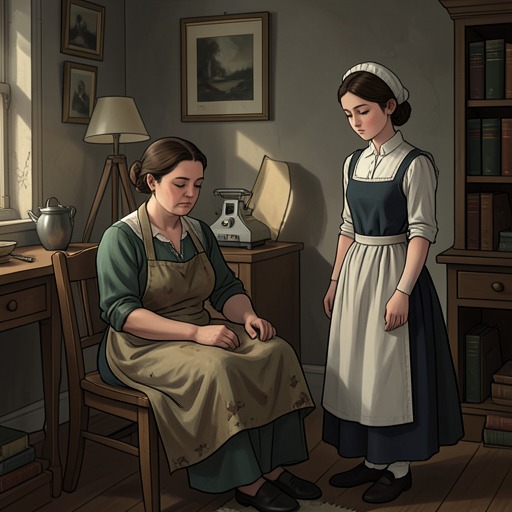
After Troy’s death, Bathsheba’s position is precarious. She has become uncertain about her future at the Upper Farm, and fears that she may soon lose the tenancy and face poverty. Gabriel has attended sales and fairs for her, managing her business alongside his own, but now plans to take Little Weatherbury Farm into his hands at Lady Day. His departure seems to Bathsheba to mean that he is withdrawing from her personally. Lonely and distressed, she visits his home after sunset, unsure whether it is proper for a single woman to call on a bachelor, even though he is her manager.
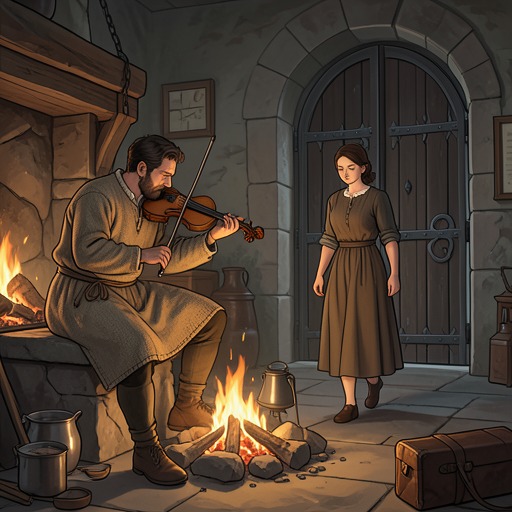
The meeting begins with the awkwardness of a changed setting. Although they know each other well in the fields and at her house, they are constrained when Gabriel becomes the host and offers her his plain chairs. Bathsheba asks whether she has offended him and whether that is why he is going away. Gabriel assures her that she could not offend him, then explains the actual reason: people have spoken as though he were waiting for Boldwood’s farm in order to marry her. He had feared that the gossip might damage her good name. His withdrawal, then, is not indifference but an attempt to protect her reputation while maintaining a difficult professional boundary.
Bathsheba’s response turns the misunderstanding into recognition. She is relieved that Gabriel’s decision was not a rejection, and her emotion becomes clear when she insists that she had said it was “too soon” to think of marrying, not that the prospect was absurd. Gabriel asks whether she would allow him to love and win her; she tells him that he will never know unless he asks. Their exchange is intimate precisely because it is not perfectly polished. A mistaken emphasis, an explanation, and a request replace the dramatic certainty of a conventional declaration.
A bond tested by loss
The value of companionship is clarified by contrast with Bathsheba’s earlier romantic entanglements. She once considers Boldwood’s proposal through the claims of reason and obligation: he is respectable, prosperous, and a suitable husband, yet she does not want him. She feels that, having begun the game, she ought honestly to accept its consequences, while also knowing that she cannot bring herself to marry him. Her conflicted response shows how obligation and attraction can pull apart; the later bond with Gabriel is not founded on the idea that a woman must repay a man’s love by marrying him.
Troy’s presence also contrasts with Gabriel’s steadiness. At the harvest revel, while storm threatens the farm’s ricks, Gabriel tries to warn Troy about the coming rain. Troy dismisses the warning and carries on with the celebration, then announces that he has married Bathsheba and proposes an additional carouse. Bathsheba asks him not to give the men more drink, but he sends the women and children away and threatens the men’s winter employment if they refuse to stay. Gabriel leaves rather than join the revel. The scene shows how marital status and public display can coexist with disregard for Bathsheba’s judgment and the practical needs of the farm. Gabriel’s care, by contrast, is repeatedly expressed through attention to those needs, even when his warnings are ignored.
After Troy’s sudden return and death at Boldwood’s Christmas gathering, Bathsheba’s grief and isolation deepen. When Gabriel enters the room, she is beside Troy’s body and immediately asks him to ride for a surgeon, though she believes it useless; she also tells him plainly that Boldwood has shot her husband. Gabriel responds at once. Later, however, the relationship does not advance through a rescue or spectacle. Bathsheba goes to Gabriel because she fears she has offended him and because she cannot bear the thought of losing the one true friendship she believes she has had. Her visit reveals that, beneath the crises of marriage and bereavement, his companionship has remained a dependable part of her life.
Work, friendship, and durable love
The narrator’s account of their relationship makes shared experience its defining condition. Gabriel and Bathsheba first encounter one another through the rougher sides of character and learn the best of one another later. Their affection grows “in the interstices of a mass of hard prosaic reality”: business, farm labor, setbacks, and the ordinary obligations through which their lives have long been entangled. Unlike relationships organized only around pleasure, theirs is strengthened by the work they have done and the conditions they have endured together.
The term “CAMARADERIE” gathers this distinction into a single idea. It does not erase romantic feeling; it describes the friendship that gives that feeling a durable foundation. The novel contrasts this attachment with passion that may intensify emotion while diminishing judgment, and with idealized love that knows its object only incompletely. Gabriel and Bathsheba’s familiarity has accumulated through practical service and mutual correction, through his continued management of her affairs and her confidence in his counsel. The eventual possibility of marriage follows from that lived knowledge rather than substituting for it.
The relationship’s significance lies in its chronology as much as in its declaration. Gabriel’s love precedes Bathsheba’s recognition, but the story does not treat persistence alone as a claim upon her. She approaches him of her own accord; he explains his conduct, and she answers his question with a clear invitation to ask. Their movement toward one another is therefore grounded in renewed understanding and reciprocal choice. In the novel’s closing conception of love, friendship is not a lesser prelude to romance but the form of intimacy most capable of lasting: affection made credible by companionship, and companionship deepened into love.