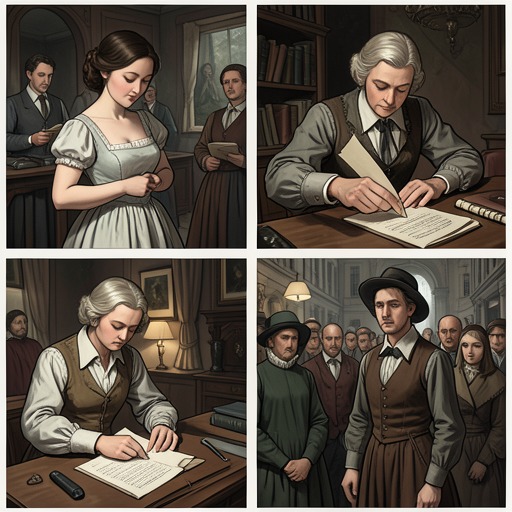
Conflict between impulse and reason
Far from the Madding CrowdConflict between impulse and reason is a central tension in Bathsheba Everdene’s character. She can perceive the sensible or ethically responsible course with considerable clarity, yet when feeling becomes personally involved, impulse can outrun judgment and turn an idea into action. Her dealings with Boldwood and her love for Sergeant Troy show two forms of that conflict: the difficulty of accepting a reasonable match she does not desire, and the danger of surrendering discernment to a passion whose object she sees imperfectly.
The Valentine and the consequences of a small act
Bathsheba’s conflict with Boldwood begins in a misjudgment that neither fully intends. Having sent him a valentine, she has unwittingly given him grounds to imagine that she is inviting marriage. Boldwood mistakes what circumstances suggest for what Bathsheba deliberately meant to initiate; she, in turn, has not adequately considered how a playful or thoughtless act might acquire serious meaning for someone who has never before looked upon a woman with the concentrated force of his attention. His new attachment alters his settled life, while she initially experiences his gaze as a flattering triumph.
That pleasure does not remain uncomplicated. Bathsheba knows that Boldwood’s attention has been prompted by her own act, and she regrets having disturbed a man whom she respects merely to test her influence over him. She considers apologizing at their next meeting, but can see that an apology might itself be misconstrued: he could take it for mockery, or as further evidence that she is encouraging him. Her reasoning identifies the trap, but only after the impulsive act has created it. She is therefore caught between acknowledging responsibility and fearing that any attempt to repair matters will deepen the misunderstanding.
Boldwood: judgment without desire
Boldwood’s proposal makes the difference between a sound argument and a genuine wish explicit. Bathsheba recognizes that he is an earnest, prosperous, respected neighbor, close at hand and, by the standards of her community, an exceptionally desirable husband. She esteems and likes him. She can also understand why marriage to him would seem prudent for a lonely young woman. Yet none of those advantages produces the desire to marry him.
Her position as absolute mistress of her farm and house further shapes the decision. That independence is new, and its appeal has not worn off; she has not yet developed an abstract wish for marriage that would make Boldwood’s offer an obvious choice. At the same time, she feels an unusual moral unease: because she began the misunderstanding, she thinks she ought honestly to accept its consequences. Thus obligation, calculation, respect, and personal reluctance all press upon her at once. She can say that refusing him would be ungenerous and that she could not marry him, revealing not simple indecision but a conflict between what her reasoning calls fair and what her feelings will permit.
The narrative describes Bathsheba as impulsive beneath a deliberative manner. Her thoughts can take the form of persuasive logical arguments, but they often remain thoughts; the less rational assumptions, by contrast, are the ones most likely to become deeds. That distinction explains why her intelligence does not reliably protect her from error. She may understand the consequences of a choice in principle and still act on a momentary inclination before that understanding governs her conduct.
Love for Troy and the surrender of self-command
Bathsheba’s attachment to Troy brings the conflict into sharper focus. Her love is described as wholehearted and fresh, but the force of feeling does not make her judgment more reliable. She is accustomed to independence, yet in love she abandons the self-reliance that had helped define her. The novelty of the experience matters: she has had little practice in managing this kind of emotional condition, and her unfamiliarity makes her weakness more acute rather than less consequential.
She is not portrayed as consciously acting with guile. Rather, her impulses seem to her more pleasant guides than discretion, and she does not carefully examine the moral and practical implications of her feelings. This failure of inquiry is the point at which the conflict becomes more than an abstract contrast between head and heart: Bathsheba has the capacity to reason, but does not consistently bring that capacity to bear when desire is involved. She can advise others about a difficult course and fail to heed her own counsel.
The contrast between Troy and Gabriel Oak clarifies the risks of this misjudgment. Troy’s faults lie beneath the surface, while his attractive qualities are immediately visible; Oak’s shortcomings are plain, while his virtues are less readily recognized. Bathsheba’s preference is therefore shaped by what she can see most readily, not by a careful weighing of character. The result is a pointed distinction between love and respect: she has discussed her interest in Boldwood freely with Liddy, but has kept her feelings for Troy within herself. Her secrecy does not correct her judgment; it leaves the attachment less exposed to the examination and counsel that might have checked it.
Reason, responsibility, and the limits of foresight
The novel does not present impulse and reason as simple opposites in which one is always foolish and the other invariably sufficient. Bathsheba’s reasoning can identify real duties: she recognizes the responsibility implied by having started Boldwood’s hopes, and she understands the social and practical merits of his offer. But those insights do not settle what she ought to choose, since marrying without desire would answer one obligation by denying another truth about herself. Her independence also complicates the supposedly prudent solution: a marriage that others would consider desirable is not automatically necessary to a woman who already possesses authority over her own farm and household.
Her errors arise less from an inability to think than from the uneven authority of thought and feeling. Where her heart is not engaged, she can reason well; where love takes hold, she becomes susceptible to attractions she recognizes only partially and to impulses she does not carefully test. The contrast between Boldwood and Troy makes that pattern visible from opposite directions. Respect and practical judgment cannot manufacture desire for Boldwood, while desire for Troy cannot by itself establish that he deserves her trust.
The recurring conflict also gives small beginnings a weight beyond their apparent scale. Bathsheba’s valentine is not a marriage proposal in her intention, but Boldwood reads it as one, and her later concern about the consequences cannot restore the original simplicity of the gesture. In the same way, a feeling that begins as private attraction can alter how she sees character and how much she allows discretion to govern her. The subject’s significance lies in that widening gap: Bathsheba often understands a choice’s logic, but understanding alone cannot prevent an action when impulse has already taken command.