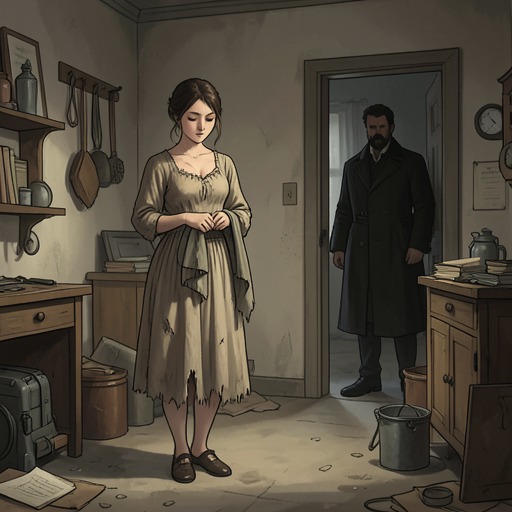
Fanny Robin and Sergeant Troy’s unresolved relationship and marriage promise
Far from the Madding CrowdFanny Robin and Sergeant Troy’s unresolved relationship and marriage promise turn on a sharp imbalance: Fanny treats marriage as a commitment to be carried out, while Troy admits he made the promise but postpones the steps that would make it real. Their interrupted meeting at the barracks gives that imbalance its clearest form, and the unfinished promise shadows Fanny’s absence and the later consequences of their relationship.
Background and Fanny’s Search
At Weatherbury, Fanny’s absence first appears as a practical mystery. Bathsheba learns that Fanny was seen leaving in her indoor working gown, apparently with a bundle but without a bonnet. Maryann adds that Fanny’s young man lives in Casterbridge and is believed to be a soldier, though Fanny had kept his identity private. Bathsheba sends men to make inquiries and, if Fanny does not return, to find the soldier at the barracks. The household knows enough to suspect a relationship, but not enough to understand its condition or the promise at its centre.
Fanny’s appearance at the barracks reveals what the household could not. On a snowy night, she identifies Sergeant Troy as the man she has come to see and calls herself his wife, though the scene makes clear that the relationship is not secure in the way that word implies. She has travelled from Weatherbury partly on foot and partly by carrier after asking which barrack window was his. Troy is surprised to see her and says he had not expected her to come.
The Promise and Its Deferrals
Fanny reminds Troy that he had told her to come, and asks whether he is glad to see her. He answers affirmatively, but when she asks him to come to her, he says the bugle has sounded, the gates are closed, and he has no leave. The immediate obstacle is real, yet the exchange leaves Fanny without the meeting she sought. She asks when they will be married; Troy initially feigns uncertainty about what she means, and she has to remind him of the promise.
Once Troy acknowledges that he will marry her if he said he would, Fanny tries to turn assurance into a plan. She asks whether they will marry by banns or licence. Troy says he supposes banns, and Fanny explains that they live in different parishes: hers is St. Mary’s, while the barracks are in another parish, so banns must be published in both. He appears not to have considered this requirement. Fanny asks whether she should arrange the banns in her parish and whether he will do the same in his; Troy agrees, but not for the following day, saying they will settle it in a few days.
The same pattern continues over military permission. Fanny asks whether Troy has obtained his officers’ consent and reminds him that he had said he was nearly able to do so before he left Casterbridge. He admits that he forgot to ask. The promise is therefore verbally renewed but practically deferred: the arrangements, permission, and date remain outstanding. Fanny apologizes for having pressed him and agrees to leave, asking him to visit her the next day at Mrs. Twills’s lodging in North Street. Troy says he will come, but the encounter itself provides no confirmation that the marriage will proceed.
Social and Institutional Constraints
Their intended marriage is shaped by more than private feeling. Fanny knows that banns must be published in both parishes because the couple reside in different places, while Troy has not even asked for the necessary permission from his officers. The conversation sets her practical knowledge and urgency against his apparent inattention to procedure. These requirements do not by themselves explain the whole relationship, but they make the gap between promise and action measurable: a marriage requires public and military arrangements, and neither has been completed.
The barracks setting also limits the meeting. Troy cannot leave after the gates close, so Fanny must depart without the conversation or decision she hoped for. The scene does not resolve whether he will keep his promise; instead, it leaves the reader with his assurances alongside the unfulfilled steps that would give them force. The relationship is consequently presented not as a completed marriage but as a commitment whose status remains uncertain.
Disappearance and Later Consequences
When Fanny is missing from Weatherbury, the people there do not initially know what has happened between her and Troy. Her connection to a soldier is only a rumour, and Bathsheba worries that Fanny may have come to harm through a man. The earlier barracks meeting gives the reader the knowledge the household lacks: Fanny had sought Troy because she understood herself to be relying on his marriage promise, while Troy had accepted that promise without settling its practical terms.
Later, Fanny’s death and the circumstances surrounding it make the unresolved relationship consequential beyond the private exchange at the barracks. At the Casterbridge Union-house, Joseph Poorgrass receives her plain elm coffin and carries it toward Weatherbury beneath flowers and evergreens. Subsequent revelations establish Fanny’s pregnancy and childbirth, while Bathsheba’s account of Troy’s absence and her own obligations to Boldwood refers to the seven-year rule applicable when a husband is missing. These later developments do not complete the marriage promise; they show how the earlier uncertainty becomes bound up with loss, responsibility, and the law’s treatment of absence.
Narrative Significance
The relationship is disclosed in stages. At first, Fanny is simply the missing woman whose departure without proper outdoor clothing alarms Bathsheba; then the barracks scene reveals her attachment and Troy’s promise; later events expose consequences that the characters at Weatherbury could not yet see. The contrast between Fanny’s detailed questions about banns, parishes, and permission and Troy’s postponements gives the promise its defining tension. It remains a promise in speech, never secured in the encounter by a date or completed arrangements, and that unresolved status helps connect Fanny’s private vulnerability to the novel’s broader concerns with responsibility, reputation, and the consequences of delay.