Fanny Robin's final journey to the Casterbridge Union-house
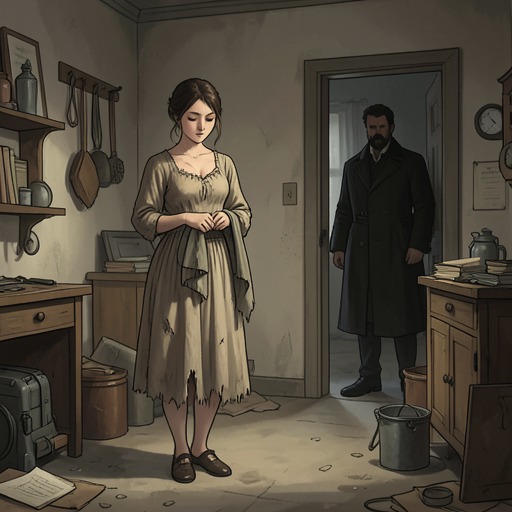
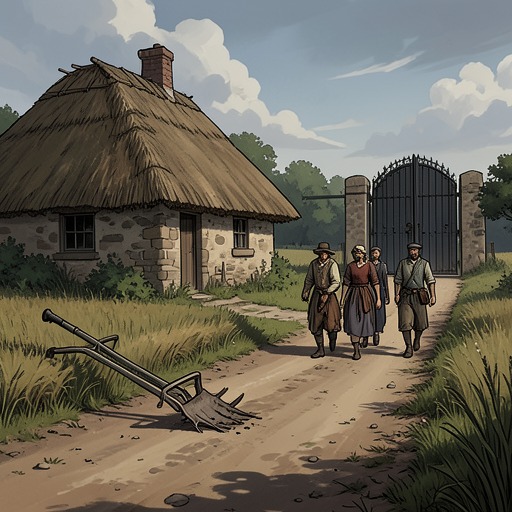
Far from the Madding CrowdFanny Robin’s final journey to the Casterbridge Union-house turns an attempt to reach shelter into a prolonged test of endurance and invention. Walking alone toward Casterbridge through the night, she repeatedly finds ways to continue as her strength fails, yet makes a point of avoiding human attention. A stray dog becomes her last support; by dawn she reaches the Union-house, where she is taken inside without it.
The journey through the night
Fanny has been walking for a considerable time when her steps weaken and the road grows indistinct in the darkness. She rests beneath a haystack, waking in a moonless night with the glow above Casterbridge visible in the distance. Her urgency is sharpened by a meeting she expects in two days: she fears she may be dead before then. A passing carriage briefly illuminates her face, and she resumes her journey, scanning the roadside for landmarks.
At a copse where woodcutters have left piles of sticks, Fanny selects two nearly straight branches forked at the top. She breaks away the smaller twigs and places the sticks beneath her arms as crutches. The improvised aid works, but only by transferring effort to her body and arms; it cannot remove the labour of moving forward. She eventually falls, lies still for more than ten minutes, and then rises, using the sticks as walking supports rather than crutches.
Measuring a way forward
As she descends Mellstock Hill, Fanny sees another milestone and the start of an iron-railed fence. Casterbridge’s lights are now individually visible, but her destination lies beyond the town. She estimates that she still has more than a mile to go and calculates the distance in yards and steps. The numbers register the scale of what remains, but she also counters it with a deliberate fiction: she tells herself that the end is only five fence posts away, then repeats the small target as she passes each group of posts.
The strategy carries her to the bridge over the Froom. There she admits to herself that she still has less than half a mile to travel. That remaining distance feels more daunting once it is seen whole. She considers other ways of getting across Durnover Moor, including crawling or rolling, but judges that these would require more exertion than walking. With her ingenuity exhausted, she lies down beside a guard-stone and whispers that she can go no farther.
The dog as support
A large, quiet stray dog approaches and licks Fanny’s hand and face. She recognizes a possible means of continuing. When she points toward Casterbridge, the dog moves ahead, then returns when he realizes she cannot follow. Fanny rises and rests her arms on his shoulders, leaning part of her weight on him as they proceed in small steps.
The dog gradually understands both where she wants to go and that she cannot keep pace. When she sinks down, he tries to rouse her by tugging at her dress and moving forward; she calls him back. Fanny listens for human sounds in order to avoid them, making clear that she wants her presence and condition on the road to remain unknown. The pair reach the bottom of Casterbridge, turn into a shaded chestnut avenue, and skirt the town rather than passing openly through it.
Arrival at the Union-house
Fanny reaches the building outside Casterbridge just before six in the morning. The Union-house is described as a stark institution whose ivy-covered exterior resembles an abbey, a contrast between its picturesque appearance and its function as accommodation for people in need. From the ground, Fanny can barely reach the hanging wire that serves as a bellpull. She pulls it and collapses forward as movement begins inside.
A man opens the small door, returns with a light, and brings two women to help lift Fanny and carry her in. One asks how she got there; another answers that only the Lord knows. Fanny manages to say that a dog helped her and asks where he has gone. The man says he drove the dog away. The journey thus ends with Fanny admitted to shelter, while the animal whose companionship made her arrival possible is left outside.
Narrative significance
The episode makes the physical distance to refuge a sequence of shrinking, improvised goals: first milestones and crutches, then fence posts, the bridge, and finally the dog’s shoulders. Fanny’s self-imposed five-post targets do not lessen the distance; they make it possible for her to face it in increments. The narrative dwells on this practical ingenuity without suggesting that it can overcome exhaustion by itself.
Her route also reveals the isolation surrounding the journey. She avoids human sounds, travels around the town in shadow, and reaches the institution without anyone inside knowing how she arrived. The dog supplies a temporary, wordless form of assistance, but the final exchange at the door separates that aid from the shelter Fanny has sought. The chapter heading that follows, “SUSPICION -- FANNY IS SENT FOR,” shifts the narrative from the private struggle of her arrival toward the consequences of her presence at the Union-house.