Gabriel Oak's flock falls into the Cretaceous pit
Far from the Madding CrowdGabriel Oak’s sheep flock plunges into a chalk-pit after Oak’s young sheepdog, still unable to judge when its work is done, drives the animals over a broken railing. The disaster kills or fatally injures roughly two hundred ewes and their unborn lambs, wipes out Oak’s uninsured savings, and ends his immediate hope of becoming an independent farmer. It is at once a sudden agricultural catastrophe and a painful demonstration of the gulf between an animal’s earnest obedience and the human judgment it has not yet learned.
Background: A Dangerous Gap in the Fence
Oak’s two sheepdogs occupy different stages of the same working life. The elder, George, is clever and trustworthy, seasoned by years among sheep; the younger dog, his son, is still learning to manage a flock. The young dog has not yet mastered the essential difference between doing a task adequately and pursuing it too far. Sent behind sheep to move them on, he works with such zeal that, unless George’s example or a human call checks him, he would happily chase them across the county. His competence is real, but incomplete: he can drive sheep without understanding the limits that make driving them safe.
The physical setting makes that limitation fatal. Beyond Norcombe Hill lies a generations-old chalk-pit, surrounded by two hedges that converge in a V without quite meeting. A rough railing protects the narrow opening immediately above the pit’s brow. The barrier is already vulnerable: later, Oak finds that a section of its railing is rotten enough to give way under the force of the flock. The danger is therefore not created by the dog alone. It emerges where imperfect training meets a neglected boundary and a steep drop.
The Night Drive and the Discovery
One night, Oak returns home believing that no further attention to the flock is needed. He calls the dogs before shutting them in their outhouse; only George answers. Remembering that he left both dogs on the hill beside a dead lamb, Oak cannot find the younger one in the house, lane, or garden. Before dawn, the flock’s bell wakes him with an abnormal sound. An experienced shepherd, he recognizes its rapid, regular palpitation as the sound of sheep running at great speed, and immediately goes out into the fog.
Oak finds the smaller group of fifty ewes with lambs where he left them, but the main body of his flock—two hundred ewes—is missing. A gap has been broken through the hedge, and sheep footprints lead onward. At first he supposes that the animals have gone after winter ivy in the plantation. They are not there. Following the track to the hill’s summit, he sees the young dog standing dark and motionless against the sky, near the point where the hedges end at the chalk-pit. A second break in the rails and the ewes’ tracks confirm what Oak fears: he looks over the edge and sees the animals below, dead or dying in a heap.
The dog comes to Oak and licks his hand, apparently expecting a reward for its service. The gesture sharpens the event’s central irony. Having eaten the dead lamb, the dog may have had extra energy; it gathers the ewes, drives them through the hedge and across the upper field, then worries them forward until their momentum breaks the rotten railing. It has performed its task with extraordinary consistency, but the very thoroughness that might have been praised in another setting has hurled the flock into the pit. The dog is not portrayed as malicious: it is a novice whose inherited working impulse has outrun its understanding.
Loss, Livelihood, and the Dog’s Fate
Oak’s first response is pity for the sheep and their unborn lambs. His humanity makes the loss more than a calculation of livestock: he has long been troubled by the knowledge that a shepherd’s care ultimately ends with the flock being turned into mutton. Only after registering the animals’ suffering does he reckon the economic consequence. The sheep are uninsured; the savings accumulated through a frugal life have disappeared in a single blow, and his ambition to become an independent farmer seems possibly destroyed for good.
After his stupor passes, Oak’s first spoken words are not a complaint about his own ruin but a reflection on the poverty that would have fallen on a wife as well as himself. He remembers this moment—the pale moon and morning star above the pond beside the pit, the star’s reflection drawn into a streak on the water—as he surveys what has happened. The remembered landscape holds together the immediate scene and the life-changing consequence: a still, beautiful dawn does not soften the physical wreckage below it.
The young dog is taken and shot at noon that same day. Its fate completes the bitter judgment passed on its mistake, though the narration frames the dog’s conduct as tragically logical rather than wicked: it has followed the principle of doing its work as thoroughly as possible in a world where safe action depends on compromise. Oak’s farm, meanwhile, had been stocked by a dealer who advanced the stock and received a percentage until the debt was cleared. Oak calculates that the stock, plant, and implements truly his will just suffice to pay what he owes. He is left free of debt, but with no more than the clothes he stands in.
Later Echoes: Care and Agricultural Knowledge
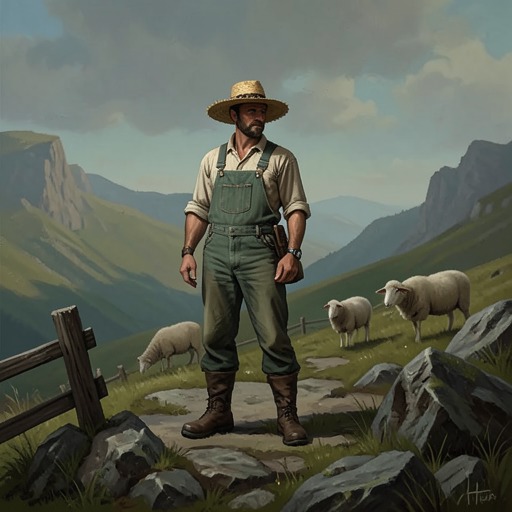
The fall into the pit gives later scenes of sheep care a painful counterpoint. When fifty-seven of Bathsheba Everdene’s sheep stray and become dangerously distended after eating clover, Oak responds with precise, practiced intervention. Using a trocar, he successfully operates on forty-nine; four sheep have already died, three recover without an operation, and one ewe is fatally injured when he misses his aim. The scale and method differ from the catastrophe at the chalk-pit, but both episodes insist that farming depends on close attention to animals whose bodies are vulnerable to human decisions and imperfect control.
Oak’s later reading of animals also becomes part of his practical authority. Before a storm threatens the harvest, he treats the behavior of sheep, as well as signs from other creatures, as evidence that demands interpretation. The flock’s movement is not mere background to human plans: it supplies knowledge that helps Oak anticipate danger. In contrast, the young dog’s untempered drive turns animal behavior into a force that cannot be checked in time. Across these episodes, the animals are both living creatures in their own right and indispensable participants in the farm’s labor and survival.
Narrative Significance
The accident changes Oak’s social and economic position through a chain of events that begins with ordinary farm practice: a dog is left working near the flock, a fence has weakened, and an inexperienced animal pursues its task beyond the point of safety. The loss is sudden, but its causes are material and specific. The broken hedge, the rotten railing, the dog’s training, the flock’s frightened movement, and the uninsured value of the sheep converge at the edge of the pit.
The episode also establishes a contrast that recurs in Oak’s life: diligence does not guarantee security, and good intentions cannot always prevent harm. The dog’s excess of zeal destroys the flock; Oak’s own patience and industry cannot restore the savings lost with it. Yet the disaster does not leave him indebted or idle. It strips him down to what remains his own and sets the conditions for the laboring, adaptable life that follows. The chalk-pit is thus both a literal grave for the flock and the point at which Oak’s former prospects collapse.