Horses
Far from the Madding CrowdHorses in Far from the Madding Crowd belong to the material life of farming and travel, yet they are more than background equipment: their bodies and behavior can determine whether people and property are safe, whether a pursuit succeeds, and whether a private decision becomes public. Across the novel, horses are managed as valuable working animals, but the very dependence they enable also makes human plans vulnerable to their limits and unpredictability.
Farm Work and Animal Care
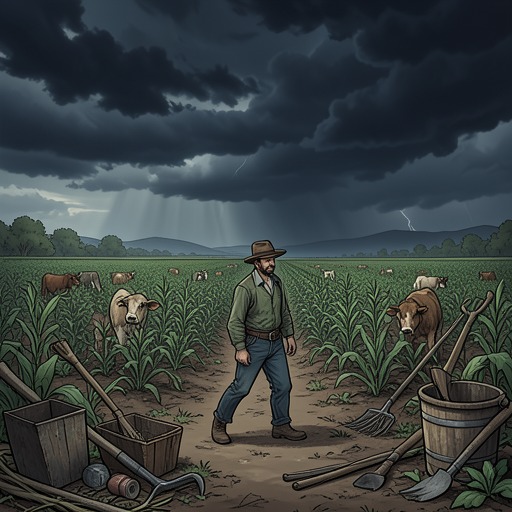
The working life of Weatherbury relies on animals and the labor organized around them. At the sheep-shearing, the barn’s catching-pen keeps sheep ready for the shearers, while the workers’ practiced handling turns a seasonal task into coordinated production. Bathsheba watches for careless cuts and insists that a finished sheep be marked with her initials before it rejoins the flock; Gabriel supervises, selects animals, and helps the shearers. Though this episode chiefly concerns sheep, it shows the wider farm ethic in which animals are valuable, vulnerable creatures whose care demands skill and attention.
Bathsheba’s nightly inspection of her property likewise places animal keeping among the routines of management. She checks the homestead and paddock before bed, where her Devon dairy cows feed in the darkness. The scene makes husbandry concrete: care means ensuring that animals are properly housed and that the farm is secure, not merely owning productive stock. The animals’ physical presence, sounds, and occasional interference with her clothing give the farm a life that cannot be reduced to its accounts.
A Flock’s Destruction and the Cost of Misjudgment
The most devastating animal disaster in the novel is caused by the young sheepdog’s misguided drive. At dawn, Gabriel finds that two hundred ewes have disappeared from the hill. He follows their tracks through a broken hedge and discovers the dog at the edge of the chalk-pit, where broken rails mark the place the flock went over. Two hundred sheep lie dead or dying below, their condition representing a loss of at least two hundred more in value.
Gabriel’s response registers both the animals’ suffering and the farm’s economic collapse. His first feeling is pity for the ewes and their unborn lambs; only afterward does he confront the fact that the sheep were uninsured and that his savings and hopes of becoming an independent farmer have been swept away. The flock is at once a collection of living creatures and the basis of his livelihood. The dog, meanwhile, has acted according to a mistaken understanding of its work: it has driven the sheep with such force that they broke through the rotten railing and fell. Its conduct is tragically consistent, but disastrous in a world where useful instincts require human judgment and restraint.
Horses as Property and Means of Pursuit
Horses make distance negotiable, but their usefulness depends on knowing their particular capacities. When Bathsheba’s horse and gig appear to have been stolen from the paddock late at night, Gabriel and Jan Coggan set out after them. They cannot simply take the farm’s ordinary mounts: the available horses are too heavy for the urgent pursuit, so Gabriel borrows Boldwood’s Tidy and Moll. With no time for saddles, Coggan rides bareback; the men fashion makeshift bridles from halters and rope, then gallop after the tracks.
The pursuit depends as much on equine evidence as on speed. At a crossroads, Coggan uses a match to examine the rain-softened ground. Fresh hoofprints and empty ruts show that a horse has been harnessed to a gig and has gone at a gallop. Later, the pattern of the hoofmarks changes: only three impressions in each set retain the regular horseshoe shape, while the fourth is a dot. Gabriel and Coggan infer that the horse is lame, and Coggan recognizes the shoeing as Dainty’s, whose shoes had recently been fitted by Jimmy Harris. This detail turns local knowledge into a practical instrument of pursuit: the horse’s impaired gait identifies both the animal and a likely limit to its flight.
At the Sherton turnpike, the men expect to catch a thief. Instead, the light reveals Bathsheba driving the gig. She explains that an urgent matter has made her abandon her visit to Liddy and leave for Bath; unable to wake Maryann, she took the coach-house key and left a chalk message on the doors for the household to find in the morning. The apparent theft was a secret departure, and the horse’s journey has brought her private choice into view. Bathsheba can continue: the problem was only a stone in Dainty’s shoe, which she had removed herself. Gabriel and Coggan turn back, agreeing to keep the night’s pursuit quiet.
Speed, Strength, and Dependence
The same animals that permit rapid travel also impose practical constraints. In the chase, speed alone cannot settle the question of where the gig has gone; the riders must interpret tracks, account for the storm’s effect on the ground, and distinguish a lame horse from one still galloping freely. Their progress depends on borrowing mounts suited to the task and adapting tack in haste. The episode presents horsemanship as a form of applied knowledge rather than a simple command over animal power.
The horse also marks the difference between outward appearance and actual circumstances. At the turnpike, Gabriel’s and Coggan’s borrowed horses make Bathsheba seem to be the object of a rescue, while she is in fact the mistress of the gig and the author of her departure. Dainty’s brief lameness temporarily gives the pursuers a clue, but Bathsheba’s removal of the stone restores her ability to travel. The animal’s body therefore both interrupts and enables her plan, while its tracks disclose what the household had not known.
Narrative Significance
Horses occupy the novel’s practical world of farm ownership, labor, and movement. They are valuable enough that their absence prompts an immediate alarm, yet their value does not make them mechanically reliable: weight, footing, shoeing, and lameness all matter. A plan formed by a person has to pass through the animal’s actual capacities and the knowledge of those who handle it.
The contrast with the sheepdog’s fatal work sharpens the book’s attention to human dependence on animal behavior. The dog’s uncontrolled drive sends a flock over a precipice; Dainty’s lameness slows a secret journey; the borrowed horses make pursuit possible. These are distinct outcomes, not expressions of animal intention that the text claims to understand. Instead, the narrative shows how work, care, and consequence arise from the meeting of human decisions with animal strength, habit, vulnerability, and physical circumstance.