Jan Coggan
Far from the Madding CrowdJan Coggan is a Weatherbury farm worker whose life joins practical agricultural labor to the sociable rituals of village community. A regular presence at the cider cup, the sheep-washing, the shearing, and the sheep fair, he is both a comic conversationalist and a dependable man of action. His partnership with Gabriel Oak becomes especially clear when he helps pursue a stolen horse, while his long-standing loyalty to Oak makes him the confidant who learns of Oak and Bathsheba’s secret wedding before it takes place.
Identity and Place in Weatherbury
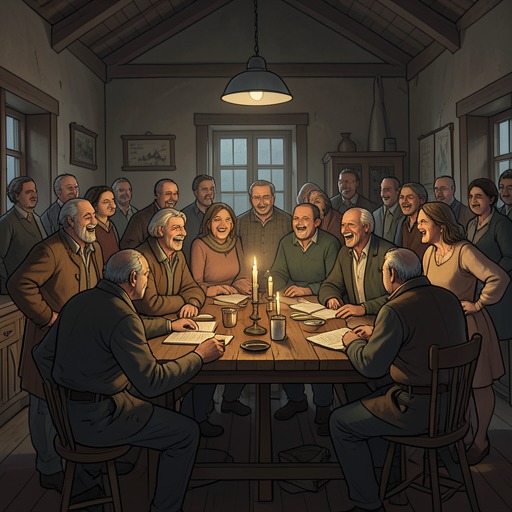
The novel presents Coggan as a crimson-faced, broad-countenanced man with a private glimmer in his eye. He belongs to the close-knit world of Weatherbury farm laborers, whose work and leisure are entwined: agricultural tasks, shared drink, songs, and parish news all bring the same people together. His social standing is reflected in the marriage register, where his name has appeared as best man and chief witness in numerous local marriages over the preceding twenty years; he has also often served as head godfather at baptisms of a particularly convivial kind.
That reputation is not simply decorative. Coggan knows how to occupy a gathering, keep the drink moving, and turn a conversation into a story. He treats sharing liquor as a matter of principle, urging Henery Fray to drink and offering the cup around. His conviviality is generous, but it can also become a source of delay and distraction, as Joseph Poorgrass discovers when an alehouse stop postpones the journey that should take Fanny Robin to Weatherbury’s churchyard.
Work and Agricultural Knowledge
Coggan’s place in the community is grounded in labor as well as sociability. At the June shearing, he is the master-shearer, working in the great barn alongside the other shearers, while Gabriel supervises the operation and Bathsheba watches for careless cuts and incomplete work. The barn gathers the farm’s routine into a collective scene: workers shear, women collect the fleeces and tie them, and Coggan takes part in the skilled, seasonal work that sustains the farm.
He also appears at the sheep-washing, where Coggan and Matthew Moon stand immersed to the waist at the lower hatch, pushing sheep into the pool. Gabriel works from the brink to submerge them as they swim; at the upper opening, Cainy Ball and Joseph Poorgrass help receive them. Coggan’s soaked presence makes visible the physical demands of the work, while the coordinated effort of the group shows the practical knowledge and shared labor on which Bathsheba’s farm depends.
His agricultural competence extends beyond the immediate task. When Bathsheba’s horse Dainty is stolen at night, Coggan joins Gabriel in the pursuit. The men borrow two horses from Boldwood’s pastures, ride bareback, and improvise bridles from halters. Once they lose the sound of the fleeing horse, Coggan strikes matches and reads the marks left in the road. He distinguishes a gallop from a canter and then a trot by the spacing of the hoofprints, and identifies Dainty’s tracks by the shoeing mark of Jimmy Harris, who had shod her the week before. When the tracks reveal that the mare is lame in a forefoot, Coggan again draws a practical inference from close observation. The episode converts local familiarity with horses and roads into the means of following a thief.
Fellowship, Humor, and Village Voice
Coggan’s speech is part of the novel’s portrait of shared village life: he tells stories, sings, teases, and joins in the community’s running commentary on its neighbors. He recalls visiting Farmer Everdene’s household when courting his first wife, Charlotte, who had been the farmer’s dairymaid. To show his appreciation of Everdene’s ale, Coggan says, he used to eat salt fish beforehand so he would arrive thirsty. His tale remembers the old household through its hospitality, and his affection for Charlotte appears in the recollection that she would not permit swearing. He wonders whether she reached Heaven after her death, mixing tenderness with the comic speculation characteristic of his conversation.
At the shearing supper, Coggan launches into a song about losing a sweetheart, which the company receives as a familiar pleasure rather than a performance requiring formal applause. He then urges Joseph Poorgrass to sing, coaxing him past his shyness. These scenes make Coggan a facilitator of communal participation: he does not merely entertain but draws quieter figures into the evening’s shared life.
His humor can also expose the limits of that fellowship. At Greenhill sheep fair, he and Poorgrass are caught in a crowd pushing into the tent for a performance of Turpin’s Ride to York. When a woman accuses him of pushing her, Coggan explains that the crowd behind is forcing him forward. Still jammed in place, he protests that the women might as well watch the show without him. The exchange is comic, but it also shows him speaking from inside the crowd’s physical confusion, not above it as a detached observer. During the performance, he responds audibly to the action, while Poorgrass follows the story with earnest feeling.
Loyalty and Dependability
Coggan’s strongest personal connection in the supplied episodes is with Gabriel Oak. He offers Oak lodging after the conversation at the Warren’s Malthouse, and the two work together during the nighttime chase after Dainty. In that pursuit Coggan’s knowledge complements Gabriel’s decisiveness: Gabriel organizes the response and secures the horses, while Coggan helps interpret the tracks and estimate the direction and speed of the stolen mare. Their partnership is practical, grounded in trust and familiarity rather than formal authority.
Coggan’s concern for Bathsheba’s affairs also appears in his response to Gabriel’s alarm over her missing horse. When Maryann reports the theft, Coggan joins the search and accepts the urgency of recovering the mare. His responsibility is not limited to his own employer or household; he is part of the wider rural network through which neighbors respond to trouble at the farm.
The limits of convivial good nature are exposed when Coggan and Mark Clark remain drinking with Poorgrass while Fanny Robin’s body is waiting in a wagon outside. Poorgrass has stopped at the Buck’s Head during his journey, and the men’s welcome prolongs the delay. Gabriel arrives at six, rebukes them, and insists that their drinking is disgraceful. Coggan defends the delay by reasoning that haste cannot help a dead person, but the defense is also a rationalization: the scene places his familiar sociability beside an obligation that demands more than talk, drink, or song. His conduct here complicates rather than erases his loyalty elsewhere.
The Sheep Fair and Its Dramatic Irony
At Greenhill, Coggan attends the annual sheep fair with Poorgrass. The fair is a working marketplace for flocks as well as a holiday gathering, and the Weatherbury men enter a crowded tent advertising a theatrical account of Dick Turpin and Black Bess. In the performance, the horse’s staged death moves Poorgrass so deeply that he helps carry the prop representing Black Bess from the arena. He later remembers touching the horse’s hoof and expects the experience to become a story told at Warren’s and passed down to children. Coggan is beside him at the performance and shares the scene’s mixture of communal amusement and sentiment.
The episode acquires dramatic irony because the actor playing Turpin is Sergeant Troy, Bathsheba’s husband, returned to England after years away and disguising himself from people who might recognize him. Coggan and Poorgrass watch the show without recognizing the performer’s identity. Their attention to the theatrical action therefore contrasts with the concealed fact unfolding within it: the performance that moves them is also the occasion on which Troy is secretly present near Weatherbury. Coggan’s part is that of an absorbed spectator, while the reader knows more than the audience inside the scene.
Ending and Narrative Significance
After Bathsheba and Gabriel decide to marry quietly, Oak tells Coggan the news on the night before the ceremony. He explains that the marriage is to be private because Bathsheba does not want the parish watching her in church, and because a conspicuous celebration would be ill-suited to the circumstances. Coggan is surprised but immediately wishes Oak joy. He then helps protect the plan by proposing a way to summon Laban Tall without revealing the purpose to Laban’s wife: Coggan will invent a pretext about farm work, while Oak waits out of sight. His readiness to assist turns long companionship into concrete service at the moment when the relationship reaches its new beginning.
Coggan’s narrative role is to make Weatherbury feel like a community rather than a backdrop. His recurring presence links seasonal work, local memory, gossip, public entertainments, and private crises. He can read a horse’s tracks and help Oak act decisively; he can also drink too long when someone else’s duty calls. The novel keeps both sides in view. Through Coggan, rural fellowship appears as a real resource—built from shared work, practical knowledge, and mutual trust—but not as a guarantee that every neighbor will respond well on every occasion.