Seven-year presumption-of-death rule for a missing spouse
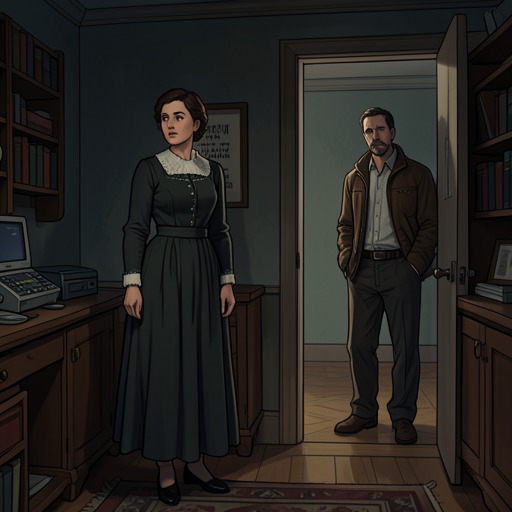
Far from the Madding CrowdThe Seven-year presumption-of-death rule for a missing spouse governs the difficult interval between apparent death and legally secure widowhood in Bathsheba’s story. Troy’s drowning is never conclusively proved, and his clothes and an eyewitness’s account make his death seem likely without ending uncertainty. Bathsheba therefore treats seven years as the legal boundary before she could remarry without objection, while Boldwood turns that boundary into a promise to wait and she weighs it against remorse, propriety, and her fear for his future.
Meaning and Circumstances
The rule concerns a spouse who has disappeared without confirmed death: the surviving partner must wait seven years before remarriage can proceed without legal objection. For Bathsheba, this is not an abstract legal technicality. Troy is believed drowned after entering the sea at Lulwind Cove, but no body is recovered. A local newspaper prints an account from Mr. Barker, a doctor from Budmouth, who saw a bather carried out by the current and followed along the coast; dusk prevented him from seeing what happened afterward. Troy’s clothes arrive and are identified, adding powerful circumstantial evidence, but neither the witness nor the clothing supplies absolute proof.
The distinction between probability and proof persists in Bathsheba’s responses. At first, when Liddy asks whether mourning should be obtained, Bathsheba insists that Troy is still alive, though she admits that she does not know this. After the newspaper report and the arrival of his clothes, she recognizes that the evidence strongly supports death. Yet she continues to describe herself as possibly not a widow, and the seven-year period remains the point at which she could act without the unresolved disappearance obstructing a new marriage.
The Rule as a Legal and Personal Limit
Bathsheba explains the waiting period to Gabriel when she asks whether she is free to consider a future arrangement with Boldwood. She understands that, in the eye of the law, Troy is only missing and that no man can marry her until seven years have passed. The interval is therefore not simply a private choice to remain faithful or unmarried: she sees it as a legal restriction, reinforced by her own scruples and by the possibility that Troy might return.
At the same time, the rule does not settle the moral question for her. Bathsheba asks whether she may entertain the idea of marrying Boldwood after the waiting period even though she does not love him. She regards such a marriage as a possible penance for having injured him earlier, and describes her wish to make amends as a debt she ought to discharge. Gabriel distinguishes this moral obligation from legal permission: in his view, if Bathsheba believes Troy dead, she is religiously free to think about remarriage as a widow, while the legal waiting period remains a separate constraint. Their conversation shows how the rule gives Bathsheba a date to reckon with but no easy answer about what she owes Boldwood.
Boldwood’s Interpretation of the Wait
Boldwood treats the seven-year limit as the outline of a future with Bathsheba. When he hears from Liddy that Bathsheba once said she might marry again at the end of seven years if she dared risk Troy’s return, he converts her tentative remark into a definite prospect. He calculates that little more than six years remain and comforts himself that this is shorter than waiting forever. His thoughts turn the legal interval into a test of devotion: he compares his intended patience to Jacob’s service for Rachel and imagines spending the intervening years in courtship directed toward eventual marriage.
That hope shapes his direct appeal to Bathsheba after the fair. Riding beside her gig in the moonlight, he asks whether she will marry again and presses her about the possibility of marrying him. Bathsheba answers that she has not seriously considered remarriage, stresses that Troy’s death was never absolutely proved, and says that she would be contemptible to indulge in thoughts of another marriage while still uncertain. Boldwood nevertheless asks whether, if she is a widow, she might someday repair the old wrong by marrying him. He makes the six-year horizon central to his proposal, asking for a promise that she will choose him if she marries again.
Bathsheba does not give him an uncomplicated commitment. She says that she will never marry another man while Boldwood wishes to be her husband, but she cannot promise to do so soon; when he presses for a time, she names Christmas. The remoteness of the legal interval thus does not make the promise emotionally harmless. The narrator presents her as feeling coerced not only into promising but into believing that she ought to promise. A rule that appears to postpone a decision becomes, through Boldwood’s hope and Bathsheba’s pity, the occasion for an immediate moral and emotional entanglement.
Consequences and Significance
The seven-year period repeatedly exposes the difference between legal status, private belief, and personal responsibility. Bathsheba may increasingly believe that Troy drowned, yet she cannot convert that likelihood into certainty; she may be legally able to contemplate remarriage after the requisite interval, yet still feel bound by remorse toward Boldwood. Boldwood, meanwhile, treats the same period as a promise of eventual reward, even though Bathsheba’s words express hesitation rather than love.
The rule therefore structures more than the timing of a possible second marriage. It gives Boldwood a calendar on which to fix his hope and gives Bathsheba a way to imagine reparation without deciding that she wants him. Her concern that he may lose his reason if she refuses intensifies the burden: she tells Gabriel that she believes his future is in her hands, while Gabriel cautions that Boldwood’s life has always been dark and strange when he is not hoping for her. The legal delay cannot resolve that conflict. It marks the earliest point at which Bathsheba believes remarriage may be possible, but the choices made in its shadow are governed by uncertainty, gratitude, fear, and a sense of moral debt.