The storm and the rescue of Bathsheba's harvest
Far from the Madding CrowdThe storm and the rescue of Bathsheba's harvest is a turning point at Weatherbury Upper Farm: as a late-summer storm threatens a large part of the farm’s grain, Gabriel Oak responds to local signs and saves the ricks through a night of solitary work. Bathsheba eventually joins him, while her husband, Sergeant Troy, and the farmhands are incapacitated after the harvest revel. The rescue makes agricultural knowledge and labor decisive, and briefly brings Bathsheba and Gabriel together in a shared crisis.
Causes and Warning Signs
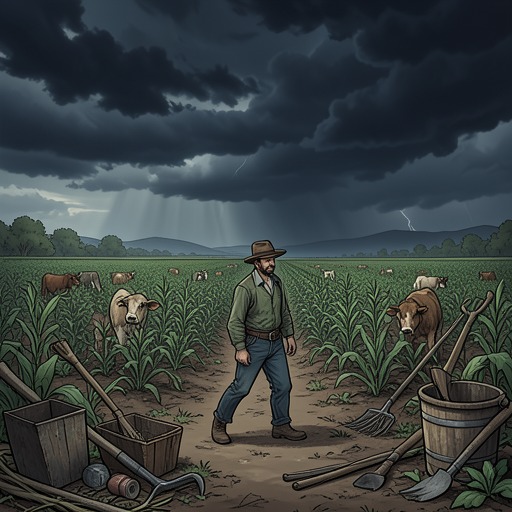
At the end of August, while Bathsheba’s married life was still new, the weather remained dry and sultry. Gabriel saw a threatening sky above the farm and worried about eight uncovered ricks holding much of that year’s produce. Earlier signs also troubled him: the sheep had walked home closely together, rooks behaved unusually, and horses moved cautiously. He understood these as indications of an approaching change in the weather, while his estimate of the possible loss gave the risk a precise economic scale.
Troy had chosen that same night for the harvest supper and dance. The contrast between the approaching storm and the celebration at the barn became consequential when the weather required urgent work. Gabriel’s knowledge of the farm and its animals led him to take the danger seriously; Troy, who was directing farm life in his wife’s place, did not make the preparations that the threat required.
After leaving the barn, Gabriel encountered a toad on the path and put it back in the grass when he found it uninjured. Indoors, a garden slug had left a shining trail across the table, and two spiders dropped from the ceiling. He treated these observations as further signs of foul weather, but turned especially to the sheep, whose instincts he trusted. The flock had crowded around furze bushes and oriented their tails away from the quarter from which the storm threatened. He interpreted the creeping creatures as anticipating prolonged rain and the sheep as anticipating thunder: the different warnings suggested that both were coming.
Gabriel calculated that the five wheat ricks held about thirty quarters each and the three barley stacks about forty, valuing the grain together at £750. His stated reason for acting was to prevent the loss of food and property, but the narration also presents a more personal motive beneath that practical argument: he still loved Bathsheba and was prepared to help her at great cost to himself.
The Revel and Gabriel’s Preparations
Inside the Great Barn, the dance occupied the central space while oats were stacked at one end. Green foliage decorated the walls and beams, and musicians accompanied the festivities. At the end of the evening, Troy proposed serving the men strong brandy and hot water. Bathsheba tried to dissuade him, warning that the workers had already had enough, but he dismissed her concern and proposed sending the women home so the men could continue drinking. Bathsheba left with the women and children; the musicians departed too. Gabriel stayed briefly before leaving, unwilling to remain for another round.
The signs outside confirmed Gabriel’s concern, and he returned to the flock to read its behavior. Back at the barn, he found that the men had fallen asleep after the drinking. The ricks could not wait for them to recover: with the available labor unable to assist, Gabriel had to undertake the work himself. He went to the house of Laban Tall to get the granary key and take out the rick-cloths. Two cloths on each of two grain stacks secured £200 worth of produce. With no more cloths available, he improvised protection for a third wheat rick, sloping sheaves across its top and filling gaps with untied sheaves. He judged that this would keep the wheat safe for a week or two if the wind did not become too strong.
The remaining barley could only be protected by thatching. Gabriel worked on it as the night deepened, using a thatching beetle to drive in spars and securing the covering by hand. His protection was practical rather than complete: cloths secured some stacks, improvised sheaves protected another, and the remaining work had to continue into the storm. The scene converts his weather reading into labor under pressure, with each decision aimed at preventing a different degree of loss.
Bathsheba Joins the Work
As the storm began, lightning illuminated the landscape in brief flashes, and Gabriel continued working on the exposed stacks. He saw a figure in the open ground and recognized Bathsheba. She had woken because of the weather, worried about the grain, and come looking for Troy, whom she could not find. Gabriel told her that Troy was asleep in the barn. When she offered to help, he asked her to carry reed-sheaves up the ladder one at a time, a task that would save him time.
Bathsheba immediately began carrying the sheaves. On one ascent, lightning threw their shadows onto the slope beside the rick; in a later flash, it revealed the tree struck nearby. The danger forced Gabriel and Bathsheba to pause, but she continued helping after descending. Her presence changes the rescue from one man’s solitary effort into shared work, even as the storm makes the task more hazardous. Gabriel’s attention to the stacks and Bathsheba’s willingness to carry material keep the labor moving when the farm’s workers are unavailable.
After Gabriel returned to the barn to confirm that the men were still asleep, Bathsheba followed him and understood that Troy and the others had been incapacitated by drink. Gabriel tried to turn their attention back to the work, asking her to help bring more sheaves. She addressed him, but the available evidence leaves the moment unfinished; the passage does not establish a new decision or outcome from what she says. What it does show is the intimacy of their shared position on the rick, set against Troy’s absence and Gabriel’s continued responsibility for Bathsheba’s property.
Rain, Completion, and Consequences
By five in the morning the wind had strengthened, and part of the wheat-stack thatching was blown away. Gabriel replaced it and weighted it with rails before returning to the barley. When the rain began in earnest, he continued working until about seven, drenched and exhausted. He had covered the stacks in time to prevent the threatened loss, and the completion brought a sense of success in a good cause, though his reflections returned to the fact that he was helping the woman he loved.
The farmhands emerged from the barn only after the night’s work was finished. Troy led them toward the village, whistling, and none of them turned to inspect the ricks. The contrast is stark: while the workers slept, Gabriel had covered the crop himself; when they awoke, the work and its risk had already been borne. The storm is therefore both a threat to Bathsheba’s livelihood and a test of who acts responsibly when the farm is in danger.
The rescue also recalls Gabriel’s earlier struggle against fire at the same place, eight months before, for the sake of the same unreturned love. Now the danger is water, and the practical work again binds his actions to Bathsheba’s welfare. But this time she is present and helps him. The emergency does not settle their relationship; it makes visible the difference between Troy’s neglect and Gabriel’s steadfast service, while allowing Bathsheba and Gabriel to meet through necessary, shared labor.