Unrequited love
Far from the Madding CrowdUnrequited love in Far from the Madding Crowd is not a single, symmetrical condition but a sequence of attachments shaped by unequal feeling and mistaken interpretation. Gabriel Oak loves Bathsheba Everdene before she returns his love, and accepts her refusal without withdrawing his devotion. Later, Bathsheba’s careless Valentine gives Boldwood reason to imagine that she loves him. The contrast is decisive: Gabriel knows his affection is not reciprocated, while Boldwood treats an ambiguous sign as evidence of a passion that does not exist.
Gabriel’s attachment and the first proposal
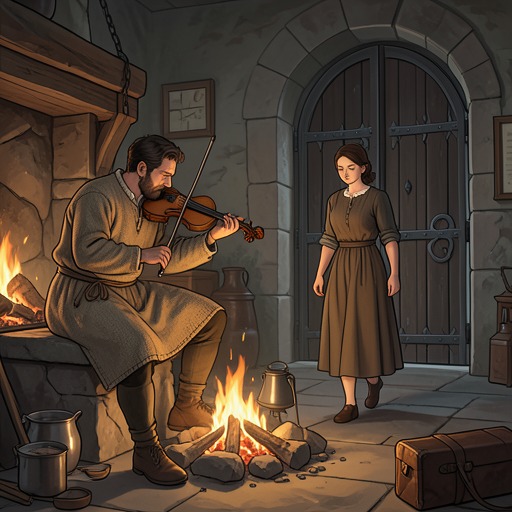
Gabriel’s love begins in watchfulness. He waits for Bathsheba’s regular appearances and finds his feelings growing without any corresponding change in hers. The narration likens his anticipation to the way his dog waits for its meals, a comparison that embarrasses him because it makes his own dependence seem undignified. He has no finished declaration ready and says nothing for a time. Even the practical detail that Bathsheba’s cow will soon cease giving milk becomes part of his anxious calculation: when the cow dries up, Bathsheba no longer comes up the hill, and the routine that had sustained his hope ends.
Gabriel then looks for a respectable reason to visit the home where Bathsheba is staying. A ewe has died leaving a living lamb, and he takes the lamb as a gift that might interest her. While waiting, he tells her aunt that the lamb is not the real purpose of his visit: he has come to ask whether Bathsheba would marry him. Her aunt incorrectly suggests that Bathsheba has many young men about her. Gabriel takes this as a reason to give up, concluding that he is an ordinary man and that his chance depended on being first.
Bathsheba runs after him to correct the story. She says she has no sweetheart and has never had one; she does not want him to leave believing that she has several. Her correction briefly revives Gabriel’s hope, but it is not a declaration of interest. When he reaches for her hand, she withdraws it. The small physical refusal anticipates the larger one: she has hurried to correct a false report, not to accept his proposal.
The refusal and its terms
Gabriel makes his case in the language of shared domestic life. He describes the farm, promises that marriage will make him work harder, and imagines a piano, a market gig, flowers, useful birds, and a frame for cucumbers. He also pictures the ordinary closeness of marriage: husband and wife looking up from their respective tasks and finding one another at home. Bathsheba likes parts of this future, but the prospect of a husband always being there is precisely what troubles her. She would like the spectacle of being a bride without the continuing presence of a husband; she is not ready to give up her independence for the life Gabriel offers.
Her refusal is direct: she does not love him. Gabriel answers that he loves her and would be content simply to be liked, but Bathsheba worries that he would eventually despise her if she married without loving him. His response is unusually firm in its constancy: he says that he will love and long for her for the rest of his life. The narration treats this as genuine feeling, not a tactic that secures her consent. Bathsheba is distressed by the disparity between his strong attachment and her inability to return it, yet does not change her decision.
Bathsheba explains the practical and personal grounds for refusing. She is staying with her aunt and has little money; Gabriel is a farmer just beginning, and she considers marriage unwise for him as well as unwanted by her. Gabriel candidly agrees that marrying a woman with money would be prudent. His honesty unsettles Bathsheba, who treats the admission as evidence against the match, but he insists that he was not saying she was unworthy. He praises her education and standing, asks whether he may call or walk with her on Sundays, and offers not to demand an immediate decision. Bathsheba refuses further pressure because she does not love him. Gabriel accepts her answer and says he will ask no more.
A contrast in the Valentine episode
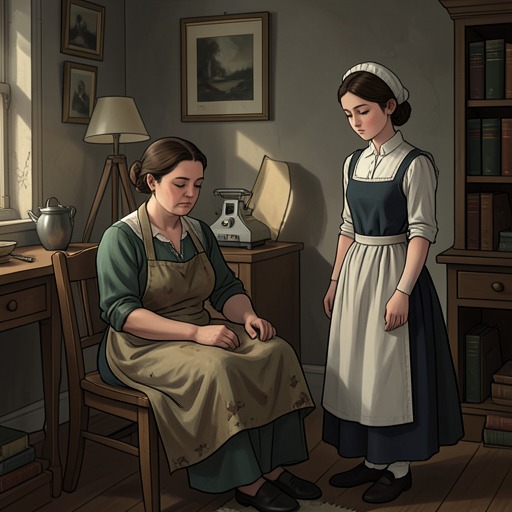
The novel later revisits unrequited love through a reversal of knowledge and intention. Bathsheba notices that Boldwood, the respectable farmer whose pew faces hers, does not look toward her in church. His lack of attention has begun to trouble her, not because she already loves him, but because she resents being denied the admiration she expects. When her maid, Liddy, suggests sending him the Valentine intended for a child, Bathsheba entertains the idea as a joke. She tosses a hymn-book to decide between the child and Boldwood, and the result leads her to address the card to Boldwood. She seals it with a large red seal and sends it without recognizing the seriousness he will attach to it.
At home, Boldwood repeatedly looks at the letter. The words on its seal, “MARRY ME,” appear to him as a deliberate message, although the card arose from Bathsheba’s idle amusement rather than a settled intention. The letter’s arrival disrupts the ordered life he has known: he takes its existence as proof that it must have a significant motive, and does not consider that its sender might have acted thoughtlessly. The red seal, rather than any knowledge of Bathsheba’s actual feelings, becomes the center of his interpretation.
His response is presented through a night of fixation. Boldwood places the Valentine by the looking-glass, imagines a woman writing his name, and wonders about the unknown writer’s appearance and expression. The imagined woman has no individual identity, because Boldwood does not understand that Bathsheba is asleep and unaware of the romantic meaning he has assigned to the card. He later searches the envelope for some additional explanation, finds nothing, and returns the message to the frame of the glass. The search does not correct his mistake; the absence of further information leaves him more fully with the meaning he has already supplied.
Unequal feeling, interpretation, and consequence
These paired episodes distinguish two forms of unreturned desire. Gabriel’s love is openly stated and accurately understood by both parties: he knows Bathsheba does not love him, and she knows the depth of his attachment. Their disagreement is painful, but it does not depend on a false belief about what has happened. Boldwood’s attachment, by contrast, is intensified by an interpretation that mistakes a playful gesture for a promise. Bathsheba is not consciously offering him a relationship, yet his seriousness turns the Valentine into a powerful sign.
The episodes also expose different motives within the desire to be loved. Gabriel imagines a shared future of work and companionship, and accepts that Bathsheba may not choose it. Bathsheba initially wants Boldwood’s attention in part because his withholding it affronts her self-image; she treats the card as an amusing way to provoke a response. Boldwood, isolated from the circumstances of its making, gives the card a gravity its sender never intended. Love here is shaped not only by the strength of feeling but by what each person believes the other’s actions mean.
The recurring image of the written Valentine makes the contrast especially clear. Gabriel’s proposal is spoken face to face and refused in words; he has no need to infer Bathsheba’s answer from a token. Boldwood receives a token without access to its trivial origin and reads intention into it. The novel thus presents unrequited love as both an emotional imbalance and a problem of knowledge: one person may know the truth of a refusal, while another builds hope from a sign that cannot bear the meaning placed upon it. It does not make the two cases equivalent. Gabriel’s acceptance of Bathsheba’s decision contrasts with Boldwood’s fixation on a message that was never a genuine proposal, showing how devotion, vanity, and misreading can lead in sharply different directions.