Warren's Malthouse
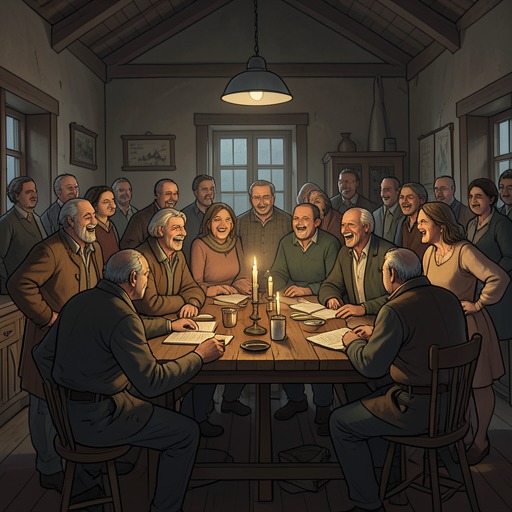
Far from the Madding CrowdWarren's Malthouse is both a working malt house and Weatherbury’s informal communal hub: a place where laborers find warmth and food, neighbors trade news, and private troubles become matters of public discussion. Its fire-lit interior repeatedly gathers the village around the fortunes of Bathsheba Everdene, Gabriel Oak, and Boldwood, so that the building’s everyday hospitality becomes part of the novel’s machinery of observation and rumor.
Setting and Everyday Use
Enclosed by an old, ivy-wrapped wall, the malt house is recognizable at night by its thatched roof rising to a central point and a small wooden lantern with louvred sides, through which mist escapes. A single glazed pane in the door casts a red glow onto the wall. Inside, the kiln fire supplies the principal light, throwing shadows across a worn stone floor. An unplaned-oak settle runs along one side; a small bed in a distant corner belongs to the aged maltster who owns and occupies the premises. The air carries the sweet smell of new malt, and the work of the kiln gives the room its warmth and atmosphere.
The malt house is more than a workplace. The fire, food, and open welcome make it an alternative to the inn and a meeting place for people whose work brings them through the village. The maltster offers potatoes roasting in the ashpit and a boiling pot of charred bread called coffee to whoever calls. During the malt-making season, from October to April, he works at the malt house; after the season ends, he makes himself useful on neighboring farms. That seasonal rhythm connects the building’s trade to Weatherbury’s wider agricultural calendar.
Gabriel Oak’s Arrival and the Village Gathering
After Bathsheba hires Gabriel Oak as a shepherd, she rides away and the workers head toward the malt house for the refreshment she has offered. Left without lodging by the bailiff, Gabriel follows them there to ask for directions. The group receives him as the new shepherd, but the maltster’s recognition makes his arrival a meeting between present and past: he recalls Gabriel’s grandfather, grandmother, and father, and links their families through generations of local acquaintance. Stories of earlier Weatherbury life emerge naturally in the same room where Gabriel is trying to establish himself in the present.
The gathering also gives Gabriel a discreet way to ask what kind of employer Bathsheba will be. He raises the subject of the new mistress while concealing the personal interest that makes the question matter to him. The men know little about her: her uncle has recently died, and she appears likely to continue running the farm herself. Their recollections of Farmer Everdene, including Jan Coggan’s stories of his visits to the household, give the new owner a history before the villagers know her well. The malt house thus turns workplace talk into an informal account of character and reputation.
Its role as a news exchange is evident when Henery Fray returns in haste with the story that Bathsheba has caught the bailiff, Pennyways, stealing barley from the granary. She has confronted him and dismissed him after he admitted taking five sacks. The news immediately prompts the practical question of who will serve as bailiff, while the company debates whether Bathsheba can manage the farm without one. Not long after, the men hear that Fanny Robin has failed to return and has recently seemed low in spirits. Their fearful guesses about what may have happened show how quickly the communal space converts incomplete information into speculation. The workers hurry to the farmhouse because Bathsheba wants to speak with them about both the dismissed bailiff and the missing servant.
Shelter for Farm Work and Seasonal Labor
In winter, the malt house’s fire becomes a practical refuge for Gabriel’s work. During a difficult lambing season, he arrives carrying newborn lambs, with George behind him and Cainy Ball helping bring more. The lambs have been exposed to snow and rain; Gabriel warms them by the hearth, wraps them in hay, and teaches the weakest to drink milk from a teapot. He has no lambing hut at the farm and explains that bringing weak animals indoors is a burden, but without the maltster’s hospitality he does not know what he would do in the bitter weather. The village gathering place is therefore not merely a setting for talk: it helps sustain the farm’s vulnerable animals and the labor that depends on them.
The episode also reveals Gabriel’s precarious position. He admits that he expected to be appointed bailiff and had hoped for the post, while acknowledging Bathsheba’s right to manage the farm herself and keep him as a shepherd. As he tends the lambs, the workers’ sympathies turn to his treatment, including his not receiving the skins of dead lambs. Gabriel rejects their suggestion that Bathsheba has taken against him, though his sigh betrays a private feeling the complaint cannot explain. The contrast between the practical care he gives the lambs and his restrained response to his own disappointments makes the malt house a place where work and personal attachment quietly share the same firelight.
The building’s social function continues beyond winter. At sheep-shearing, it belongs to the broader network of farm work that gathers the maltster and laborers around Bathsheba’s estate. When the malt-making season has passed, the maltster assists on nearby farms; in the great barn, he helps gather fleeces and twist the wool ties, while Bathsheba watches the shearing and Gabriel supervises the men. These scenes place the malt house within an interconnected rural economy rather than isolating it as a picturesque tavern. The labor performed in the barn, fields, and malt house follows the seasons, and the workers carry their shared knowledge and conversation between them.
A Stage for Private News and Public Observation
The malt house repeatedly becomes a place where news alters the meaning of what the villagers have seen. When Boldwood brings Gabriel a letter accidentally delivered to him, the gathering’s ordinary farm talk gives way to its contents: Fanny Robin writes to thank Gabriel for his earlier kindness, returns the money she owed, and says she expects to marry Sergeant Troy, of the 11th Dragoon Guards. She asks that the news remain secret because she and Troy hope to surprise Weatherbury by returning as husband and wife. Gabriel lets Boldwood read the letter, knowing he is interested in Fanny; Boldwood responds with concern that Fanny’s confidence may prove misplaced. The malt house gives this private announcement an audience and allows the letter’s promise to enter the village’s shared knowledge.
Later, the same pane of glass makes the building a point of observation. On a Christmas gathering night, villagers leaving Boldwood’s house see him pause outside and speak anxiously to himself, hoping Bathsheba will come and end his suspense. When she arrives, he welcomes her inside. The men then notice Troy’s face close to the malt house window: he is looking in and listening as Gabriel and the maltster discuss Boldwood’s attachment to Bathsheba. The hidden watcher changes the scene’s meaning. The malthouse is at once a place where villagers interpret events and a place whose conversations can be overheard, exposing the limits of their control over what becomes known.
After Boldwood shoots Troy, Warren’s Malthouse again becomes a center for the community’s effort to understand what happened. The men wait anxiously for news, and later discuss the concealed evidence of Boldwood’s deteriorating state. In a locked closet, people discover expensive dresses in colors associated with Bathsheba’s clothing, fur muffs, and fine jewelry, all carefully wrapped and labelled “Bathsheba Boldwood,” with dates six years in the future. News of Boldwood’s guilty plea and death sentence reaches the malt house alongside these revelations, prompting renewed attention to whether he was mentally responsible. The villagers’ earlier impressions are reconsidered in light of the evidence; the room functions as a communal forum where fragmented observations are gathered into a belated account of his condition.
Narrative Significance
Warren’s Malthouse joins two forms of time. The maltster’s memories reach back through Gabriel’s family, while the fire-lit company responds to immediate changes in farm work, employment, courtship, and crisis. Its recurring, practical details—kiln smoke, roasted potatoes, winter lambs, and the lit pane—anchor the novel’s more dramatic turns in the routines of a working village. Because neighbors gather there, news has consequences beyond the people directly involved: it is examined, doubted, embellished, and sometimes belatedly understood.
The setting also gives communal speech a distinctive role in the novel. The villagers may misjudge Bathsheba’s ability to manage the farm or make ominous guesses about Fanny, yet their conversation preserves local memory and records how knowledge changes. The malt house offers no single, authoritative interpretation; rather, its talk gathers different voices around the same uncertain events. In that sense, it is a social counterpart to the farm itself: both depend on shared labor, but the malt house makes the community’s acts of watching and telling visible. Its warmth shelters people and animals, while its window and conversations expose how closely the village watches the lives unfolding around it.