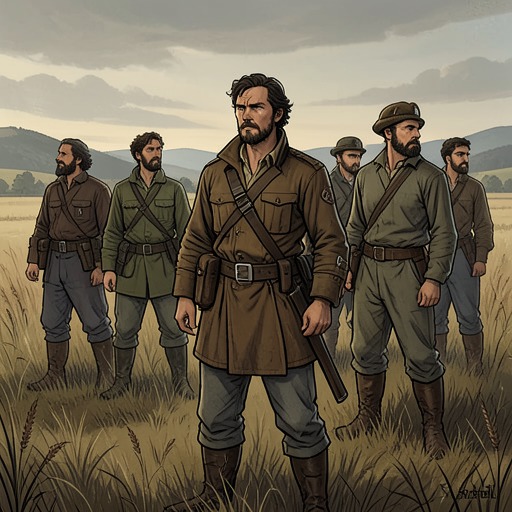
Weatherbury Upper Farm
Far from the Madding CrowdWeatherbury Upper Farm is both Bathsheba Everdene’s home and a substantial working estate, where personal authority is made visible through decisions about staff, livestock, and crops. Its old house, laboring yards, fields, and great barn form the practical center of the story: a place of seasonal work and shared local custom, but also of economic vulnerability, where one neglected task or misjudged storm can threaten a year’s livelihood.
House and Estate
By daylight, the farm’s principal house appears as an old, stone-built residence whose architecture reflects an earlier life as the hall of a small estate. Fluted stone pilasters, chimneys with panelled or columnar forms, and surviving traces of Gothic detail coexist with moss on the roof and the low farm buildings around it. Its gravel path is greened at the edges, and the house gives an impression of age and sleepiness. The busy, animated rear of the building, however, suggests that adapting a house for farming has turned its activity inward: the working farm has reshaped the older residence around its own needs.
Inside, the upper floors are irregular and worn. The oak staircase twists upward; the bare boards rise and dip, and movement through the house is accompanied by creaks and tremors. When Bathsheba and Liddy Smallbury sort through the former occupier’s papers, books, bottles, and household odds and ends, the building reads not as an untouched country seat but as a home being reordered for a new mistress and a new working life. These rooms connect domestic administration with the business conducted elsewhere on the farm.
Bathsheba’s Management
Bathsheba makes her authority explicit in the hall, where she sits with the farm time-book and pays the workers from a canvas money-bag. She announces that she has dismissed the bailiff for theft and intends to employ no replacement, choosing to manage the farm herself. Her decision places the routine work of supervision and judgment directly in her hands. She also asks whether anyone has heard of the missing Fanny Robin, showing that the hall serves as a place not only for wages and work but for gathering news from the surrounding community.
In addressing the workers, Bathsheba promises to do her best and expects them to serve her well in return. She insists that being a woman does not prevent her from distinguishing proper conduct from misconduct, and declares that she will rise early and be at work before the men. Her assurance is both a managerial pledge and a public claim to competence. The novel later shows that the claim must be continually proved: her authority depends on knowledge of the farm’s practical demands as well as the ability to direct people who have previously worked under a male master.
That public test comes at the Casterbridge grain market. Bathsheba takes sample-bags and learns to present grain for inspection in the customary manner, arguing over prices with firmness while avoiding mere obstinacy. Other farmers identify her as the woman who has taken Weatherbury Upper Farm and dismissed its bailiff; their interest mixes recognition of her unusual position with assumptions about her youth, sex, and beauty. Her appearance attracts attention, but her conduct in the market shows her entering the actual business of farming rather than serving as a decorative proprietor.
The working farm also depends on a division of labor among its people. Gabriel Oak serves as shepherd and, at the sheep-shearing, as general supervisor; Jan Coggan leads the shearers, while other farm workers shear, assist, collect fleeces, and tie the wool. Bathsheba watches for careless cuts and insists that shorn sheep be marked with her initials. Lambs born on the farm are similarly marked with the letters B. E., identifying them as hers. Such routines make ownership concrete: it is maintained through care, labor, supervision, and the repeated marking of animals, not simply through possession of a house or title.
Livestock, Seasons, and Collective Work
The farm’s year is measured by agricultural work. During a difficult lambing season, Gabriel brings newborn lambs to the malt-house fire because Weatherbury Upper Farm has no lambing hut. He and Cain Ball have been working through snow and rain, and the season’s late, numerous births require continuing attention. The episode links the farm to a wider rural network: the malt-house offers shelter and warmth when the farm’s own facilities are inadequate, while shepherding knowledge and the help of a younger worker keep the lambs alive.
At shearing time, the great barn becomes a specialized workplace. Its central threshing floor, worn smooth by generations of use, provides room for the shearers; hurdles separate the sheep, and a catching pen keeps several animals ready so the work can proceed without delay. Women gather fleeces and prepare wool ties, and the old maltster helps when the malting season has ended. Bathsheba oversees the shearing while Gabriel selects and handles sheep and supports the other workers. The barn’s ancient construction and its continuing usefulness bring the farm’s present labor into close contact with inherited custom: the building remains suited to work that has changed little across generations.
The farm is also vulnerable to animal behavior and environmental conditions. When Gabriel has been away from feeding the flock for about a day, sheep break through a fence into young clover. The workers recognize that the animals are in danger and rush to Bathsheba for direction. She immediately abandons her preparations for church and runs to the field, rebuking them for bringing the news instead of acting at once. Under her pressure, they help Gabriel treat the affected sheep. Fifty-seven animals have strayed and become dangerously ill; four die, while three recover without an operation. Bathsheba then asks Gabriel to stay on, and he agrees. The crisis exposes the cost of his absence, but also demonstrates that the farm’s survival depends on trained labor and a manager able to respond decisively.
Weather, Harvest, and the Great Barn
At the end of August, the farm’s harvest wealth is concentrated in eight uncovered ricks. Gabriel reads several signs of approaching bad weather: the sheep’s behavior, the movement of rooks and horses, the appearance of the sky, and later the signs of a toad, a slug, and the flock’s changed grouping. He estimates that the five wheat stacks contain about 150 quarters and are worth £500, while the three barley stacks contain about 120 quarters and are worth £250. Their combined value of £750 gives the impending storm an immediate economic measure: the danger is not simply a dramatic change in the weather but damage to food and property accumulated through a season’s work.
The harvest revel takes place in the great barn, where an area of the building is cleared for dancing and a remaining section is screened off around the stored oats. Foliage decorates the walls and beams, and fiddlers and a tambourine player provide music. Sergeant Troy, who has taken charge in his wife’s place, makes the gathering a public celebration of his marriage to Bathsheba and orders brandy and hot water for the workers. When Bathsheba objects that they have already had enough, Troy dismisses her concern and proposes sending the women home so the men can continue drinking. She leaves with the women and children. The scene reveals a division within the farm’s management: the barn is a communal space, but Troy uses his authority over the gathering in a way that overrides Bathsheba’s judgment and threatens the order needed to protect the harvest.
Gabriel’s warning that heavy rain is coming is rejected. He leaves the revel and undertakes the work himself, covering two stacks with the available waterproof cloths and protecting a third wheat stack by arranging the upper sheaves and filling gaps. With no more cloths, he begins thatching the barley. During the storm Bathsheba comes out to ask whether the corn can be saved, having found her husband absent from the work. Gabriel asks her to carry reed-sheaves up the ladder, and she does so repeatedly despite the lightning and thunder. The episode makes their cooperation physical and practical: the farm’s harvest is secured through labor undertaken together, after Troy has failed to act on the warning.
Tenure and the Farm’s Changing Meaning
The farm is the material basis of Bathsheba’s independence, but her marriage unsettles that security. The estate’s agent had initially doubted whether a young woman could succeed James Everdene, yet Bathsheba’s uncle’s will, his testimony to her ability, and her energetic handling of the livestock overcame that hesitation. After her marriage, however, she is uncertain about the legal effect on her position. No one has yet acted on her change of name, but the coming January rent-day makes the risk immediate: if she or her husband cannot meet the agent, little consideration will be shown, and losing the farm would bring poverty.
Weatherbury Upper Farm therefore gathers the novel’s central conflict between practical competence and unstable authority. Its house preserves traces of an older estate, while the halls, barn, fields, and ricks are organized around present work. Bathsheba establishes herself by taking responsibility for wages and labor, learning the market, marking livestock, and directing urgent responses. Yet the same farm that gives her independence also exposes her to the consequences of marriage, inadequate resources, and another person’s decisions. Its continuing demands make character visible through action: the prosperity of the estate rests on whether its people can read the seasons, respect skilled labor, and respond before opportunity passes.