Winter
Far from the Madding CrowdWinter is not merely a backdrop in Far from the Madding Crowd: it is a recurring condition that tests bodies, animals, property, and the routines of rural labor. From the midwinter darkness on Norcombe Hill to snowbound lambing and the storm that threatens Weatherbury’s harvest, the season shapes what can be done, what can be lost, and how characters respond to risks that human intentions cannot control.
Seasonal setting and natural signs
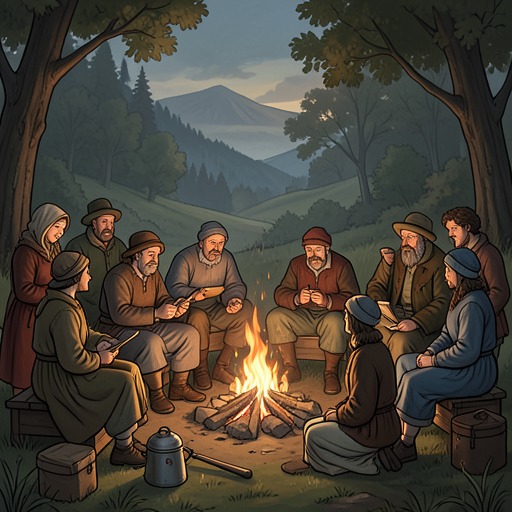
The novel introduces winter through a night on the eve of St. Thomas’s, the shortest day of the year. On Norcombe Hill, a north wind moves through an old beech plantation and over the exposed grass; dead leaves rattle against tree trunks, while the stars appear unusually clear. The scene gives winter a physical presence before it becomes a practical crisis. Wind, darkness, and the stillness of the landscape establish a season in which people must attend closely to conditions beyond their control.
The novel also presents weather as something read through local observation. On the night of the harvest revel, Gabriel Oak notices signs of a coming change: sheep have come home in an unusual formation, rooks behave confusedly, and horses move cautiously. He later studies the ricks and watches the flock, understanding from their behavior that a storm is approaching. The sheep’s orientation indicates the likely thunderstorm, while other natural signs suggest prolonged rain afterward. Such knowledge is not abstract prediction; it guides decisions about when to act and which parts of a harvest can still be protected.
Cold, work, and animal care
Winter’s demands are clearest in the work of keeping animals alive. During an increasingly severe frost, Oak tends the yearling ewes, adding bedding before entering his hut and attempting to make it safe and warm. His attention to the animals takes place alongside the ordinary hazards of the season: cold weather, interrupted sleep, and the need to maintain a fire while ensuring ventilation. The incident makes winter care a matter of practical judgment, not simply endurance.
Snow and cold also intensify the labor of lambing. At the Warren’s Malthouse, Oak arrives with newborn lambs carried over his shoulders, while Cainy Ball follows with more. Oak says that he and Cainy have been awake through the night and repeatedly soaked by snow or rain. This year’s lambing is unusually prolonged, with many twins; Oak expects it to continue until Lady Day, rather than ending by Sexagesima Sunday as it had the previous year. Because there is no lambing hut at Weatherbury as there had been at Norcombe, he has to bring weak lambs into shelter. The seasonal schedule, the weather, and the shortage of appropriate shelter combine to make the work both exhausting and consequential.
Cold weather can also make small decisions urgent. On the eve of the sheep’s disaster at Norcombe, Oak’s young dog is left on the hill, and the shepherd goes indoors believing he need not return. Before dawn, the flock’s bell sounds at an abnormal pace: Oak recognizes it as the sound of sheep running and hurries outside. The winter landscape’s fog and early darkness do not prevent him from interpreting this familiar signal, but they frame a catastrophe already underway. The flock has gone through a broken hedge toward the chalk-pit, and two hundred ewes lie dead or dying below it. The episode makes clear how vulnerable a working flock can be, and how an animal’s misguided training can turn a routine night into financial ruin.
Winter within the agricultural year
The novel places winter inside a larger cycle of agricultural time. At the June shearing, the sheep’s fleece is gathered and marked, and the work is understood in relation to the warmth it will provide to people far away in winter. The fleece thus connects summer labor to a later season: wool is not only a commodity but also stored protection against cold. The clean, newly shorn wool is described as valuable before washing and processing alter its qualities, underscoring the distance between an animal’s living coat and the finished material used by others.
This cyclical structure also appears in the movement from seasonal hardship to renewed work. After Oak loses his flock and his savings, he returns to farming as a shepherd. His later labor continues through difficult lambing and wet weather, while the community’s established routines supply practical help. Winter does not halt rural life; it changes the conditions under which that life must be maintained. The work carries forward from one season to another, even when individual fortunes have been sharply altered.
Weather, labor, and threatened wealth
The harvest storm shows winter’s approach as an economic danger before winter itself has arrived. At the end of August, Oak sees ominous weather gathering over Weatherbury Upper Farm. Eight unprotected ricks hold a large share of the farm’s harvest, and he calculates that the wheat and barley together are worth £750. The threat is not simply atmospheric: rain could spoil grain, and the value at stake belongs to Bathsheba’s farm.
The harvest revel is being held in the great barn while the ricks remain exposed. Oak enters and finds the farm workers asleep after the feast; Sergeant Troy is present, but the revelers have not attended to the danger outside. Oak sets aside his own exhaustion, obtains the granary key, and brings out the rick-cloths. He covers two ricks, securing an estimated £200 worth of grain, then improvises protection for a third wheat rick and begins thatching the barley. His work continues through the night as the wind rises and the rain begins. By about seven in the morning, he has finished, drenched and tired but assured that he has protected the harvest as far as he can.
The danger of the storm lies partly in its timing. The harvest has been gathered into the ricks, but it is not yet safe from the weather; the revel occupies the workers at precisely the moment when the grain needs attention. Oak’s response is based on agricultural knowledge, practical calculation, and physical labor, whereas the festivities provide no protection against the rain. The contrast makes the change of season an active pressure on the plot: an approaching spell of wet weather forces Oak to act and reveals how much the farm depends on his vigilance.
Narrative significance
Winter links the novel’s intimate encounters to its larger account of rural economy. The cold that makes shelter and care urgent also provides the conditions for illness and exhaustion; snow and rain complicate journeys and work, while the seasonal needs of sheep determine when shepherds must remain awake. Yet the season is not presented as an enemy in every circumstance. Its place in the agricultural cycle gives meaning to the production and use of wool, and its predictable demands are met by accumulated local skill.
The repeated movement between seasonal description and practical consequence gives weather an unusual narrative weight. Winter can expose a flock to danger, delay lambing work, or make shelter inadequate; the first signs of a later wet season can place a harvest worth hundreds of pounds at risk. Against these forces, the novel sets attentive labor and communal knowledge, without suggesting that either guarantees success. Winter’s significance lies in this tension: rural life depends on careful response to the natural world, but neither wealth nor affection can make its hazards wholly controllable.