
Faust’s Pact and Wager
FaustFaust and Mephistopheles turn Faust’s dissatisfaction into a binding bargain, defining service, risk, and the temptation of a moment of perfect contentment.
increasing Bearing strength in each event
 decreasing
Bearing strength in each eventdecreasingThe Offer of Service

An Offer in Faust’s Study
Two kinds of service
Mephistopheles proposes to serve Faust on earth, then calls for Faust to serve him in the world beyond.
Faust distrusts the offer but sees in it an opportunity to leave the barren routine that has made life seem unlivable.
The bargain’s attraction
The contract promises access to pleasures and experiences Faust cannot obtain through study alone.
The apparent freedom of the offer conceals its central risk: Faust will be tested through the very desires he thinks he can master.
The Moment’s Condition

A Bet on Satisfaction
Faust’s wager
Faust declares that Mephistopheles may claim him if he becomes so satisfied with a moment that he begs it to remain.
The condition makes contentment, rather than a particular sin, the decisive test of Faust’s freedom.
Confidence and vulnerability
Faust believes that no experience can end his appetite for further experience. His wager is therefore also a refusal to imagine that desire might ever be fulfilled.
The Blood Signature
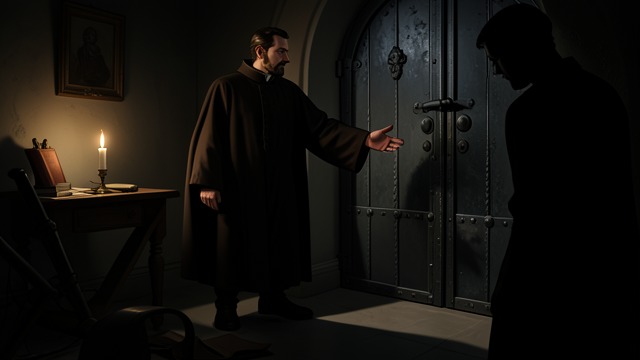
Words Made Material
Mephistopheles asks for proof
Faust initially argues that a spoken promise should be enough, but Mephistopheles insists on written proof and suggests signing in blood.
The exchange turns an abstract agreement into a physical mark of Faust’s commitment.
A deliberate surrender
Faust accepts the ritual without believing that the act has solved his deeper crisis. He chooses the contract because knowledge has disappointed him and sensation beckons.
Service in the World
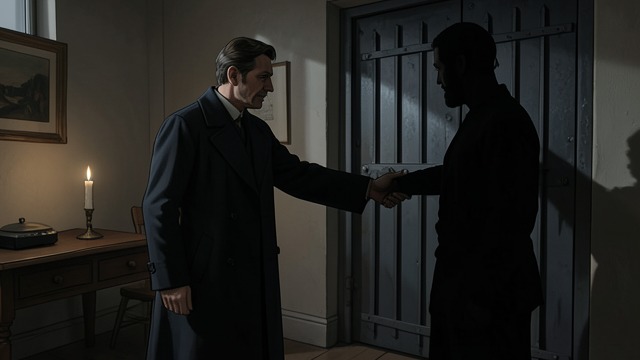
The Bargain in Motion
A first outing
Mephistopheles takes Faust to the Leipzig cellar, where magic and drinking expose him to a coarse social world far removed from his former study.
The scene tests the promise of release, but its carousing offers little that can answer Faust’s larger hunger.
An early warning
Faust is ready to leave the revellers, while Mephistopheles treats their bestiality as entertainment.
Their differing responses show that service does not mean shared values or shared purposes.
A Moral Reckoning
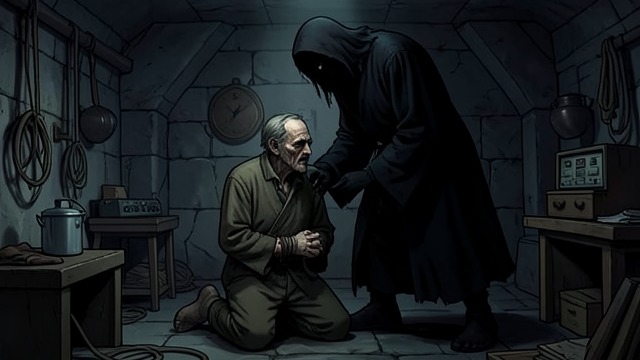
The Cost of Compliance
A bargain with consequences
Faust’s choices have helped produce the deaths, grief, and imprisonment surrounding Margaret. The promise of earthly service has not shielded him from responsibility.
At the dungeon, his effort to rescue her becomes a desperate attempt to reverse consequences that cannot simply be erased.
Unequal endings
Mephistopheles takes Faust away, yet Margaret is saved when she rejects escape and calls upon God.
Their contrasting outcomes keep Faust’s bargain open while showing that the Devil’s apparent control is not absolute.
After the poodle reveals Mephistopheles
During the negotiations in Faust’s study
At the end of the pact negotiations
Soon after the pact, at Leipzig
At the final dungeon scene
