
The Union's Commercial Promise
Federalist PapersThis thread traces the case that a common market and coordinated maritime policy can turn geographic variety into shared national strength.
increasing Bearing strength in each event
 decreasing
Bearing strength in each eventdecreasingTrade as National Wealth

Trade as National Wealth
Commerce and revenue
Hamilton presents commerce as a source of circulating money, productive activity, and public revenue. Agricultural and commercial interests, he argues, can reinforce rather than displace one another.
A common fiscal base
A larger and more integrated market would make customs collection more effective. The essay links commercial prosperity to the government’s capacity to meet public obligations.
A National Commercial Policy

A National Commercial Policy
Coordinated bargaining
Hamilton argues that a unified government could regulate access to American markets and negotiate commercial privileges with foreign powers. Separate State policies would weaken that leverage and invite inconsistent treatment.
Shared maritime capacity
A federal navy could protect trade and give the United States influence in regional conflicts. Commerce, naval power, and diplomacy are presented as mutually reinforcing national resources.
A Shared Naval System
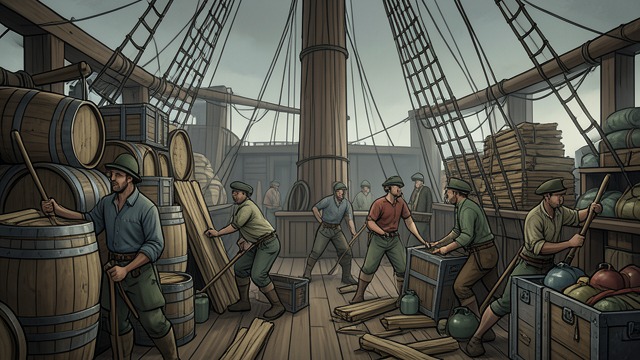
A Shared Naval System
Resources across regions
Hamilton points to different regional contributions, including naval stores, iron, timber, and seamen. No single State possesses all the materials needed for a substantial maritime establishment.
Cooperation as capacity
A national navy can combine these varied resources under one plan. The essay makes interdependence an argument for Union rather than a reason for regional competition.
Free Movement Between States

Free Movement Between States
Complementary production
Hamilton describes how States can exchange products to meet local needs and supply foreign markets. Diversity of crops and goods can reduce the risks created by a failed harvest or a narrow export base.
Common circulation
Trade among the States requires protection from competing restrictions and duties. A shared government is presented as the institution capable of keeping internal commercial channels open.
The Commerce Clause

The Commerce Clause
Incomplete authority repaired
Madison argues that federal authority over foreign commerce would remain ineffective without power over commerce among the States. State duties and barriers could burden neighbors and provoke resentment.
Uniform rules
National regulation is defended as a means of preventing commercial hostility and making the Union’s external policy coherent. The clause is framed as a practical instrument for internal harmony as well as foreign relations.
Federalist No. 12, November 27, 1787
Federalist No. 11, November 24, 1787
Federalist No. 11, November 24, 1787
Federalist No. 11, November 24, 1787
Federalist No. 42, January 22, 1788
