American Revolutionary War
Federalist PapersThe American Revolutionary War is presented as more than a struggle for independence: it is the shared ordeal through which the colonies became a people with a common political inheritance, and the conflict whose costs exposed the weakness of their first federal arrangement. In the Federalist, the memory of joint resistance helps justify a durable union; the war’s debt and institutional aftermath, in turn, sharpen the case for a more capable government founded on the people’s consent.
A common country and a people made through war
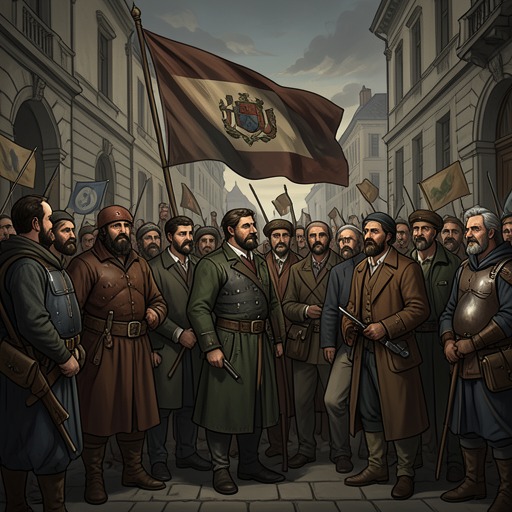
The argument begins with the geography of a connected country: fertile land, varied productions, navigable waters along its borders, and rivers that offer routes for communication, aid, and exchange. That physical connection is paired with a political and cultural one. The people are described as descended from common ancestors, speaking the same language, professing the same religion, and sharing principles of government, manners, and customs. Their joint counsels and arms, and their efforts fighting side by side through a long war, established general liberty and independence. The war thus serves as evidence for the claim that the country and its inhabitants belong together, rather than as a collection of detached territories destined to become rival sovereignties.
That claim rests on a contrast between common experience and possible division. The text recalls that, as a nation, the Americans had made peace and war, defeated common enemies, formed alliances, and entered treaties and other agreements with foreign states. Independence had not erased those shared practices; it had made their collective character visible. The prospect of dividing into jealous, alien sovereignties is therefore set against an already established record of common action.
The first federal government and the cost of the conflict
The people established a federal government early, while the war was still underway and the circumstances were profoundly unfavorable to careful constitutional design. Habitations were in flames, citizens were suffering, and continuing hostilities left little opportunity for the calm, sustained reflection needed to frame a balanced government. The text does not treat the resulting deficiencies as surprising: a system formed amid emergency could prove inadequate to the purposes it was meant to serve. Its shortcomings became apparent through experience, even as the people remained attached both to union and to liberty.
The war also left a substantial public debt. In arguing about the proposed division of taxing authority, the text points to the debt contracted in a single war as evidence that national emergencies can impose financial demands far beyond the ordinary needs of state governments. It distinguishes those exceptional federal burdens from the more limited continuing expenses of state administration. The conflict therefore figures not only as a unifying memory but as a material reason why the Union would need access to resources adequate to its responsibilities.
Reform, consent, and the authority to propose a new system
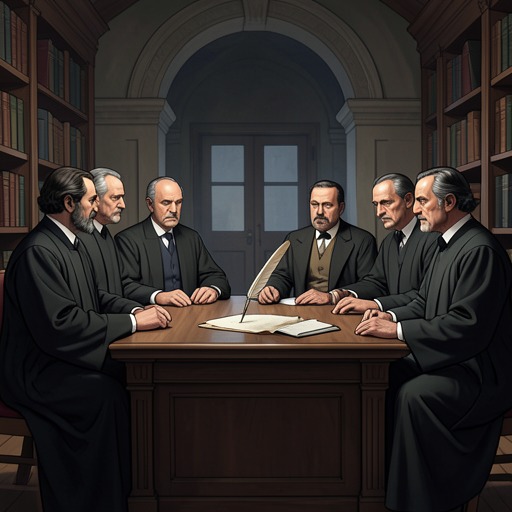
The perceived danger to union, and the more distant danger to liberty, led the people to convene the Constitutional Convention in Philadelphia. Its members had the people’s confidence, and many had distinguished themselves through patriotism, virtue, and wisdom in earlier trials. Unlike the first federal arrangement, formed in the unsettled conditions of war, this convention met during peace, with time for months of daily consultation. It presented a plan produced by joint and broadly unanimous deliberation, a contrast that made the new proposal appear more considered than the government created under wartime pressure.
The argument also places constitutional innovation within the revolutionary principle of popular authority. It recalls that the people’s right to alter or abolish government for their safety and happiness could not be exercised through perfectly regular procedures in every circumstance. The movement that united the states against the old government had itself depended on citizens proposing measures beyond ordinary forms; committees and congresses had concentrated common efforts, and conventions elected in the states had established the constitutions under which they were governed. On this reasoning, irregularity in proposing reform did not settle its legitimacy: the new plan was to be submitted to the people, whose rejection could end it and whose approval would authorize it.
The union argued by comparison
The war’s unifying example is set against histories in which confederacies failed to prevent rivalry among their members. The account of the Greek republics under the Amphictyonic council describes sovereign states with equal votes and a common authority empowered to address shared welfare, conduct war, arbitrate disputes, and punish disobedience. Yet those formal powers did not ensure concerted action. The Greek states repeatedly failed to unite even during dangerous wars, while internal disputes and the ambitions of stronger members weakened the association. The later rivalry of Athens and Sparta, culminating in the Peloponnesian War and Athens’s ruin, is presented as a warning about the distance between nominal association and effective union.
The European examples make a related point about institutions that address laws to sovereign members rather than directly governing their inhabitants. The German empire is described as constitutionally imposing but practically weak: its foundational treatment of the empire as a community of sovereigns left it unable to regulate its members securely, and its history was marked by wars among rulers and states, disregarded requisitions, foreign interference, and disorder. The United Netherlands likewise comprised sovereign provinces and independent cities whose unanimity requirements obstructed reform. Patriots convened four extraordinary assemblies to remedy acknowledged constitutional defects, yet each effort failed to unite the public councils. These examples sharpen the contrast with the Americans’ wartime experience of common action and the convention’s reported ability to reach agreement.
From revolutionary union to a mixed constitutional design
The proposed Constitution is presented neither as wholly national nor as wholly federal. Its foundation is federal because ratification is given by the people acting through their distinct states, not by a single national majority. Its ordinary powers draw partly on federal and partly on national principles; those powers operate on individuals in a national manner, while their extent remains federal in character. The amendment procedure also combines both principles, requiring more than a simple majority while not requiring the concurrence of every state. The resulting design is described as a composition of the two forms.
That mixed structure gives institutional form to the distinction between the first federal government, created amid the Revolutionary War, and the later effort to preserve the union under more deliberate arrangements. The war had demonstrated what the states could accomplish through common counsel and action; its difficult conditions had also helped produce a deficient initial system, and its costs left a lasting financial burden. In the argument, the proposed Constitution answers both sides of that inheritance: it seeks to sustain the union made meaningful by shared resistance while giving the common government means to perform the work that union requires.