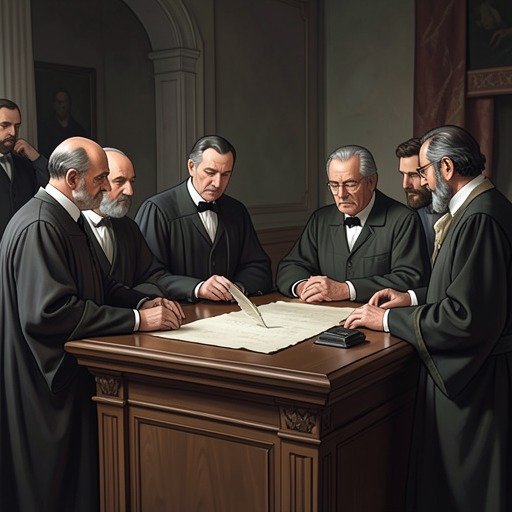
Factional politics and tyranny of the majority
Federalist PapersFactional politics and tyranny of the majority is the problem of collective power turning against the rights of citizens and the enduring interests of the community. Its force lies in a political paradox: faction is rooted in the differences that liberty protects, yet popular government can give a faction that commands a majority the means to rule in its own interest. The proposed remedy is not to erase disagreement, but to arrange representation, territory, and governmental powers so that a majority bent on oppression is less likely to form and less able to act.
Definition and Sources of Faction
A faction is a number of citizens, whether a majority or a minority, united and moved by a common impulse of passion or interest adverse to the rights of other citizens or to the permanent, aggregate interests of the community. The definition turns on what a group’s shared motive threatens, not on its size alone. A minority faction may obstruct or unsettle government; a majority faction has the additional capacity to use popular rule to enact its designs.
The causes of faction are described as latent in human nature and activated by the circumstances of civil society. Fallible reason produces differences of opinion; self-interest connects opinions with passions; and unequal human faculties give rise to unequal property. These differences cannot be made uniform without abandoning liberty or attempting the impracticable task of giving every citizen the same opinions, passions, and interests. Government’s first object is to protect people’s different faculties, but the resulting variety of property and outlook also divides society into parties.
The argument identifies religious and political convictions, attachment to ambitious leaders, and even frivolous distinctions as sources of hostility. The most common and durable source, however, is the unequal distribution of property. People with property and people without it, creditors and debtors, and landed, manufacturing, mercantile, and moneyed interests form groups with distinct views. Their conflicting claims are not exceptional disturbances outside politics: regulating them is a principal task of modern legislation, bringing the spirit of party into ordinary government.
Why Majority Rule Can Become Oppression
The essay distinguishes between the two possible responses to faction: removing its causes or controlling its effects. Removing the causes would mean either destroying the liberty faction needs to exist or making citizens uniform in opinions and interests. The first remedy is worse than the disease; the second is impossible. The practical constitutional question is therefore how to restrain faction’s consequences without surrendering popular government.
A minority faction can be defeated through regular voting by the majority, though it may still clog administration or convulse society. The more dangerous case arises when a faction includes a majority: the forms of popular government can then enable it to sacrifice both the public good and the rights of other citizens to its own ruling passion or interest. The object is to protect public welfare and private rights while preserving the spirit and form of popular government.
The danger becomes especially clear when legislation settles conflicts among social groups. The principle that no person should judge their own cause is applied to lawmaking: legislators may themselves be interested parties in the questions they decide. In disputes over private debts, for example, creditors and debtors stand on opposing sides, while the legislature must determine the rules governing them. If the most numerous party is also the most powerful faction, the balance intended to secure justice may instead be controlled by one of the parties to the dispute.
A small, direct democracy offers no dependable cure for this problem in the account presented. A common interest is likely to unite a majority, and the citizens’ direct assembly makes communication and coordination part of the political arrangement itself. With little to impede concerted action, the weaker party or an unpopular individual can be sacrificed. The argument contrasts this with a republic, where representation and a wider territory can make the formation and coordination of an oppressive majority more difficult.
Representation and the Extended Republic
Representation is offered as one institutional restraint. In a larger republic, each representative is chosen by more citizens than in a small one. That broader electorate makes it harder for unworthy candidates to succeed through the corrupt practices associated with elections, and the voters’ choice is more likely to settle on people of established character and merit. Representation thus mediates popular power rather than simply reproducing a local majority’s immediate impulse.
The argument also recognizes a limit: if the electorate grows too large, representatives may lose familiarity with local circumstances and particular interests; if it is too small, representatives may become too attached to local concerns to pursue national objects. The proposed federal arrangement addresses this tension by assigning great, aggregate interests to the national government and local, particular ones to the state legislatures. The design relies on levels of representation with different constituencies and responsibilities, not on assuming that one scale can serve every purpose equally well.
Territorial enlargement supplies a further check. A smaller society is likely to contain fewer distinct parties and interests, making it more probable that one party will become the majority. When that majority is made up of fewer people living within a smaller area, it is easier for them to discover their strength, concert their plans, and carry out oppression. A larger republic takes in more varieties of interests. A common motive to invade others’ rights is consequently less likely to unite a majority; even where such a motive exists, distance and distrust make coordinated action harder, particularly when many participants would need to conceal dishonorable purposes.
The argument presents the Union as gaining, on a larger scale, the advantage a republic has over direct democracy. It claims that a broader representation is more likely to include people capable of looking beyond local prejudice and injustice, while a greater variety of parties makes it harder for any one group to outnumber and oppress the rest. This is a constitutional claim about probabilities and political structure: enlargement does not abolish conflicting interests, but it makes their alignment into a unified majority less assured and their concerted action less easy.
Federal Structure and the Security of Rights
The proposed Constitution is described as a mixed composition rather than as wholly national or wholly federal. Its foundation is federal; the sources of ordinary governmental powers are partly federal and partly national; the operation of those powers is national; their extent is federal; and the procedure for amendments is neither wholly federal nor wholly national. This mixed character matters to the problem of faction because political safeguards operate through more than one level of government rather than depending on a single undivided majority.
The federal system adds a second division of power to the separation of departments within each government. In a single republic, the people’s surrendered power is administered by one government, whose usurpations are checked by distinct departments. In the compound republic, power is first divided between the federal and state governments, then divided among departments within each. The resulting double security rests on governments checking one another while each is also checked internally.
A second protection is social as well as governmental: the multiplication of interests and classes. If a majority shares an unjust interest, minority rights are insecure. One conceivable alternative would be to place authority beyond the society, as in hereditary or self-appointed government, but such authority could side with the unjust majority or turn against both majority and minority. The federal-republican alternative is to include many different interests within the society while keeping all authority derived from and dependent on it. In the argument, this diversity makes an unjust coalition of a majority less probable without placing power outside popular control.
The analogy between civil and religious rights clarifies the mechanism: security depends, respectively, on the multiplicity of interests and of religious sects. The broader the country and the greater the number of people under the same government, the more varied the interests are presumed to be. Conversely, dividing the Union into more circumscribed confederacies or states would facilitate oppressive combinations, reduce the security of every class, and increase the relative importance of some power independent of the people as a substitute safeguard.
Political Insecurity and the Case for Union
The argument’s warning extends beyond the immediate injury to a minority. Where a stronger faction can readily unite and oppress a weaker one, the condition resembles anarchy: the weaker individual lacks protection against the stronger. In a state of nature, even the strong have reason to accept government because their own security is uncertain. By the same logic, powerful factions may eventually desire a government able to protect weaker groups as well as themselves. Oppression can therefore generate pressure for authority detached from popular dependence—the very alternative the federal design is meant to make less necessary.
Rhode Island serves as a pointed hypothetical. If separated from the Confederacy and left to itself, the state’s narrow limits, the argument predicts, could permit repeated oppression by factious majorities. The factions responsible for that misrule might then themselves call for a power independent of the people. Against this possibility, the extended republic of the United States is presented as encompassing such variety of interests, parties, and religious groups that a coalition of the whole society would seldom unite except on principles of justice and the general good. The conclusion is not that majority oppression is inconceivable, but that a properly composed Union reduces both its likelihood and the excuse for countering it with popular-independent authority.
A separate warning about legislative procedure shows how protection against majority rule can itself become a danger. Requiring more than a majority for a quorum or for decisions might shield particular interests and slow hasty measures, but it could transfer the effective power of government to a minority. That minority could block laws needed for justice or the general good, resist equitable sacrifices, or demand unreasonable concessions in an emergency. The account also associates such defensive privileges with secessions, which it regards as subversive of regular government and capable of leading to public convulsions. The constitutional problem is therefore one of balance: safeguards must restrain an oppressive majority without making government hostage to a blocking minority.
Factional politics and tyranny of the majority ultimately becomes an argument for institutional design grounded in a sober view of collective behavior. Moral and religious motives alone, the text contends, cannot reliably restrain a majority when passion and opportunity converge; the efficacy of such motives diminishes as the number acting together increases. A large, diverse republic, representative government, and divided federal powers are proposed as practical barriers to that convergence. Their purpose is not to make citizens alike or to silence political conflict, but to preserve liberty and popular government while making it harder for a temporary or interested majority to convert its numbers into domination.