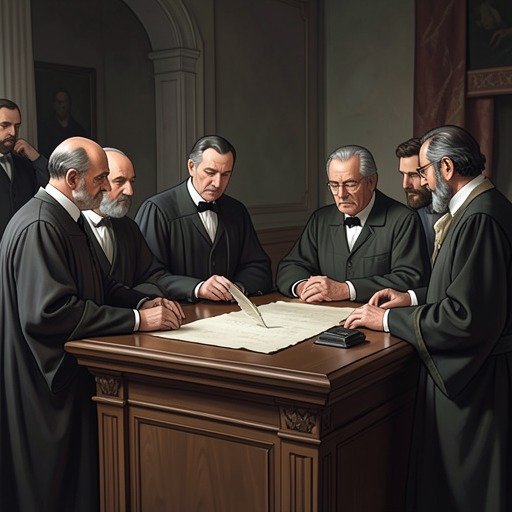
People's Sovereignty
Federalist PapersPopular sovereignty is the principle that the people are the ultimate source of legitimate political authority, not merely the audience for government or the subjects of competing institutions. The Federalist essays make this principle do several kinds of work: it supplies the proposed Constitution with a deeper foundation than legislative consent, explains how a federal union may be established through the people acting in their respective States, and identifies the people as the final authority over government’s constitutional boundaries. It also makes popular power a continuing responsibility, requiring constitutional design to guard against both governmental encroachment and domination by a political majority.
The People as the Source of Authority
The essays contrast the people’s direct authority with the vulnerable foundations of the existing Confederation. That system rested on the consent of State legislatures, leaving its powers exposed to intricate disputes over validity and to the claim that a legislature could repeal the law by which it had ratified the compact. Even if the claim that one party could revoke a compact was treated as an error, its advocates made the danger practical: a national government founded only on delegated legislative authority could be challenged at the very point where its legitimacy began. The proposed alternative was to ground national power in the people’s own consent, so that the streams of authority would flow from the original source of political legitimacy rather than from State legislatures alone.
This foundation does not mean that every officeholder must be chosen by a direct popular vote. The essays define a republic as a government deriving all its powers, directly or indirectly, from the great body of the people, and administered by officials serving at the people’s pleasure, for limited periods, or during good behavior. The distinction is between authority that ultimately comes from the people and authority claimed by a small or favored class. Indirect appointment and differing terms of office can therefore coexist with republican government, provided that the chain of authorization leads back to the people rather than closing around a hereditary or self-appointed ruling group.
The popular source of authority is also reflected in the proposed Constitution’s mode of adoption. Its assent and ratification are to come from people elected as deputies for that special purpose, but acting as members of distinct and independent States. This makes the founding act federal rather than national in the argument’s precise sense: it does not take effect by a majority vote of the entire population or by a majority of the States. Each State is treated as a sovereign body, bound by its own voluntary act. The people authorize the new arrangement, but do so through the political communities to which they belong.
Ratification and Constitutional Change
The convention’s proposal is presented not as a self-executing exercise of final authority, but as an advisory plan whose force depends on popular approval. Without the approbation of those to whom it is addressed, the proposed Constitution would be no more consequential than the paper on which it was written. This distinction answers the charge that the convention’s authority was merely recommendatory: whatever irregularity might attend the proposal, its submission to the people leaves them free to reject it, while their approval supplies the decisive authorization.
The essays defend the convention’s action against strict appeals to established forms by invoking the people’s right to alter or abolish government for their safety and happiness. They argue that a people cannot always move spontaneously and unanimously toward a political change; proposals must therefore sometimes begin with an informal and unauthorized initiative. The argument points to earlier occasions on which plans for public safety were advanced outside ordinary institutional forms, including the formation of committees and congresses and the election of conventions in the several States to establish their governments. In this account, popular sovereignty is not extinguished by procedural irregularity: the people’s final acceptance or rejection is what gives the proposal its ultimate political standing.
The same reasoning appears in the defense of ratification by nine States rather than unanimous consent among all thirteen. Requiring unanimity, the essays contend, would place the essential interests of the whole at the mercy of a single member. They appeal both to the necessity of self-preservation and to the people’s express authority to validate the Constitution. The question of how the Confederation’s compact could be superseded without unanimous consent is thus answered by distinguishing the authority of the old arrangement from the higher claim of public safety and the people’s power to establish a new one.
Popular sovereignty also informs the proposed route for constitutional correction. One proposal would have allowed two of the three branches, each by a two-thirds vote, to call a convention to alter the Constitution or correct breaches of it. The case for such a mechanism rests on the proposition that the people, as the grantors of the branches’ commissions, can alone declare the charter’s true meaning and require its observance. The essays accept the importance of keeping a constitutional appeal to the people open for extraordinary occasions, while questioning whether such an appeal would work as a general remedy for every conflict among departments. Popular authority supplies the ultimate recourse; it does not make every proposed procedure for invoking that authority adequate.
The People as the Common Superior of Government
The federal and State governments are described as different agents and trustees of the people, created with different powers and purposes. They are therefore not ultimately independent rivals whose struggle for jurisdiction can be settled by ambition or political address alone. Their common constituents retain the ultimate authority, and the outcome of any contest between the governments depends on the people’s sentiments and sanction. This account shifts the focus from a contest between institutions to the public that authorizes both.
The essays nevertheless expect the people’s immediate attachments to favor their respective State governments. State administrations touch domestic and personal affairs more closely; people know them more familiarly and have more opportunities for personal, family, and party connections with their members. More offices and emoluments are also likely to arise from State government. The federal administration, by contrast, had not become the lasting object of popular devotion: after the early enthusiasm for Congress passed, attention and attachment turned back toward the particular governments. These observations make popular sovereignty a concrete political relationship, shaped by familiarity and everyday interests, rather than an abstract claim that all levels of government command equal affection.
The essays use this relationship to resist the assumption that State and federal authorities can freely enlarge their own spheres at one another’s expense. Ultimately, neither government can settle the limits of its power simply by asserting a stronger claim. The people’s approval is the common standard above both. At the same time, a government derives its legitimacy from the people without thereby receiving unlimited power: it remains an agent whose commission defines and confines its authority.
Delegated Power, Enforcement, and Limits
The argument for popular sovereignty appears in the discussion of the Necessary and Proper Clause and the Supremacy Clause. The national government must judge in the first instance how to exercise its granted powers, but the people who created it remain the authority in the last instance. If federal power is used tyrannically or beyond its proper bounds, the people may appeal to the constitutional standard they have formed and take measures to redress the injury, as the circumstances and prudence warrant. The key distinction is between a legitimate exercise of delegated authority and an act that exceeds the commission.
The supremacy of federal law is likewise presented as conditional on constitutional authorization. A law made pursuant to the Constitution must be supreme within the political association established by that instrument; otherwise the Union would amount only to a treaty dependent on each party’s good faith rather than a government exercising political power. But an act that is not pursuant to constitutional powers does not become supreme merely by being enacted. It is instead an act of usurpation against the authority retained elsewhere. Supremacy therefore does not erase the people’s original authority or convert a limited grant into an unlimited one.
The essays also connect popular authority to judicial enforcement of constitutional limits. In a limited Constitution, restrictions on the legislature can be preserved in practice only if courts may declare acts contrary to the Constitution void. That power is not described as making judges superior to the people or to the legislature in its proper sphere. Rather, a delegated authority cannot validly act against the terms of the commission from which it derives its power. The people remain the principals; the legislature and courts operate within the constitutional arrangement authorized in their name.
Representation and the Risks of Majority Power
Popular sovereignty does not mean that every decision by a numerical majority is just. The essays distinguish the people as the source of authority from the risk that a majority, united by a common interest, may oppress a minority. They identify two possible safeguards: an authority independent of the society, or a society containing enough distinct interests and classes to make an unjust majority combination difficult. The first is treated as precarious because an independent authority might side with the majority against the minority, or turn against both. The preferred protection is a representative republic encompassing many interests, in which authority remains derived from and dependent on society while the society itself is divided among numerous groups.
This concern gives the federal structure a double function. The people’s power is divided first between the State and federal governments, and then within each government among separate departments. The governments can check one another while each is also checked internally. For the essays, this is a “double security” for the rights of the people: popular authority establishes the system, and the multiplication and division of political power help prevent any single institution or coalition from monopolizing it.
The representative principle connects popular authorization to the conduct of officials. Federal representatives are to be chosen by the same broad body of electors who choose the corresponding branch of their State legislatures, without qualifications of wealth, birth, religious faith, or civil profession that would restrict the people’s choice. The essays argue that representatives selected through free suffrage have reasons to remain faithful to their constituents: public preference signals qualities that inspire confidence, while the honor and esteem involved in election can foster gratitude and a desire to serve. These are proposed safeguards, not guarantees; they rest on the relationship between those who confer office and those who exercise delegated trust.
Popular sovereignty thus operates at once as a founding principle, a rule of political accountability, and a limit on institutional claims. It authorizes the Constitution through the people’s ratification, gives the people the last word when governments dispute their boundaries, and makes popular approval the ultimate test of proposals for constitutional change. Yet the essays do not equate the people’s authority with unchecked majority rule. They place that authority within representative, federal, and departmental arrangements designed to preserve the rights of minorities and prevent delegated power from becoming its own source of legitimacy.